
Updated July 2026 — reviewed against our current export packing practice and warranty workflow.
Saturday, 4 p.m., your busiest hour. The two-player basketball machine stops feeding tickets, and a queue of ten-year-olds melts away toward the exit. The failed part is a ticket-feed wheel that weighs less than a coffee cup. But you don’t have one, your supplier is asleep on the other side of the world, and the courier quote plus customs clearance puts the machine back in service weeks from now, not days. One small carton of arcade machine spare parts, loaded into the leftover space of your original container, would have had it running again before closing time.
Key takeaways
- Order spare parts with your first machine shipment. A parts carton travels almost free inside your container; the same parts sent later travel by international courier and wait in customs.
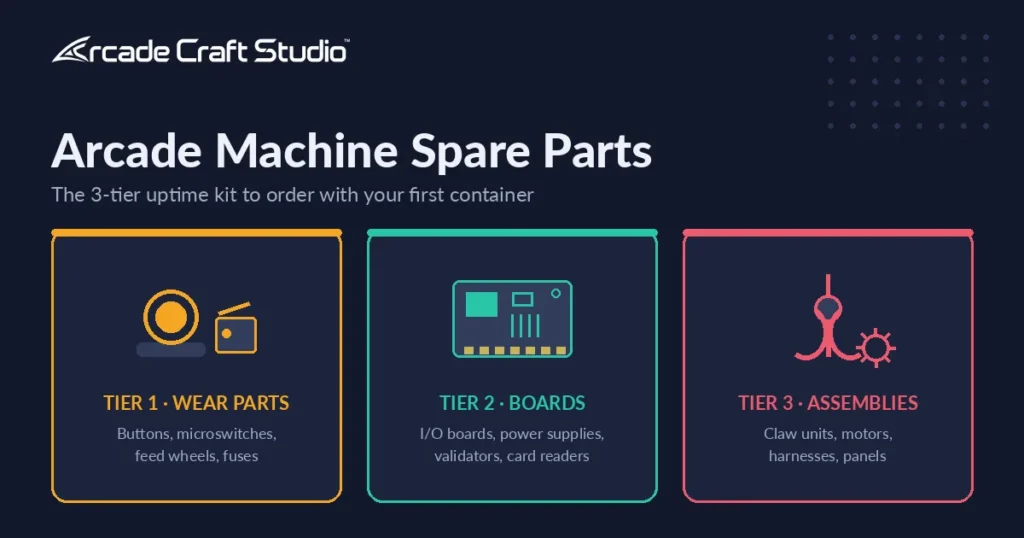
- Structure the kit in three tiers: wear parts (buttons, microswitches, fuses, feed wheels), boards (I/O boards, power supplies, validators), and assemblies (claw units, motors, harnesses).
- Match quantities to your floor: high-touch wear parts in multiples, one board of each critical type per group of similar machines, assemblies only for your revenue-critical games.
- Parts alone don’t create uptime. A daily walk-through, a failure log, and a defined reorder point matter as much as the shelf of spares.
- Ask your supplier for a labeled, machine-matched parts list before you wire payment — a factory that can’t produce one is telling you something about its after-sales support.
Why arcade machine spare parts belong in your first container
Spare parts ordered with your machines ship inside your container at almost no extra freight cost and arrive matched to your exact machine versions. Parts ordered after a breakdown travel alone by courier and can leave a machine dark for weeks. The order sequence, not the part price, decides your downtime.
There is a second reason that only shows up later: board revisions. Factories update I/O boards, wiring harnesses, and software between production batches. A part ordered eighteen months after delivery may need version-checking by photo and serial number before anyone can confirm it fits. A part packed with the original shipment is, by definition, the right revision.
At Arcade Craft Studio we pack spare parts as a separate labeled carton with its own packing list, following the same packing SOP we use for the machines themselves — every board wrapped, every screw bag numbered. If you are still comparing suppliers at this stage, our checklist of five after-sales questions to ask before you buy covers how to test whether a factory takes this seriously.
The 3-tier arcade machine spare parts kit
A practical spare parts kit has three tiers. Tier 1 is wear parts that fail on a schedule: buttons, microswitches, fuses, feed wheels, belts. Tier 2 is boards and modules: I/O boards, power supplies, validators, card readers. Tier 3 is assemblies: claw units, motors, harnesses, monitor panels for your revenue-critical machines. Stock deepest at Tier 1, thinnest at Tier 3.
| Tier | What it covers | Typical parts | Starting rule per 10 machines | Failure pattern |
|---|---|---|---|---|
| Tier 1 — Wear parts | Anything a guest touches or that moves every game cycle | Buttons, microswitches, joysticks, fuses, ticket-feed wheels, belts, coin selectors, lamps/LED strips | 3–5 of each common item; more for buttons on fighting or rhythm games | Predictable and frequent; fails through normal use |
| Tier 2 — Boards & modules | Electronics that stop the whole machine when they fail | I/O boards, power supplies, bill/coin validators, card readers, amplifier boards | 1 of each critical board type shared across similar machines | Rare but machine-killing; hard to source locally |
| Tier 3 — Assemblies | Large mechanical or display units on your top earners | Complete claw units, gantry motors, wiring harnesses, monitor panels | Only for revenue-critical machines; decide per machine, not per floor | Rare; long replacement lead time justifies the shelf space |
Use the table as a negotiation asset, not just a shopping list. When we prepare a quote, we can attach a spare parts list matched to the specific models in the order — a claw machine’s kit looks nothing like a racing simulator’s. Our management systems and machine accessories category covers the readers, validators, and system parts that Tier 2 draws from.
Stocking rules: how much to order and how to store it
Start from a simple rule: for every ten machines, carry three to five of each common wear part, one of each critical board type shared across similar cabinets, and assemblies only for the machines you cannot afford to lose on a weekend. Adjust after your first three months of operation, using your failure log rather than guesswork.
Two refinements earn their keep. First, weight your stock toward the machines that earn the most — if your claw machines are the anchor of the floor (see our claw machine revenue and payback breakdown for why they usually are), their claws, motors, and boards deserve deeper stock than a mid-floor video cabinet. Second, standardize where you can: ordering machines from one factory with shared button types, shared power supplies, and shared validators shrinks the kit and the reorder headache.
Storage is unglamorous and decisive. Keep boards in their anti-static bags in a dry cabinet, not on the workshop floor. Label every bin with the part name, the machines it fits, and the quantity that should be there. Photograph the shelf once a month; when a part is missing from the photo, it is missing from your next order.
The uptime plan: five habits that keep machines earning
An uptime plan is a short set of routines that catches failures before guests do: a daily powered-on walk-through, a weekly clean of coin paths and sensors, a written failure log, a photo-and-video habit for support calls, and a defined reorder point for every stocked part. None of it needs special tools. All of it needs consistency.
- Daily walk-through. Power on every machine before opening and play one credit on the earners. A dead machine found at 10 a.m. costs you an hour; found at 4 p.m., it costs the day.
- Weekly cleaning. Coin selectors, ticket paths, and optical sensors fail dirty long before they fail broken. A soft brush and compressed air prevent a surprising share of “breakdowns.”
- Failure log. One line per incident: date, machine, symptom, part used. After three months this log, not intuition, sets your restock quantities.
- Video-first diagnosis. When something fails, film the symptom before calling support. Our after-sales team runs in three shifts, 7×24, and a clear thirty-second video helps the team identify the exact part far faster than a written description alone.
- Reorder point. When any Tier 1 part drops to its last unit, it goes on the reorder list — and reorders ride along with your next machine purchase whenever possible, back inside a container instead of a courier box.
Operators running full floors often fold these routines into staff checklists; our solutions for arcade operators page shows how we support that side of the business beyond the machines themselves.
Red flags, common mistakes, and what to verify before you pay
The cheapest way to test a supplier’s after-sales support is to ask for a machine-matched spare parts list during quotation, before any money moves. A factory that supports its machines can produce one quickly, with part names and photos. Vague answers now predict vague answers later, when a machine is dark and the stakes are higher.
Red flags during quotation:
- No itemized spare parts list available for the specific models you are ordering.
- “Parts are always available” with no named warranty terms, response time, or shipping method for replacements.
- No English manuals or installation videos — if documentation is missing, part identification during a failure will be slow.
- Warranty claims that sound absolute. Coverage always has boundaries; ask for the written agreement and confirm what counts as a consumable.
Common operator mistakes:
- Skipping the parts carton to shave a little off the first invoice, then paying it back several times over in courier fees and lost weekends.
- Stocking by fear instead of by failure pattern — three spare monitors and zero microswitches.
- Letting staff cannibalize one broken machine to fix another without logging it, so the parts shelf and the failure log both quietly stop being true.
- Ignoring customs on later parts orders. Replacement boards ship internationally and clear customs like any goods; our guide to importing arcade machines from China explains the documents involved, and your customs broker can confirm duty treatment for spare parts in your market.
Verify before you wire payment:
- The written warranty and what it excludes.
- Who pays freight on warranty replacements.
- The after-sales response time in your time zone.
- Whether a matched parts list is included with your quotation.
Frequently asked questions
What spare parts should I order with my first arcade machine shipment?
Order a three-tier kit: wear parts (buttons, microswitches, fuses, ticket-feed wheels, belts), one of each critical board type (I/O boards, power supplies, validators), and complete assemblies only for revenue-critical machines such as claw units on your anchor games. Ask the factory to match the list to your exact models.
How many spare parts do I need per machine?
A workable starting rule per ten machines: three to five of each common wear part, one of each shared critical board, and assemblies decided machine by machine. Review the quantities after three months against your failure log and adjust the next order accordingly.
Are spare parts free under warranty?
It depends on the agreement. Factory warranties typically cover main hardware for a defined period while excluding consumables and wear items, and terms differ on who pays replacement freight. Ask for the written warranty before ordering and confirm exactly which parts are covered, for how long, and how replacements ship.
Can I buy arcade machine spare parts locally instead of importing them?
Generic items such as fuses, lamps, and some buttons are often available locally. Machine-specific parts — I/O boards, claw assemblies, themed panels, validator modules — usually are not, and substitutes can create new faults. Stock machine-specific parts from the factory and treat local sourcing as a backup for generics only.
Get a parts list matched to your order
If you are planning a machine order, send us your machine list, destination port, and venue type, and we can include a matched three-tier spare parts list with the quotation — part names, photos, and suggested quantities for your floor size. Request a quote with a matched spare parts list, or start the conversation with just your floor plan and we can work from there.