
Updated July 2026 — a buyer’s guide for FEC operators and equipment importers.
Say you sign off on an EXW quote for a container of redemption machines and gift machines. You budget around that number. Then the freight invoice arrives, and it carries an ocean rate, a peak-season surcharge, a bunker adjustment, destination port fees, customs clearance, and a duty line nobody flagged. The machines you priced as a tidy buy are suddenly a different number on your floor — and the deposit is already wired.
That gap between the quote and the landed cost is what catches first-time importers. Unit price is what everyone compares. Landed cost is what decides whether the floor pays back on schedule. Here is how to import arcade machines from China without the ambush, in a 2026 freight market that has been running against buyers.
Key takeaways
- Budget the landed cost, not the unit price: freight, surcharges, duty and delivery can rival the machines themselves.
- 2026 ocean freight is running high, well above early-2026 levels, so get a fresh freight quote tied to your port.
- Pick your Incoterm on purpose: FOB if you have a forwarder, DDP if you want one all-in number.
- Confirm the HS code and duty rate with your own customs broker; never assume a “typical” rate.
- Run the pre-shipment readiness checklist below before you wire the deposit.
How much does it cost to import arcade machines from China in 2026?
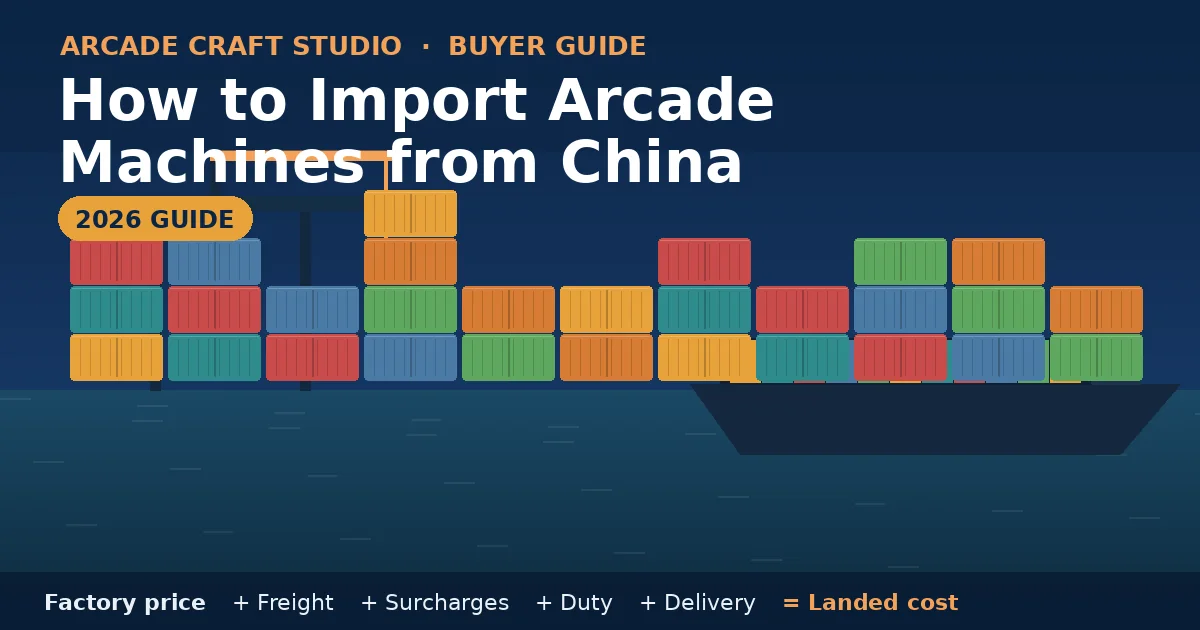
Plan on the factory price being only one part of the total. On top of it sit ocean freight, carrier surcharges, destination port and handling fees, customs clearance, import duty and tax, and inland delivery. Treat the unit price as a starting figure, not the budget; in 2026 the freight slice has been the heaviest.
Freight is the line that moved most this year. By late May 2026, the Shanghai Containerized Freight Index sat near 2,218 points, roughly 70% above its February low, according to shipping-market reporting, and carriers layered on peak-season surcharges of about $500 to $2,000 per container plus rising bunker adjustment factors. That environment was expected to hold through June and July. None of it changes the machine you ordered; all of it changes the number on your floor.
Duty and tax are the line you cannot eyeball. The rate depends on your destination country, the HS code your machines are classified under, and any trade measures in force when the container arrives. Do not let anyone hand you a “typical” duty percentage as if it were settled. Confirm the classification and rate with your own customs broker before you book. Arcade Craft Studio can coordinate the export paperwork, but the final duty position for your market is yours and your broker’s to confirm.
Don’t forget cargo insurance
Marine cargo insurance is the line first-time buyers skip until a cabinet arrives cracked. It covers loss or damage in transit for a small percentage of the insured value, but the exact rate and what counts as a covered event depend on your route and policy. Confirm both with your insurer or broker. Arcade Craft Studio can coordinate cargo insurance as part of a CIF or DDP arrangement; whichever way you insure, get the coverage limit and the claims process in writing before the container sails.
EXW, FOB, or DDP: which Incoterm should you choose?
An Incoterm sets where the supplier’s responsibility ends and yours begins. EXW leaves everything from the factory door to you. FOB gives a clean handover at the Chinese port. DDP puts delivery to your door, duties paid, on the supplier. For most overseas operators FOB or DDP fits best; EXW suits only buyers who already run a forwarder in China.
The three terms most arcade buyers actually weigh:
| Term | What you handle | Best for | Watch-out |
|---|---|---|---|
| EXW (Ex Works) | Pickup at factory, China export clearance, freight, everything | Buyers with an established forwarder in China | You own export clearance — most overseas operators are not set up for it |
| FOB (Free On Board) | Ocean freight, destination fees, customs, duty, delivery | Operators with a freight forwarder in their own country | Surcharges and destination fees are yours, and they swing |
| DDP (Delivered Duty Paid) | Usually just receiving and unloading | First-time importers who want one number | Confirm in writing exactly what “duty paid” includes for your country |
Arcade Craft Studio quotes EXW, FOB, or DDP, and ships under its own company letterhead, so the proforma invoice, packing list, and bill of lading come from a single party rather than a broker chain. If you want a DDP number, ask for the breakdown behind it. A real DDP quote names the freight, the surcharges, and what is assumed for duty, so you can see what changes if rates move between booking and sailing.
FCL or LCL, and how many machines fit in a container?
Full Container Load (FCL) means booking a whole 20ft or 40ft box; Less than Container Load (LCL) means sharing a consolidated one. Once you are filling half a container or more, FCL almost always wins on per-unit cost and spares cabinets the extra handling. LCL only suits one or two machines, where consolidation and terminal fees eat the saving.
How many units fit comes down to each model’s crated size. A 40ft high-cube might swallow only a handful of 55-inch motion racing cabinets, yet hold dozens of compact 60-jaw gift machines or ticket-redemption units. Guessing is how cabinets get left on the dock. Arcade Craft Studio works out the cubic-meter (CBM) figure and the loading plan per order before booking, so you are not paying for empty space or finding at the port that the last two units did not fit.
How to import arcade machines from China: step by step
Importing arcade machines from China runs through a fixed sequence, and knowing it tells you what to confirm and when. The order: confirm spec and Incoterm, sign a proforma invoice and pay the deposit, production and QC, export documents, freight booking, customs clearance, then delivery and install. Skip a confirmation and the delay surfaces later, usually at the port.
A typical project at Arcade Craft Studio moves through these stages:
- Order confirmation — final model list (our arcade machine buying guide helps you settle the mix), customization, voltage and plug standard, and Incoterm agreed in writing.
- Proforma invoice and deposit — standard terms are 30% to start production, 70% before shipment. The PI is your reference document for everything that follows.
- Production and QC — assembly, a routine quality inspection, and a 48-hour aging test before anything is packed; for full-venue projects a 2D/3D layout is produced first.
- Export documentation — commercial invoice, packing list, and bill of lading prepared; CE/RoHS documentation coordinated where you need it.
- Freight booking — FCL or LCL booked against the confirmed CBM and your chosen Incoterm.
- Customs clearance — your broker clears the shipment using the export documents and the HS classification you confirmed earlier.
- Delivery and install — machines delivered, then commissioned with English manuals, 3D install videos, and 7-to-1 technical support on call.
Production timelines vary by product and order size; a few compact machines clear faster than a full mixed container with customization, so get the lead time written onto your PI rather than relying on a verbal estimate.
Your pre-shipment import readiness checklist
Before you wire the deposit, you should be able to tick every box below. Each unchecked item is a place where landed cost or delivery time can slip. This is the list experienced importers run before, not after, money moves.
- ☐ Incoterm agreed in writing (EXW / FOB / DDP) and matched to whether you have a forwarder.
- ☐ Landed cost estimated in full: unit price + freight + surcharges + port fees + duty + delivery.
- ☐ HS code and destination duty rate confirmed with your customs broker — not assumed.
- ☐ Voltage, plug type, and language/currency of the payment system spec’d for your market.
- ☐ CBM and loading plan confirmed; FCL vs LCL decided on that basis.
- ☐ CE / RoHS or local compliance documentation requested and its status confirmed for your country.
- ☐ Payment terms and milestones on the proforma invoice, with production lead time stated.
- ☐ After-sales terms in writing: spare-parts stock, warranty, who pays freight on warranty parts, response time.
- ☐ Photos or video of your actual units at the QC/aging stage before they ship.
Red flags when vetting a supplier
A quote that is far below every other you have collected usually means a cost was left out, often freight assumptions, a stripped configuration, or no after-sales budget. Other warnings: a supplier who will not put the Incoterm and lead time in writing, who answers compliance questions with “no problem” instead of documents, who cannot show you the machines at QC, or whose support contact is the same salesperson who closed the deal rather than a technical line. The five after-sales questions worth asking before you buy are the quickest way to tell a real support operation from a sales promise.
Common mistakes first-time importers make
The most expensive one is comparing unit prices instead of landed costs across suppliers. Landed cost only means something next to what a machine earns; our commercial claw machine ROI breakdown shows how to run that payback math. Close behind: booking LCL for a half-container of machines, assuming a duty rate instead of confirming the HS code, forgetting to spec voltage and plug standard for the destination, and treating the cheapest freight forwarder as equal to a reliable one. Each is avoidable with the checklist above.
FAQ
How much does it cost to ship a container of arcade machines from China?
It depends on the route, the container size, and the surcharges in force when you book. Through mid-2026, ocean rates plus peak-season surcharges have run well above 2025 levels, so treat any number older than a few weeks as stale and ask for a fresh freight quote tied to your destination port.
Is it cheaper to buy DDP or arrange my own freight?
If you already run a freight forwarder in your country, FOB plus your own booking can save money and give you control. If you do not, DDP usually lands cheaper than learning customs the hard way on your first shipment — provided the DDP quote spells out what “duty paid” covers for your market.
Do I need to handle customs and import duty myself?
Under FOB you (through a customs broker) clear the goods and pay duty at destination. Under DDP the supplier’s side arranges clearance and duty. Either way, the duty rate is set by your country and your machines’ HS classification, so a local broker is worth engaging before your first container.
Can Arcade Craft Studio handle compliance certificates like CE?
We can coordinate CE and RoHS documentation and prepare export paperwork. What we will not do is decide your market’s compliance position for you — final requirements should be confirmed with your broker or the relevant authority in your destination country, and we will tell you what we can and cannot certify before you order.
What payment terms are normal when importing from China?
A 30% deposit to begin production with the 70% balance before shipment is the common structure, and it is what Arcade Craft Studio works to. Be cautious of any supplier demanding 100% up front, and keep your milestones written on the proforma invoice.
Plan your landed cost before you commit
Operators who import without surprises price the whole container before the deposit, not after the surcharge: machines, freight, duty, and delivery together. Tell Arcade Craft Studio three things — your destination port, the models you are weighing, and whether you want FOB or DDP — and request a landed-cost quote. You will get back an itemized quote and a loading plan you can budget against, with the duty line shown separately so you can confirm it with your own broker.