
Updated July 2026 — current as of first publication.
You have a high-traffic corner near the front door, the spot every guest passes on the way in, and you want something loud, cheap to run, and hard to ignore. A punch machine keeps coming up in your notes. It draws a crowd, it doesn’t hand out prizes, and one guest daring another to beat their score sells the next play for you. Before you wire a deposit, here is how experienced FEC and arcade operators decide which arcade punching machine to buy and where to put it.
Key takeaways
- An arcade punching machine earns on price-per-play and throughput, not prize redemption, so its running cost is mostly power and the occasional pad or sensor.
- Placement decides the outcome. A punch machine near an entrance, bar, or queue line will out-earn the same unit parked in a back corner.
- Three formats cover most buyers: punch-ball, target-pad, and lower-force kids/combo units. Match the format to your crowd, not to the flashiest cabinet.
- The specs that protect your uptime are frame strength, sensor quality, a serviceable strike assembly, and switchable voltage — confirm each before you order.
- Novelty fades. Plan the punch machine as a rotating attraction, and vet the supplier’s after-sales and spare-parts support up front.
What an arcade punching machine is, and where it earns
An arcade punching machine is a coin- or card-operated cabinet that measures the force of a strike on a ball or padded target and posts a score. Unlike a claw or ticket game, it pays out no prizes, so most of each coin is margin after power. That makes placement and play count the levers that decide what it earns.
Because there is no redemption cost, a punch machine game behaves differently from your prize floor. Where a claw or redemption unit trades a share of revenue for prizes, a boxing arcade machine keeps its take. The trade-off is that its pull is social and novelty-driven: it spikes hard when it is new and visible, then settles. You manage that by placing it where people gather and rotating it before the crowd stops noticing. If you want the underlying math for how any single machine pays back, our breakdown of how to model machine payback with real revenue inputs uses the same price-per-play logic.
Boxing arcade machine types: which one fits your floor
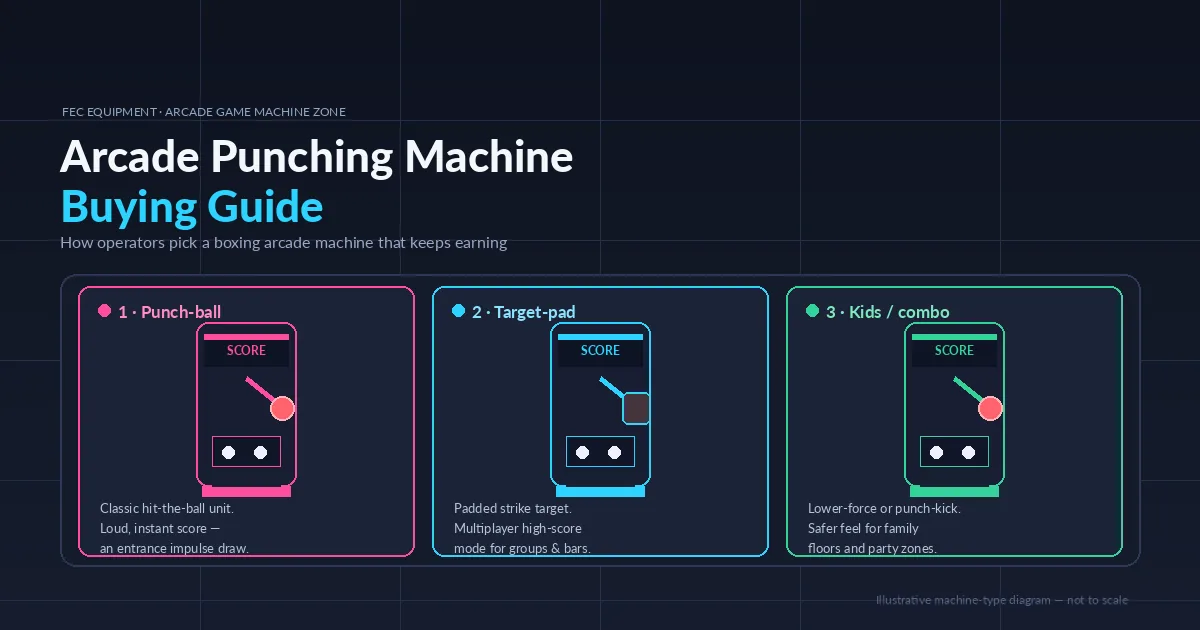
Most buyers choose between three formats. A punch-ball unit is the classic hit-the-ball cabinet — loud, simple, best as an impulse draw at an entrance. A target-pad machine uses a padded strike surface and usually adds multiplayer high-score modes, which suits bars and group venues. A kids or punch-kick combo runs at lower force for family floors.
| Format | Best for | Why operators pick it | Watch-outs |
|---|---|---|---|
| Punch-ball | Arcade & FEC entrances, cinema exits | Instant score, big noise, self-marketing impulse play | Needs open swing space and clear standoff room |
| Target-pad | Bars, adult-night venues, group outings | Multiplayer modes turn dares into repeat plays | Pad is a wear item — confirm it is easy to replace |
| Kids / punch-kick combo | Family centers, party zones, kids’ arcades | Lower force feels safer for younger guests and parents | Position away from strollers and seating flow |
If you are still shaping the wider machine mix around this attraction, you can compare coin-operated boxing punch machines by format and see how each cabinet is built before you commit to a spec.
What makes a punch machine earn — or sit idle
Three things separate a punch machine that pays for itself from one that gathers dust: where it sits, how fast a play cycles, and how long it stays fresh. Placement drives play count more than any spec. A short, obvious play cycle keeps a queue moving during peak hours. Novelty decay turns today’s crowd-puller into next quarter’s dead corner unless you rotate it.
Placement beats specs
A punch machine is a spectator attraction: people play because others are watching. Put it where crowds naturally pause: the entry funnel, near the bar, or alongside a redemption queue, and the machine markets itself. Tucked into a back aisle, the same cabinet goes quiet. Our guide to where to place high-energy machines on your floor maps the zones that concentrate foot traffic.
Throughput during peak hours
On a Saturday night the value of a punch machine is how many plays it can turn per hour. A quick strike-score-reset cycle and a coin or card reader that never jams matter more than a fancy display. If a play takes too long or the reader stalls, the line breaks up and walks away.
Novelty decay is real
The same spike-then-settle pattern hits every high-energy attraction. Budget the punch machine as a rotating draw, not a permanent fixture: move it, re-theme the marquee, or swap it into a different zone before regulars stop trying it. Operators who plan the floor as a rotation keep the “new machine” effect working for them.
Spec checklist before you buy an arcade punching machine
Before you approve a quote, walk this arcade punching machine checklist with the supplier. The goal is uptime: at high play volume, the strike assembly, sensor, and frame take real abuse, and a cabinet built to a price will fail at the joints and the reader first. Confirm each item in writing.
- Frame & strike assembly: heavy-gauge steel around the arm mount and base; the striking mechanism should be a serviceable module, not a sealed unit.
- Sensor accuracy: a force sensor that stays calibrated under sustained use — inconsistent scores kill repeat plays faster than anything else.
- Pad / ball as a wear part: ask directly whether the strike surface is a stocked, swappable consumable and how it ships.
- Payment options: coin, bill, and card reader support (ACS boxing units such as the Hit and Kick 2 support coin, bill, and Nayax card systems) so you are not locked out of cashless guests.
- Voltage: 110V/220V switchable if you operate across markets — confirm the configuration for your country before production.
- Compliance: ask what CE / RoHS documentation the supplier can provide; final certification and your venue insurance should be confirmed with your own broker and local authority, not assumed.
- Spare parts & support: which parts are stocked, how a replacement board or sensor ships, and the after-sales response window.
That last point is where most first-time importers get burned, so it is worth its own conversation — these after-sales questions to ask before you buy apply directly to any punch machine order.
Red flags and common mistakes
Most punch-machine regret traces to two errors: picking a cabinet on looks instead of build, and putting it in the wrong place. A close third is ignoring the wear parts. Each one is avoidable at the quote stage, before any money moves. Watch for these signs before and after the sale:
- No answer on spare parts. If a supplier can’t tell you what’s stocked or how fast a sensor ships, expect downtime you didn’t budget for.
- Sealed strike module. A striking assembly you can’t service in-venue means the whole cabinet is down until a full unit arrives.
- Coin-only in a card-first market. If younger guests don’t carry coins, a coin-only reader caps your revenue from day one.
- Buying too many at once. One well-placed punch machine that you rotate usually beats three parked in weak spots. Start with placement, then scale.
- Treating it as permanent. Skipping a rotation plan lets novelty decay quietly erode the take.
You can see how a punch machine fits alongside redemption and skill games in the broader arcade game machine range when you plan the floor as a whole.
Frequently asked questions
How much does a commercial arcade punching machine cost?
Price depends on format, build quality, payment hardware, and OEM options, so a single number would mislead. Ask for a factory-direct quote that lists the cabinet spec, payment configuration, and landed shipping to your port, then compare like-for-like builds rather than headline prices.
How much can a punch machine earn?
Because it pays out no prizes, a boxing arcade machine keeps most of its take after power, but the actual figure is driven by price-per-play, foot traffic, and how long it stays novel. Model it the same way you would any machine: price per play times realistic daily plays, minus running cost, rather than trusting a fixed revenue promise.
Is a punching machine safe for a family entertainment center?
Lower-force kids and punch-kick combo units are designed for family floors, and clear standoff space around any striking machine matters more than the model. For safety certification and insurance, confirm requirements with your own insurer and local authority — a supplier can coordinate documentation but cannot decide compliance for your venue.
What maintenance does a boxing arcade machine need?
Routine care is mostly the wear parts: the strike ball or pad, the sensor, and the payment reader. Ordering spares with your first shipment and confirming the supplier stocks replacement sensors and boards keeps a busy machine from sitting dark during peak weekends.
Planning an arcade punching machine for your floor? Send us your destination port, the format you’re leaning toward (punch-ball, target-pad, or kids/combo), and your target quantity, and we’ll put together a factory-direct quote with the spec and landed shipping laid out. Request a punch machine quote and tell us about your venue — Arcade Craft Studio ships arcade and FEC equipment worldwide, direct from the factory.