
Updated July 2026 — current as of first publication.
Eighteen months after opening, your Saturday door count looks the same as it did in launch quarter. Game-card revenue doesn’t. The four-screen racing simulator that had a queue in month one now logs a handful of plays a day, and two cranes near the back wall have gone quiet. Nothing is broken. The floor is simply aging, and the question is which machines to keep, which to move, and when to replace arcade machines before they drag down revenue per square meter.
Key takeaways
- Replace a machine only after relocation and a settings review have failed — replacement is the most expensive of four options, not the first.
- Novelty decay shows up in data: falling share of card swipes, vanished peak-hour queues, repeat guests walking past, and rising maintenance cost per play.
- Video-based titles usually decay faster than mechanical redemption and claw cabinets, which can hold earnings for years with prize rotation.
- Budget refresh as a standing annual line (roughly one machine in eight to twelve) so no single quarter takes the whole capital hit.
- Time replacement orders around production and sea-freight lead times so new machines land before your peak season, not after it.
When to Replace Arcade Machines: The Short Answer
Replace an arcade machine when its revenue has trailed your floor average for two consecutive 90-day review windows despite a relocation and a settings review, and the cabinet no longer earns its footprint in any zone. Most underperformers don’t need replacing at all: they need moving, new prizes, or updated content. Replacement is the last of four options.
The measurement matters more than the rule. Pull per-machine revenue from your card system in 90-day windows and compare each cabinet to the current floor average, not to its own launch weeks; every machine falls from its debut peak, and that alone tells you nothing. What you’re looking for is a machine that sits in the bottom slice of the floor and stays there after you’ve tried cheaper fixes.
Machine type changes the calendar. Across the floors we equip at Arcade Craft Studio, mechanical redemption and claw cabinets tend to hold earnings for years, because the prize wall, not the cabinet, carries the novelty; operators refresh the plush and licensed prizes, not the machine. Screen-based titles are different: a racing or shooting game’s draw is its content, so its earning prime is shorter and it should be first in the rotation plan. If you’re comparing categories before a reorder, our venue-type equipment buying guide breaks down which machine families anchor which zones.
Four Signals of Novelty Decay on Your Game Floor
Novelty decay shows up in four measurable signals: the machine’s share of total card swipes falls quarter over quarter; its peak-hour queue disappears; repeat guests walk past it; and maintenance cost per play climbs. Any single signal is noise. Two or more, sustained for eight weeks or longer, mean the machine has left its earning prime.
1. Falling share of swipes. Absolute revenue can dip for reasons that have nothing to do with the machine — weather, school terms, a slow month. Share of floor revenue strips that out. A boxing machine that took 4% of Saturday swipes in its first quarter and takes 1% now has a real problem, even if the dollar figure only looks slightly soft.
2. No queue at peak. Walk the floor at your busiest hour. A healthy attraction piece has a small line or at least back-to-back plays on a Saturday afternoon. A machine idle at peak is idle all week.
3. Repeat guests skip it. Party groups and members are your most honest testers; they’ve played everything. If your card data can segment repeat visitors, watch what they stop playing. That’s the earliest signal of the four.
4. Maintenance cost per play rises. An aging cabinet that still earns is worth fixing; an aging cabinet earning 12 plays a week is not. Track repair time and parts against plays, and read it alongside your spare parts and uptime plan: a machine that is down every other weekend decays faster, because guests learn not to walk to it.
Keep, Relocate, Retheme, or Replace: A Decision Matrix
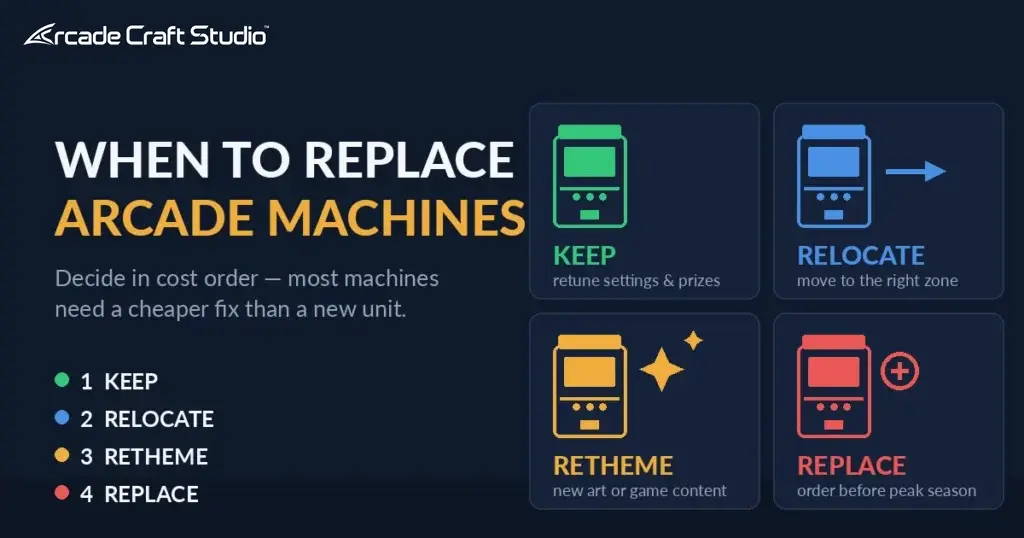
Run every flagged machine through four options in cost order: keep it with retuned settings or fresh prizes, relocate it to a different zone, retheme it with new artwork or game content, or replace it. Each step costs a fraction of the next. Operators who jump straight to replacement pay container money for a problem relocation would have solved.
| Option | Choose this when… | Cost and effort | Watch out for |
|---|---|---|---|
| Keep & retune | Play counts are soft but the machine still queues on weekends. Payout percentage, difficulty, or stale prizes are the likely cause. | Lowest: settings time plus a prize reorder. | Retuning a claw too tight to “recover” revenue; guests notice and the decay accelerates. |
| Relocate | The machine underperforms its category average but sits in a dead corner, behind a pillar, or in the wrong zone for its audience. | Low: labor and a floor-plan update. | Moving it into your entrance sightline “to fix it” and displacing a proven anchor. Re-zone against a plan; our six-zone FEC floor plan guide covers which families belong where. |
| Retheme / update content | The cabinet and hardware are sound but the theme or game content has gone stale — common with video titles and kiddie rides. | Medium: new artwork, software, or licensed content where available. | Retheming a machine whose mechanism (not theme) is the problem. Check the downtime log first. |
| Replace | Bottom of the floor for two 90-day windows, relocation tried, retune tried, and parts costs are climbing. | Highest: new unit plus freight, installation, and lead time. | Ordering a like-for-like unit. A replacement slot is your cheapest chance to rebalance the mix toward what your data says earns. |
Evidence to pull before you decide: per-machine weekly revenue for two 90-day windows; the machine’s position on your current floor plan; the downtime and parts log; prize payout percentage (for redemption pieces); and, if your system records it, repeat-guest play rates. Deciding without the first two is guessing.
Budgeting an Arcade Game Refresh Without a Cash-Flow Shock
Treat refresh as a standing budget line, not an emergency purchase. A practical arcade machine rotation strategy is to turn over a small slice of the floor each year — many operators budget one machine in eight to twelve — funded from game revenue, so the floor never ages all at once and no single quarter absorbs the full capital cost.
Sequencing is where the money hides. A replacement machine from an overseas factory carries production time plus sea freight, so a “we’ll order when it dies” approach leaves a revenue hole on your floor for a quarter. Plan the refresh list in January for machines you expect to retire by summer, and consolidate replacements: one shipment means one freight booking and one customs clearance instead of three. Our guide to importing arcade machines from China walks through the lead-time and landed-cost math in detail.
Retired cabinets are not write-offs. Working machines move on the secondary market to smaller venues and route operators; a retired unit can also be kept as a parts donor for its siblings still on the floor. And when a redemption piece rotates out, its prize stock usually transfers straight to the redemption machines that stay, so factor that recovery into the replacement cost before you approve it. For payback math on the incoming machine, the same discipline applies as at opening: our claw machine ROI breakdown shows the worked calculation.
Common Mistakes and Red Flags When Refreshing the Floor
The expensive refresh mistakes are predictable: replacing machines the data says to relocate, buying the newest release with no zone plan for it, retiring redemption anchors that still feed the prize counter, and landing a container after peak season instead of before it. Every one of them is avoidable with the evidence checklist above.
Common mistakes
- Chasing launch buzz. A new title that queues at a trade show will also debut-spike on your floor, then settle. Buy it for the zone it fills, not the spike.
- Refreshing everything at once. A full-floor makeover creates one great quarter, then a floor that all decays on the same schedule. Stagger it.
- Ignoring the anchor effect. Some machines earn indirectly: a big crane at the entrance pulls guests in even when its own numbers are mid-pack. Check what sits around a machine before you pull it.
- Skipping the parts order. A refresh container without a spare parts kit repeats the mistake that made the last machines age badly.
Red flags in your own process — no per-machine revenue data (fix the card system first, refresh second); decisions made from the show floor rather than your floor; and a refresh plan with no date tied to your peak season. In short: replace arcade machines on evidence, not on age.
FAQ
How long do arcade machines last?
Arcade machine lifespan splits in two. Physically, a well-built commercial cabinet stays serviceable for many years with parts support; earning life is shorter and varies by type: screen-based titles usually leave their prime earlier because their content goes stale, while claw and redemption machines can earn steadily for years when operators rotate prizes.
How do I know whether it’s a location problem or a machine problem?
Relocate first and measure for 60–90 days. If revenue recovers in a new zone, it was location. If the numbers stay in the bottom slice of the floor after the move, the machine itself has decayed and moves up the replacement list.
Should I buy new releases every year?
Only if a zone needs them. A steady stream of small refreshes beats a headline purchase: repeat guests respond to visible change on the floor, and one machine in eight to twelve per year keeps that change visible without straining cash flow.
What should I do with machines I retire?
Three routes: sell working units on the secondary market to smaller venues or route operators, keep one as a parts donor for identical machines still on your floor, or redeploy it to a lower-rent corner where its reduced earnings still cover its footprint.
Can Arcade Craft Studio help plan a floor refresh?
Yes. As an arcade machine manufacturer and FEC equipment supplier, we review your machine list and per-machine revenue, suggest a keep-relocate-replace split, and propose replacement models with a 2D layout for the affected zones. Export coordination and after-sales parts support can be arranged for the replacement order; compliance paperwork for your market is confirmed with your broker or authority.
Plan Your Next Refresh Before the Floor Decides for You
If your card system already shows machines sliding, the cheapest time to act is now, before peak season, not after. Send us your current machine list, your floor plan, and 90 days of per-machine revenue, and request a machine mix review for your floor. We’ll come back with a keep-relocate-replace recommendation and a lead-time-aware order plan.