
Updated September 2026 — current as of first publication.
A new family entertainment center in a mall’s teen zone has about 30 square meters left near the entrance, a reasonable sound budget, and a manager who keeps hearing that a dance machine “pulls a crowd.” The real question is which dance machine. An upright cabinet, a twin competitive platform, a kids’ rhythm unit and a touchscreen music cabinet are all sold as an arcade dance machine, yet they earn in different rooms, need different floor space, and pull different age groups.
This guide compares the four working dance and rhythm formats by venue, footprint and player type, so you can match the cabinet to your floor before you ask for a quote.
Key takeaways
- A dance machine earns partly as a spectacle. Players on the pads pull a watching crowd, so sightlines and placement matter as much as the cabinet itself.
- Upright single or two-panel cabinets fit tight floors; twin competitive platforms need clear space around the pads for movement and onlookers.
- Kids’ rhythm units trade difficulty for bright, low-step play in family zones; touchscreen music cabinets serve casual and solo players who want a screen, not a full step platform.
- Footprint, ceiling height for the marquee and speakers, and clear play space around the pads decide fit more than the spec sheet.
- We quote dance formats per configuration; freight, duty and delivery sit on top of the factory price.
How to choose an arcade dance machine by venue and footprint
Match the arcade dance machine format to the room, not the spec sheet. Teen-heavy malls and FECs reward twin competitive platforms that draw a watching crowd. Tight or mixed floors suit an upright cabinet. Family zones want a kids’ rhythm unit, and casual solo players are served by a touchscreen music cabinet. Footprint and audience come first.
Dance machines are a floor’s advertising. Two players stepping in time to a big screen and loud music turn passers-by into an audience, and that audience is what fills the queue. So a format that looks impressive on a spec sheet can still underperform if it sits in a back corner where nobody sees the play. Before you compare cabinets, decide where the machine goes and who walks past it. For a wider view of how a dance machine sits alongside redemption, prize and racing games, our guide to planning your full FEC games mix is a useful starting point.
Four arcade dance machine formats, and where each earns
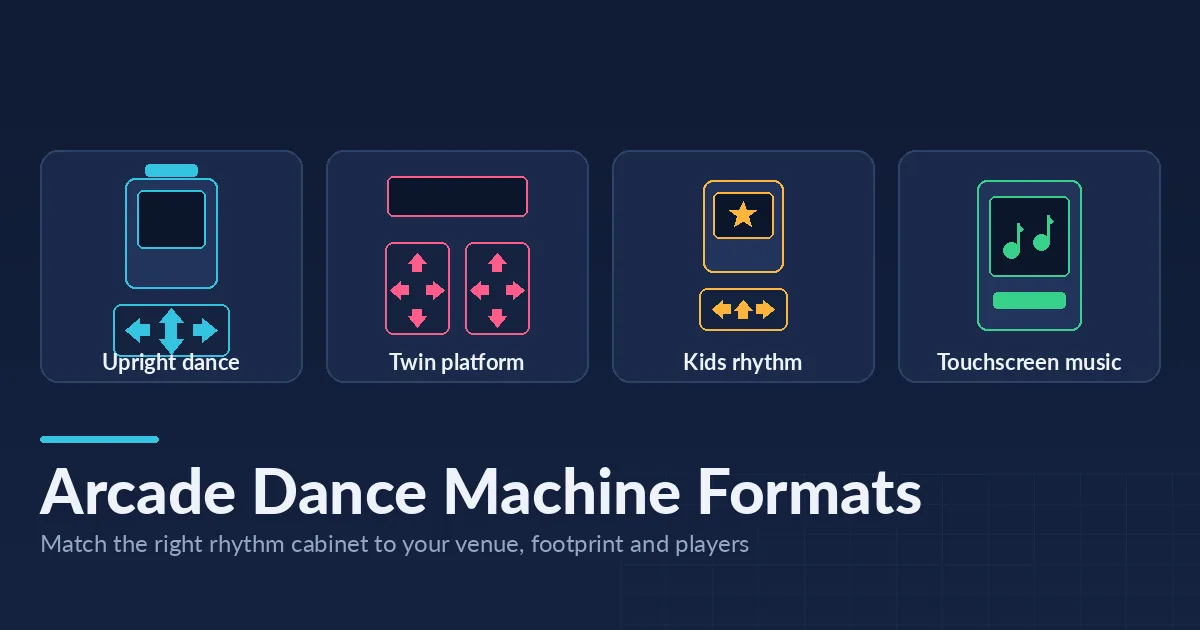
The dance category splits into four working formats: the upright single or two-panel cabinet, the twin competitive step platform, the kids’ rhythm machine, and the touchscreen music cabinet. Each occupies a different footprint and pulls a different player, so the right pick follows your floor space and your core age group rather than a headline feature list.
| Format | Best venue | Typical footprint | Players | Watch out for |
|---|---|---|---|---|
| Upright single / two-panel cabinet | Mixed FEC floors, mid-size arcades, tight mall spaces | Small; players step on integrated foot panels at the base | 1 to 2, casual to regular | Panel wear over time; confirm spare pad sensors and switches |
| Twin competitive step platform | Teen-heavy FECs, high-traffic entrances, esports-style zones | Large; needs clear space around both platforms for movement and onlookers | 2 head-to-head, plus a watching crowd | Reserve room for the crowd, not just the platforms; check floor levelling |
| Kids’ rhythm machine | Family zones, kids’ corners, indoor playgrounds | Small to medium; low step height | Young children and parents | Lower earning per play; value is dwell time and family draw |
| Touchscreen music cabinet | Casual arcades, bars, waiting areas, solo play | Small; seated or standing at a screen | 1 to 2, casual and solo | Not a step-based workout; sets a different expectation than a dance platform |
Upright single or two-panel cabinet
The upright cabinet keeps the whole machine in one small footprint, with foot panels built into the base and the screen at eye level. It is the flexible choice for a mixed floor or a tight mall space, because it draws attention without demanding a whole zone. The trade-off is that the foot panels take heavy wear, so ask what the sensor and switch replacement path looks like before you commit.
Twin competitive step platform
This is the format most people picture as a DDR-style machine: two open step platforms side by side, a large shared screen, and a sound system built to be heard. It earns best in teen-heavy venues and busy entrances, where head-to-head play and a watching crowd feed each other. Plan the space around it carefully. The platforms are only part of the footprint; the crowd that gathers to watch is the other part, and cramming it into a corner throws away its main advantage.
Kids’ rhythm machine
Kids’ rhythm units lower the step height, brighten the cabinet, and simplify the play so young children can join in. They earn less per play than a competitive platform, but that is not really the point. In a family zone they hold children’s attention, extend a family’s stay, and give parents a reason to keep buying credits. Treat them as dwell-time and family-draw machines rather than top earners.
Touchscreen music cabinet
A touchscreen music cabinet serves the player who wants a rhythm game without a full step workout. Play happens at a screen, seated or standing, which makes it a good fit for bars, waiting areas and casual arcades where floor space and noise are limited. Just be clear with your team and your signage that it sets a different expectation than a dance platform, so casual players are not disappointed looking for pads to stand on.
Footprint, power and placement for a dance machine
A dance machine needs more than its cabinet footprint. Players move and onlookers gather, so plan clear space around the step pads, not just under them. Check ceiling height for the marquee and speakers, confirm a stable power supply for your region, and place it where its screen and crowd are visible from the entrance or a main walkway.
Sound is part of the placement decision too. A dance machine is meant to be heard, which is an asset near an entrance and a problem next to a quiet redemption counter or a party room. Think about where the noise helps you and where it works against you. For how footprint and placement translate into factory-direct pricing across machine categories, see our reference on factory-direct price ranges by machine category, and browse the current commercial dance arcade machines to see real cabinet dimensions.
What to check before you buy a dance arcade machine
Once you have chosen a format, the buying decision comes down to build quality, serviceability and honest support. Dance machines take physical punishment that a video cabinet never sees, so the questions below matter more here than in most categories.
Evidence checklist
- Foot panel or platform build: material, sensor type, and how panels are replaced when they wear.
- Music library and update path: what songs ship, and how the library is refreshed over time.
- Payment options for your market: coin, bill, and card or cashless system as needed.
- Sound and screen specs matched to a noisy floor, not a quiet showroom.
- Spare parts availability and lead time for high-wear items.
- After-sales response: who answers, how fast, and in what language.
Red flags
- A supplier who cannot show the spare-parts list for foot panels and sensors.
- Vague answers on the music library or on whether it can be updated.
- Prices quoted without configuration, freight or duty spelled out.
- No clear after-sales contact or response-time commitment.
Common mistakes
- Buying a twin competitive platform, then squeezing it into a space with no room for a crowd.
- Putting a loud dance machine next to a party room or a redemption counter.
- Choosing a kids’ rhythm unit for a teen zone, or a competitive platform for a toddler area.
- Judging the machine on its screen and ignoring the foot panels, which are what actually break.
Compliance items such as electrical certification, voltage, and any local safety approval depend on your market. We can coordinate on documentation, but the final call on CE, RoHS, insurance and customs should be confirmed with your own broker, insurer and local authority. A dance machine is one part of a sports-simulation lineup; if you are weighing it against other active formats, our sports simulator buyer’s guide and the wider full sports simulator range put it in context.
Arcade dance machine FAQ
Buyers ask a similar handful of questions about dance machines: how much floor space each format needs, how a DDR-style platform differs from a touchscreen music cabinet, whether young children can play, what a machine costs, and whether it can be branded for a venue. Short answers follow, with the detail in the guide above.
How much floor space does an arcade dance machine need?
It depends on the format. An upright cabinet fits a small footprint with foot panels at the base, so it suits tight floors. A twin competitive platform needs a larger clear area, because you plan space for player movement and for the crowd that gathers to watch, not just for the two platforms.
What is the difference between a DDR-style machine and a touchscreen music cabinet?
A DDR-style machine uses step platforms, so players dance on foot pads in time to the screen, and it draws a watching crowd. A touchscreen music cabinet is a rhythm game played at a screen, seated or standing, with no step platform. One is a floor spectacle; the other is a compact casual game.
Are dance machines suitable for young children?
Kids’ rhythm machines are built for them, with a lower step height, brighter cabinets and simpler play. Full competitive platforms suit teens and adults better. For a family zone, choose a kids’ rhythm unit and treat it as a dwell-time and family-draw machine rather than a top earner per play.
How much does a commercial dance arcade machine cost?
Dance and rhythm cabinets vary widely by format, screen, sound system and payment hardware, so we quote each configuration rather than publish a single price. Freight, duty and delivery sit on top of the factory price. Send us your format and market and we will price your exact configuration.
Can dance machines be customized or branded for our venue?
Yes. As a factory-direct manufacturer we handle OEM work, so cabinet artwork, branding and configuration can be adapted to your venue and market. Tell us what you need and we will confirm what is possible for your chosen format.
Get a dance machine quote for your floor
The right dance machine follows your room, your audience and your floor space. If you tell us your venue size, ceiling height and floor plan, we can recommend a format and price it for you. Send us your venue size, ceiling height and floor plan and we will put together a factory-direct proposal for your dance and rhythm lineup.