
Updated July 2026 — factory-direct price ranges, current as of first publication.
Working from a total budget instead of per-machine prices? Run your budget through our free arcade ROI calculator to see how many machines fit your space and a payback model.
You are costing out a 300 m² floor. The bank wants a number by Friday, the landlord wants the fit-out date, and every supplier you email answers with “please send your requirements for a quote.” Fair enough — but you cannot build a budget out of a question. You need to know whether a claw machine is a $950 line or a $9,000 line before you can decide how many of them go on the floor.
So here are real ranges. Not a quotation, and not a promise about your order, but the bands Arcade Craft Studio actually quotes across the main categories, plus an honest account of what pushes a machine to the top or bottom of its band.
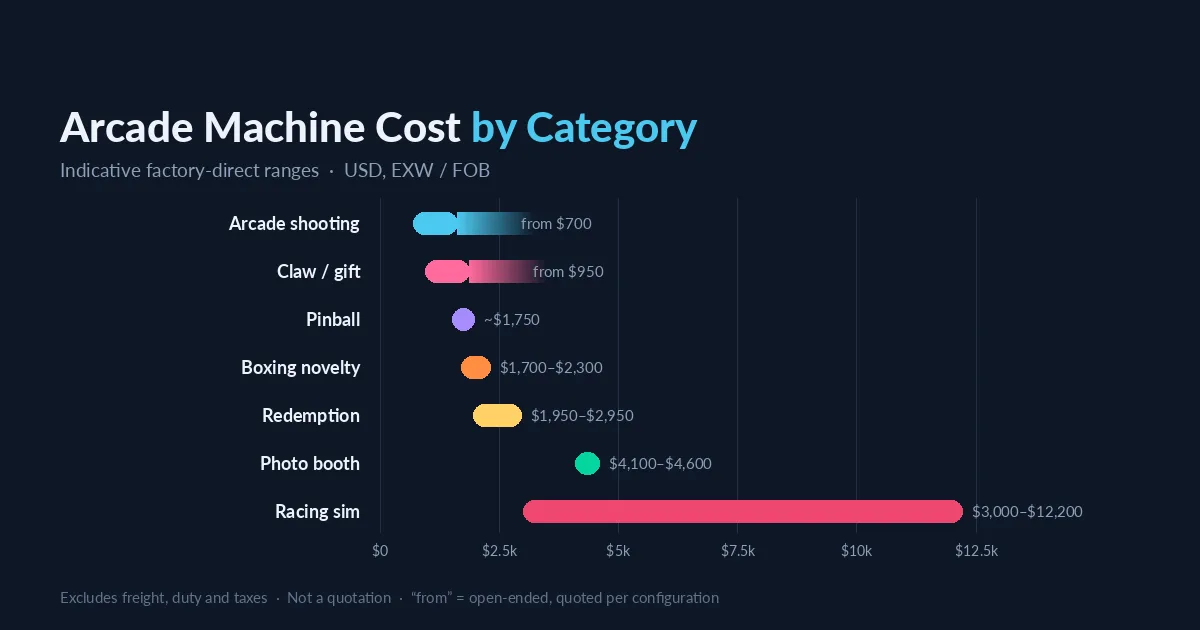
How much does an arcade machine cost in 2026? Most commercial arcade machines cost between about $700 and $12,200 factory-direct (EXW/FOB). Claw and gift machines start around $950, punch machines run roughly $1,700–$2,300, pinball is about $1,750, ticket redemption games run $1,950–$2,950, and racing simulators run $3,000–$12,200. All figures are indicative, exclude freight and duty, and move with configuration.
Key takeaways
- Most commercial arcade machines fall between roughly $700 and $12,200 factory-direct — the category you pick matters more than the supplier you pick.
- Claw and gift machines are the cheapest way to add earning units; motion racing simulators sit at the top of the range.
- The factory price is not your budget. Freight, duty and delivery land on top of every figure here.
- Configuration drives the spread inside each band: screen size, motion platform, and the payment stack you spec.
- Any range older than a few months is stale. Get a written quote against your model list before you commit.
How much does an arcade machine cost in 2026?
Most commercial arcade machines run between roughly $700 and $12,200 factory-direct, before freight and duty. Compact shooters and single-player cranes sit at the bottom. Large motion racing cabinets sit at the top. Category sets the band; configuration decides where in that band your unit lands.
That spread is wide because “arcade machine” covers very different objects. A 60-jaw gift machine is a steel box, a claw mechanism, and a payment device. A 55-inch racing cabinet is four screens, a servo-driven motion platform, an ergonomic seat, and a content licence. Both earn money on a play; they do not cost the same to build, and no honest supplier quotes them in the same breath.
Arcade machine cost by category: 2026 factory-direct ranges
Factory-direct ranges run from roughly $700 for a compact light-gun shooter to about $12,200 for a 55-inch motion racing cabinet, with most categories landing in between. Figures below are US dollars on EXW or FOB terms, drawn from what we quote in practice. They exclude freight, duty and taxes, and they move with configuration and order size.
| Category | Indicative range (USD, EXW/FOB) | What sits at each end |
|---|---|---|
| Gift / claw machines | From ~$950; larger cabinets quoted per configuration | Entry: compact single-player 60-jaw crane. Large and multi-player cabinets with premium lighting and prize display are priced on spec — ask |
| Ticket redemption games | $1,950 – $2,950 | Entry: compact stacker and prize games. Top: ticket eaters, large-format hockey tables, multi-station units |
| Boxing / sports novelty | $1,700 – $2,300 | Entry: standard punch machine. Top: dual-action punch-and-kick units with scoring and ticket output |
| Arcade shooting (light-gun) | From ~$700; large-format shooters quoted per configuration | Entry: compact 42-inch single or twin shooter. Large-screen and theater-style shooters are priced on spec — ask |
| Racing simulators | $3,000 – $12,200 | Entry: single-seat fixed cabinet. Top: 55-inch multi-screen with a servo motion platform |
| Pinball | ~$1,750 | Digital-content cabinets. Licensed themes raise IP questions in some markets — ask before you order |
| Photo booth / self-service | $4,100 – $4,600 | Camera grade, dye-sublimation printer and the payment stack drive the number |
| String bowling | ~$16,800 per lane (10-lane basis) | Quoted as a package; a 10-lane installation runs into six figures EXW including lane parts and capping |
| VR platforms | Quoted per configuration | Motion platform, headset count and content licensing produce a spread too wide to band honestly |
Two notes on reading this table. First, the bottom of a band is usually a promotional or volume figure, not a walk-up price for one unit. Second, VR genuinely has no useful range — a single 360 chair and a multi-station racing setup are different projects, and quoting a band would mislead more than it helps. We would rather say “ask” than invent a number.
What moves the price of an arcade machine?
Six things account for most of the spread inside any category: screen size and count, whether there is a motion platform, cabinet build and materials, the payment system you spec, customization and branding, and order volume. Motion and screens move the number hardest. Payment devices surprise people most.
The variables, in rough order of impact
- Motion platform. A servo-driven platform is the single biggest jump in a racing or VR cabinet. It is the difference between a $3,000 seat and a $12,200 one.
- Screen size and count. A 42-inch panel and a four-screen 55-inch panoramic wall are not adjacent costs.
- Payment stack. A coin acceptor is the cheapest option. A bill acceptor calibrated to your local currency costs more, and a card reader more again — each is a separate line we quote per model. Spec this early; it is the line most first-time buyers forget until the PI arrives.
- Cabinet and materials. Thicker metal, imported acrylic, reinforced hardware and better lighting all cost more and all last longer on a busy floor.
- Customization. Artwork, branding, difficulty tuning and language localization carry setup cost, which volume then dilutes.
- Order volume. Bulk pricing is real, and it is why a mixed container often beats buying units one at a time.
Payment devices deserve their own warning. Operators routinely budget the machine and forget that a bill acceptor calibrated to their currency, or a card terminal, is a separate line on the invoice. On a twenty-machine order, that oversight is not a rounding error.
What the factory price does not include
Every figure above is the machine leaving the factory. On top sit ocean freight, carrier surcharges, destination port fees, customs clearance, import duty and inland delivery. On a container of compact machines, that stack can rival the machines themselves. Budget the landed cost, never the unit price.
This is where price guides mislead people. A $950 crane is not a $950 crane on your floor, and the gap is not small. The mechanics of that calculation — Incoterms, FCL versus LCL, HS codes, what a real DDP quote should itemize — are covered in our guide to what freight, duty and delivery add on top of the factory price. Read it before you sign anything.
On terms: EXW, FOB and DDP are defined by the ICC Incoterms rules, and which one you agree changes who carries the freight and clearance cost. Duty rates depend on your destination country and the HS code your machines classify under. We can coordinate export documentation; the duty position for your market is something to confirm with your own customs broker rather than take from any supplier’s guide, including this one.
Red flags when comparing arcade machine quotes
A quote far below every other you have collected has almost always had something removed. Usually it is the payment stack, a thinner cabinet, no spare parts, or freight assumptions that will not survive contact with a booking. The cheapest quote and the cheapest machine are rarely the same object.
Things worth a second look:
- A price with no Incoterm attached. “$1,200” means nothing until you know whether it is EXW Guangzhou or delivered to your door.
- A quote that omits the payment device, then adds it after you have committed.
- Refurbished or second-hand boards presented as new. Ask directly whether the hardware is new.
- Licensed-theme content with no answer on IP clearance for your market — a real risk on pinball and some video content.
- No spare-parts line at all. Uptime is a cost you either budget or absorb later.
Price only means something next to earnings, which is why a per-unit comparison is the wrong first move. Our breakdown of what a claw machine actually earns back walks the payback math. And if you are still shortlisting vendors, the five-criteria supplier scoring checklist for FEC buyers is a faster filter than another round of price emails.
FAQ
How much does a claw machine cost?
A compact single-player 60-jaw crane starts around $950 factory-direct. Larger and multi-player cabinets cost more and are quoted per configuration, because size, number of jaws, cabinet finish and the payment device you spec all move the number. Freight and duty are additional.
How much does a racing arcade machine cost?
Racing cabinets range from about $3,000 for a single-seat fixed unit to around $12,200 for a 55-inch multi-screen cabinet with a servo motion platform. The motion platform and the screen count are what separate the two ends; the seat and wheel matter far less to the price.
Are used arcade machines cheaper than new ones?
Up front, yes. Over a few years the sum often reverses, because second-hand boards and worn mechanisms drive downtime, and downtime on a busy floor costs more than the discount saved. If you do buy used, ask specifically which components are new and which are refurbished, and get it in writing.
Do arcade machine prices include shipping?
Not at EXW or FOB, which is how the ranges here are quoted. Shipping, surcharges, duty and delivery sit on top. If you want one all-in figure, ask for a DDP quote and make sure it itemizes freight and what it assumes for duty in your country.
Can I get a discount on a bulk arcade machine order?
Volume pricing is standard across the industry, and a mixed container generally prices better per unit than buying machines individually. How much better depends on the model mix and the order size, so send the model list rather than asking for a percentage in the abstract.
Get an exact number for your model list
Ranges are for building a budget. Orders need a quote. Send Arcade Craft Studio three things — your destination port, the models and quantities you are weighing, and whether you want EXW, FOB or DDP — and request an exact quote for your model list. We can return an itemized figure with the payment devices, customization and loading plan shown as separate lines, so you can see exactly what you are paying for and confirm the duty line with your own broker.
Not sure of the mix yet? Browse our claw and gift machine range or the ticket redemption games, send us the shortlist, and we will price it against your floor.
Free planning tool
Will your game zone pay off?
Enter your venue size, budget and visitor assumptions — get a machine mix and payback model in about a minute.