
Updated July 2026 — supplier details below are current as of first publication and each company links to its own site so you can verify them.
You have a 900 m² unit signed, an opening date about nine months out, and four quotes that refuse to compare cleanly. One US manufacturer quotes three flagship video cabinets. A Chinese factory quotes an entire floor for less than those three cabinets. Two distributors quote a mix of both, with margin baked in somewhere you cannot see. Nothing in any of the quotes tells you who still answers the phone in month fourteen, when a bill acceptor dies on your busiest Saturday.
That is the real question behind “who are the best arcade machine suppliers” — and it is why the answer is never one company.
Key takeaways
- There is no single best supplier. There are four supplier types, and a working FEC floor usually draws from two or three of them.
- Almost every “top 10 suppliers” article ranking on Google was published by a supplier who put themselves at number one. This one is published by a supplier too. We put ourselves last and told you why.
- Licensed video cabinets, redemption games, cranes and full-floor fit-outs are different businesses. A company excellent at one is rarely the cheapest or best at another.
- Price per machine is the wrong comparison unit. Compare landed cost, parts lead time, and who owns the fix when a board fails.
- Shortlist three suppliers, not eight. Score them on evidence you can actually check.
Why “best arcade machine suppliers” lists are written by suppliers
Search “best arcade machine suppliers” and most of page one is supplier-published listicles, each ranking its own author first. That is not a scandal, just the economics of the format. It does mean you should read every such list, including this one, as a pitch with useful facts attached rather than a neutral ranking.
So, our disclosure: Arcade Craft Studio is an arcade machine manufacturer, and we sell the machines this article discusses. Several companies below beat us outright on things we cannot match: licensed IP, decades of North American service depth, patented crane mechanisms. We put ourselves last in the table and described only what we actually do. Judge the list on whether the other nine entries are described accurately.
The four kinds of supplier you are choosing between
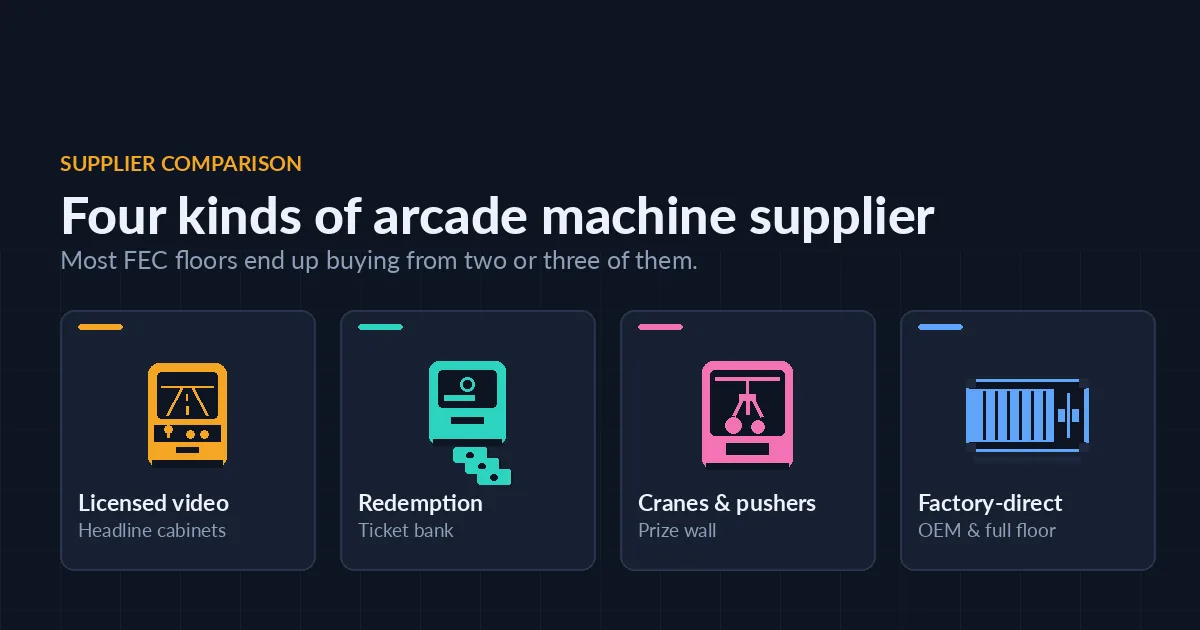
Arcade suppliers split into four groups by what they build: licensed video-game makers, redemption and prize specialists, crane and pusher specialists, and factory-direct manufacturers who build a broad catalogue. Distributors sit across all four as a route to market rather than a fifth type. Most floors need at least two groups.
1. Licensed video-game makers
The licence is the product. A driving game with a film franchise on the marquee draws players who have never heard of the manufacturer, and you pay for that. These are usually the most expensive single units on a floor.
2. Redemption and prize specialists
Ticket redemption is its own engineering discipline: skill mechanics, ticket dispensing, and a payout curve that keeps guests playing without giving away the prize counter. These companies live and die on that curve.
3. Crane and coin-pusher specialists
Cranes look simple and are not. Grip strength, claw calibration and payout consistency are mechanical problems that firms have spent decades refining, which is why a handful of specialist names dominate the niche worldwide.
4. Factory-direct and OEM manufacturers
Mostly Chinese and Korean factories building a broad catalogue and shipping by container. The trade is cost and breadth against marquee recognition. This is our category, so read our claims about it with that in mind.
10 arcade machine suppliers compared
Here are ten manufacturers worth knowing, grouped by what they build rather than ranked by who is “best”. Every entry links to the company’s own site. This is an arcade machine supplier comparison of manufacturers only; distributors such as Betson resell many of these brands and are often the practical way to buy them in North America.
| Supplier | Based in | Best known for | Typical FEC fit |
|---|---|---|---|
| Raw Thrills | Skokie, Illinois, USA | Coin-op video: racing and light-gun shooter cabinets. | Headline video row; draws teens and adults |
| Bandai Namco Amusement America | Itasca, Illinois, USA | Licensed video cabinets and ticket redemption built on well-known game IP. | Recognisable marquee names; mixed video and redemption |
| Sega Amusements International | Chessington, UK | Video and prize machines for FECs, bowling, cinemas. Origins trace to 1951; production sites include Cardiff and Chicago. | European and UK floors; mixed-leisure venues |
| LAI Games | Australian origin, US operations | Prize and redemption games, photo booths, unattended VR. Established 1958. | Prize zone and attended-free attractions |
| ICE (Innovative Concepts in Entertainment) | Clarence, New York, USA | Redemption and sports games. Founded 1982; deep North American service network. | Redemption core; air hockey and sports pieces |
| Bay Tek Entertainment | Pulaski, Wisconsin, USA | Ticket redemption games built for repeat play. | Redemption bank; family and kid traffic |
| Elaut | Sint-Niklaas, Belgium | Claw machines and coin pushers. Founded 1959; pioneered the three-motor claw mechanism. Group includes Benchmark Games and Coast to Coast. | Crane wall and pusher bank |
| Andamiro | South Korea (US subsidiary since 2000) | Pump It Up dance machines, redemption and prize merchandisers. Founded 1992. | Dance/rhythm anchor; prize merchandisers |
| UNIS (Universal Space) | China | Redemption, kiddie rides and prize machines, sold through distributors worldwide. | Volume redemption and kiddie zone |
| Arcade Craft Studio (us) | Guangzhou, China | Factory-direct machines across nine categories, OEM customization, 2D/3D venue layout and export coordination. Manufacturing since 2012. | Full-floor fit-out; container orders; custom builds |
Two things this table deliberately does not have: revenue figures and a winner. Per-machine earnings depend on your footfall, pricing and prize strategy far more than on the badge, and any supplier quoting you a guaranteed weekly take is quoting a number they cannot know. If you want to see how those variables actually move, we worked through the arithmetic in our breakdown of claw machine payback maths.
How to shortlist three suppliers in a week
Cut the list to three before you talk price. Score each candidate on evidence you can verify in a week: certification documents, a reference venue in your region, parts lead time in writing, and a named support contact in your timezone. Anything a supplier will not put in writing during the sales phase gets worse after payment, not better.
The evidence checklist we would use:
- Documents, not adjectives. Ask for the actual certificate PDFs and check the issuing body and expiry. Which certifications your venue legally needs is a question for your local authority or compliance adviser, not for the supplier selling you the machine.
- A reference venue you can contact. Same region, same venue type, opened at least a year ago. Then call them.
- Parts lead time in writing. “Fast support” is not a commitment. “Bill acceptor shipped within X days from Y warehouse” is one you can hold someone to.
- A named human in your timezone. Ask who answers at 9pm local on a Saturday, and get the name.
- Landed cost, not unit price. Freight, duty and clearance can move the comparison substantially between a domestic distributor and a direct factory order. We covered the mechanics in our guide to landed cost and customs when importing from China. Duty rates and clearance requirements must be confirmed with your own customs broker.
For a scored version of this, our five-criteria supplier scoring checklist for FEC buyers turns it into a 1–5 matrix you can fill in during calls. The service side is worth its own conversation: the after-sales questions to ask before you buy are the ones operators tell us they wish they had asked.
Red flags and the expensive mistakes
The costly errors cluster in three places: buying a floor from one supplier because it is administratively easier, comparing unit prices across suppliers whose quotes include different things, and treating certification as a box the supplier ticks for you. Each one shows up months later, usually as downtime.
Red flags worth walking away from:
- A guaranteed revenue or payback figure. Nobody can guarantee your footfall.
- Certificates supplied as photographs with no issuing body visible, or that name a different company.
- No reference venue anywhere in your region, at any age.
- Reluctance to put parts lead times in the contract.
- A quote that cannot be broken into machine, freight and terms.
Common mistakes: ordering the machine mix before the floor plan, which we argue against in our FEC floor plan and guest flow guide; and ordering no spare parts with the first container, which turns a cheap consumable into three weeks of dead floor.
FAQ
Who are the best arcade machine suppliers for a new FEC?
There is no single answer, because the four supplier types build different things. Most new FECs combine a licensed video maker for the headline cabinets, a redemption specialist for the ticket bank, and a factory-direct manufacturer for volume and custom pieces. Shortlist by venue type and region, not by brand fame.
Is it cheaper to buy factory-direct from China or through a distributor?
Factory-direct unit prices are usually lower, but the comparison only holds at landed cost, after freight, duty and clearance. A distributor’s higher price often includes local service, parts stock and warranty handling. Which is cheaper depends on your order size and whether you have someone who can fix a machine locally.
What certifications should arcade machines have?
It depends entirely on your market, and it is not a question your supplier should answer for you. Ask suppliers for the certificate documents they hold, then confirm what your venue actually requires with your local authority, insurer or compliance adviser. We can coordinate documentation for an order, but the requirement itself is yours to verify.
How many suppliers should one FEC floor use?
Two or three is common. One supplier for everything is simpler to administer and usually means compromising on either the headline cabinets or the redemption curve. More than four gets hard to manage across parts, service contacts and shipping schedules.
Getting a comparable quote
If you want our column of that table filled in properly, send us three things: your venue size in square metres, your target opening date, and the machine categories you are considering. We will come back with a machine list, a 2D layout and a landed-cost breakdown.
That breakdown splits into machine, freight and terms, so you can lay it beside any other supplier’s quote and compare like for like. Send your venue size, opening date and machine mix and we will put the numbers together. If a factory-direct fit-out is not the right answer for your venue, we will tell you that too.
Browse what we build in our redemption machine range before you send the brief, if it helps you frame the mix.