
Most first-time FEC and arcade operators buy equipment based on what they’d personally enjoy playing. This is the wrong framework. Machine selection is a revenue problem, and the math is different depending on who walks through your door, how long they stay, and what they’re willing to spend.
This guide covers how to think about equipment selection from the floor up.
Step 1: Know Your Venue Type Before You Order Anything
The same machine performs differently in different environments. Your equipment list should follow from your venue type, not the other way around.
Family Entertainment Centers (FECs)
Primary demographic: families with children aged 4–14. Revenue model: high volume, moderate per-visit spend, high repeat rate. Top performers:
- Prize redemption machines (claw machines, crane games)
- Ticket redemption games
- Multi-player cooperative games
- Beginner-friendly sports simulators
Bars and Adult Entertainment Venues
Primary demographic: adults 18–40. Revenue model: lower volume, higher per-session spend, strong impulse behavior. Top performers:
- Punching bag / strength tester machines (high impulse purchase, especially evenings)
- Head-to-head racing or sports games
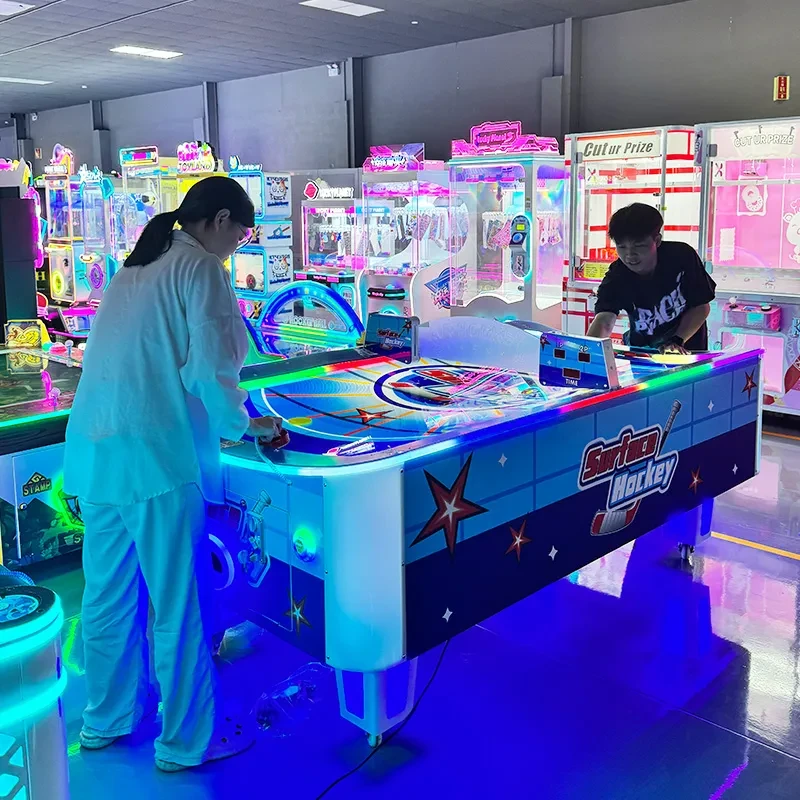
- Air hockey tables (social, skill-based, keeps groups engaged)
Shopping Mall Activations
Mixed demographic, skews families and teenagers. Revenue driven by visibility and impulse. Best placements: near escalators, food courts, cinema exits. Top performers: claw machines, photo booths, compact skill games that don’t require a full arcade commitment.
Step 2: Understand Revenue Per Square Foot, Not Just Per Machine
Floor space is the real constraint. Rank your machine choices by revenue per square foot, not headline revenue:
| Machine Type | Avg. Monthly Revenue | Floor Space | Rev/sq ft |
|---|---|---|---|
| 40″ Commercial Claw Machine | $1,500–$4,000 | ~25 sq ft | High |
| Punching / Strength Tester | $1,200–$3,500 | ~20 sq ft | High |
| Commercial Air Hockey Table | $600–$1,800 | ~60 sq ft | Medium |
| Twin Racing Simulator | $2,000–$6,000 | ~80 sq ft | Medium-High |
| VR Adventure Cabinet | $2,500–$7,000 | ~40 sq ft | High |
Air hockey tables generate less revenue per square foot than claw machines, but they serve a different purpose: dwell time. Players who spend 15 minutes at an air hockey table stay on the floor longer and play more machines overall. A balanced layout uses both high-revenue-density units and high-engagement units.
Step 3: Build Your Floor Around a Core-Anchor-Filler Logic
The best-performing independent FECs don’t fill space at random. They work from a deliberate structure:
- Core machines (40% of floor): Highest revenue per square foot. Claw machines, punching machines, compact simulators. These are your P&L drivers.
- Anchor machines (30%): High-visibility, high-dwell attractions that draw customers in and keep them on the floor. Racing sims, VR cabinets, air hockey tables.
- Filler machines (30%): Lower-cost games that serve casual players, reduce intensity pressure on your core units, and fill visual gaps in the layout.
This isn’t a rigid formula — it’s a framework that reflects how high-performing arcades across Mexico, the UAE, and Southeast Asia structure their floors.
Step 4: Plan Sightlines and Power Before You Order
Machines that are visible from venue entrances or food court transitions generate 30–60% more plays than identical machines in secondary positions. Prize redemption units — where the visible prize cabinet creates desire — benefit most from this rule.
Practical pre-order checklist:
- Confirm dedicated circuit capacity for each machine’s power draw
- Leave 18–24 inches of rear clearance for service access
- Boxing and punching machines need 4 feet of clear swing space in front
- Air hockey tables need blower motor access from the side or rear
- Group by experience type (prize zone, sport zone, sim zone) — not by machine category
Step 5: Total Cost of Ownership, Not Sticker Price
A $2,000 machine requiring $800/year in maintenance and lasting two years before major refurbishment costs more than a $3,200 machine running five years with $200/year in spare parts. Before finalizing any order, check current price ranges by machine category as a purchase-price baseline, then confirm:
- Expected component lifespan for high-wear parts
- Spare parts pricing and availability (and whether the model is still in active production)
- Power consumption per unit (a 15-machine floor running 12 hours/day has a real electricity cost)
- Warranty terms and the supplier’s actual claims process — not just their stated policy
FAQ
How many machines do I need to open a profitable FEC?
There’s no universal number, but a viable standalone arcade section typically starts at 8–12 machines with a clear revenue mix. Below that, the floor looks sparse and customers leave faster. Above 20 machines, you’re entering territory where layout planning and machine diversity matter significantly.
Should I buy all my machines from one supplier?
For your first order, yes — consolidating to one supplier simplifies spare parts inventory, technical support, and warranty management. Once you have operational experience, diversifying for specific machine categories makes sense.
What’s the biggest mistake new FEC operators make when selecting equipment?
Buying machines they personally enjoy rather than machines their customer demographic will play repeatedly. The second most common mistake is underestimating the importance of placement — a great machine in a bad spot earns like a mediocre machine.
How do I know if a machine is genuinely commercial grade?
Ask for the rated play cycle per day and the expected component lifespan under that load. Any supplier that can’t answer this specifically is selling consumer or semi-commercial equipment at commercial prices.
—
ACS Amusement works with FEC operators, arcade owners, and distributors across North America, the Middle East, and Southeast Asia. If you’re planning a new floor or expanding an existing one, contact us for a consultation — we’ll walk through machine mix, floor planning, and pricing without a hard sell.