
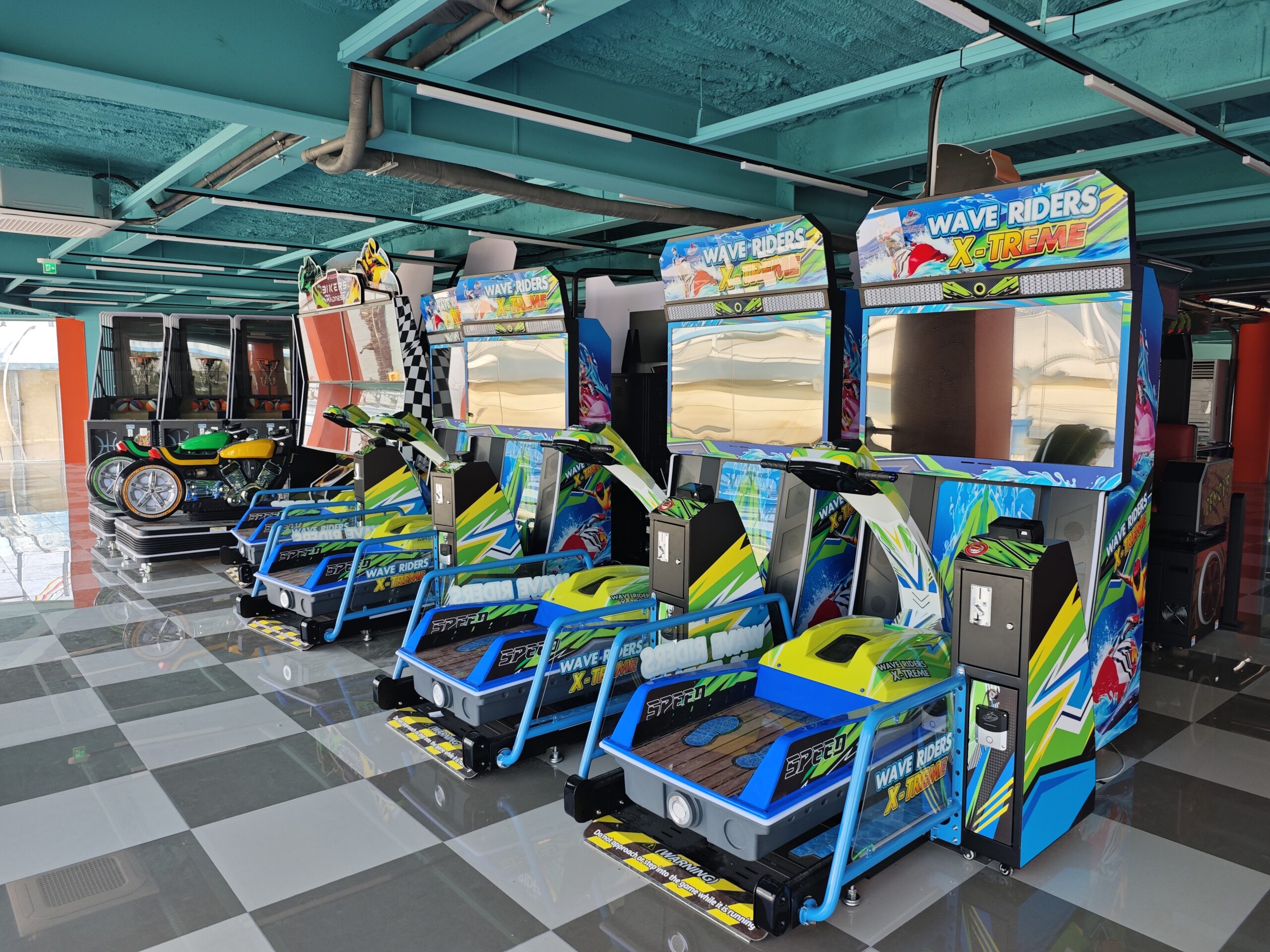
A Korean distributor building a motion-ride corner is buying a group experience, not a shelf of separate cabinets. The row has to read as one themed zone, keep riders clear of moving parts, and give the distributor enough documentation to support the machines once they land. This supplied photo shows several jet-ski wave-rider simulators lined up in one direction, with a motorbike racing unit and additional cabinets positioned behind them.
The photo does not establish the customer name, venue results, exact model list, or any revenue figure, and none are claimed here. The graphics on the machines are game artwork, not a venue brand. Arcade Craft Studio, founded in 2012, is writing this as a factual look at one distributor’s equipment mix.
What does this Korean motion-simulator row show?
The photo shows a line of jet-ski wave-rider simulators with tilting rider platforms, handlebars, and large graphic canopies, all facing the same way. A motorbike racing machine sits behind the row, and further cabinets line the wall. The floor is a reflective checkerboard under an open turquoise ceiling, which points to a mixed motion-ride zone rather than a single-game corner.
Why do distributors order motion simulators as a themed row?
Distributors order motion simulators as a themed row because rider machines sell on visibility and repeat turns, and a matching group draws attention faster than one unit alone. The buyer should confirm footprint, tilt-motion clearance, power draw, floor loading, and payment method for the whole row before promising a venue a final layout. Arcade Craft Studio offers 2D/3D layout support to test that arrangement on paper first.
| Machine role | What the photo shows | Distributor check |
|---|---|---|
| Motion-ride anchor | Row of jet-ski wave-rider simulators with tilting platforms | Confirm motion clearance, floor loading, power, and rider safety spacing |
| Racing support unit | One motorbike racing machine behind the row | Confirm cabinet footprint, screen size, seat access, and payment mode |
| Wall-line cabinets | Additional machines along the side wall | Confirm the mix, sightlines, and the customer walking path through the zone |
What should a Korean distributor confirm before quoting motion simulators?
A distributor should confirm the model-specific specification, packing list, payment and language options, install notes, spare-parts route, and test evidence before issuing a venue quotation. Rider machines especially need clear motion-clearance and safety guidance. Arcade Craft Studio documents a quality process that includes triple raw-material inspection, a 48-hour load test, and a 72-hour aging test; the exact records for an order should be requested in writing.
- Exact cabinet dimensions, tilt-motion clearance, floor loading, power, and rider spacing.
- Whether any units link or run standalone, and the operator/payment mode.
- Software language, content updates, and safety signage for motion rides.
- Pre-shipment inspection, loading evidence, English manuals, and 3D install videos.
- Spare-parts and remote-support route after the equipment reaches Korea.
- Any local electrical, safety, import, or insurance requirements to confirm independently.
How does an arcade machine supplier support a Korean distributor?
An arcade machine supplier supports a distributor by handling the sourcing, factory testing, export paperwork, and after-sales route so the distributor can focus on selling to venues. Arcade Craft Studio’s documented scope covers factory-direct supply, OEM and customisation, export coordination, and after-sales with a 10-minute response target, English manuals, and 3D install videos. Sea shipping to Korea typically runs about 30–35 days after production, subject to order size and port; confirm the schedule per order.
Frequently asked questions
Can Arcade Craft Studio supply motion ride simulators to Korean distributors?
Yes. Arcade Craft Studio supplies commercial amusement machines, including motion and riding simulators, factory-direct with export coordination to Korea. The exact models, specifications, and available options for a distributor’s motion-ride row should be confirmed in writing before ordering, since the photo alone does not fix a model list.
What space and power do jet-ski and motorbike simulators need?
Motion simulators need enough footprint plus extra clearance for the tilting platform, correct power supply, and a floor that carries the load. Arcade Craft Studio provides model-specific spec sheets and 2D/3D layout support so a distributor can confirm the row fits a venue before quoting or committing to an arrangement.
How long does shipping to Korea take?
Sea shipping to Korea usually takes roughly 30–35 days after production is finished, though the exact time depends on order size, the destination port, and freight schedules. Arcade Craft Studio coordinates export documentation; a distributor should confirm the production and shipping timeline in writing for each specific order.
Does Arcade Craft Studio provide after-sales support after machines reach Korea?
Yes. Arcade Craft Studio runs 7×24 after-sales with a 10-minute response target, English manuals, and 3D installation videos. A distributor should confirm the spare-parts route and remote-support process for the selected motion-simulator models so venue-side maintenance is covered after delivery.
Related Arcade Craft Studio cases
- Racing Arcade Machine Supplier for Korean Distributors — another look at the same Korean dealer venue, focused on the racing cabinets.
- Wholesale Arcade Machine Supplier for Korea Distributors — how a Korean distributor plans a mixed wholesale order.
- Sport & motion simulation machines — the product category behind rider units like these.
- Arcade game machines — cabinets to round out a motion-ride zone.
- Browse all Arcade Craft Studio products, or read why distributors work with us.
Planning a motion-ride corner for a Korean venue? Send Arcade Craft Studio your floor size and target machine mix and request a model-specific spec sheet plus a 2D/3D layout for your motion-simulator row.