
Updated July 2026 — current as of first publication, based on the group-play formats we specify in FEC layout proposals.
Your party bookings are climbing. Saturday mornings are three birthdays deep, a local company just asked about a team night, and the phone keeps ringing about group rates. Then you watch a party of twelve nine-year-olds hit the floor and scatter: a queue of eight forms at the one basketball unit while a single-player racing seat sits empty, two kids fight over the claw machine, and the host is refereeing instead of selling more play. The machines earn fine on a normal Tuesday. On a booked party they bottleneck. Choosing arcade machines for birthday parties and group events is a different buying problem from stocking a walk-up floor, and getting it wrong quietly caps the most profitable revenue you have.
This guide covers which machine formats absorb a group instead of splitting it, how to match equipment to each type of booking, and how to keep fifteen people playing at once rather than lining up.
Key takeaways
- Party and group revenue rewards machines that serve several players at once — multiplayer and competitive formats, not single-seat cabinets.
- Buy for the group scenario you actually book: a nine-year-old birthday, a mixed family gathering, a teen group, and a corporate team night each reward a different mix.
- Throughput is the hidden constraint: a party of twelve needs enough simultaneous “seats” to keep everyone playing, or the booking stalls at a queue.
- Redemption and prize play give a party its ending — the ticket count and the prize wall are what the group remembers and photographs.
- A repeatable party package is built on the equipment first; the food, room, and host wrap around what the machines can absorb.
Which arcade machines for birthday parties and groups earn most
The machines that drive party and group revenue are the ones several people can play at the same moment: multiplayer air hockey, basketball banks, linked racing, boxing games, and interactive projection. A single-seat cabinet serves one guest while eleven watch. A group format turns the same booking into a dozen simultaneous players — where a party’s money actually sits.
The test for every machine on a party floor is simple: when a group of ten crowds around it, how many are playing versus waiting? Air hockey seats two head-to-head and pulls a cheering ring around the table. A four-player basketball bank turns a queue into a race. A row of linked racing seats — some of our racing cabinets run local competition across up to five seats — makes one heat out of a whole friend group. Competitive boxing and “hit and kick” games hand a group an instant leaderboard. Interactive floor and wall projection has no cabinet and no seat limit at all, so a room of toddlers or a corporate team can all move at once. None of that shows up when you evaluate a machine as a solo earner. It only shows up when you picture the group standing around it.
Match the machines to the group you actually book
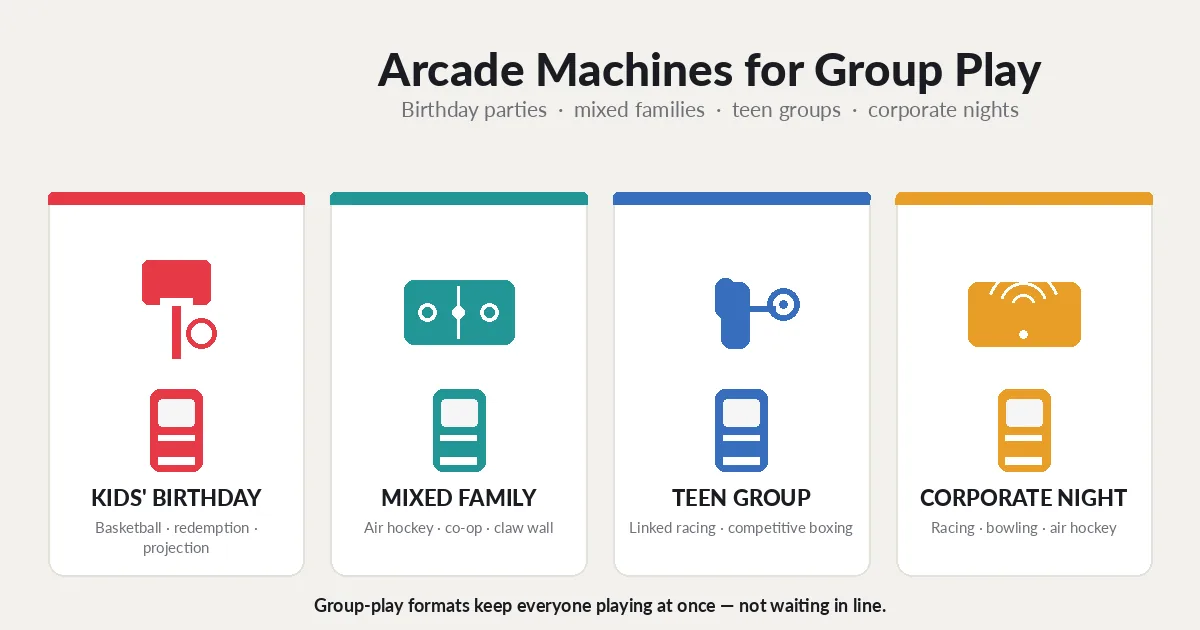
Buy for the booking, not the average day. A children’s birthday, a mixed-age family party, a teen group, and a corporate team night reward different formats, footprints, and price points. Before you shortlist machines, look at your own booking sheet and weight the mix toward the groups you sell most, then cover the others with a few flexible units.
| Group type | What they reward | Machine formats that fit | Watch out for |
|---|---|---|---|
| Kids’ birthday (6–11) | Quick turns, easy wins, tickets to redeem together | Basketball banks, ticket redemption games, interactive projection, kiddie-friendly hammer/boxing, claw and gift machines | Skill games too hard for the age; single-seat cabinets that make kids queue |
| Mixed-age family | Something for every age at once, shared watching | Multiplayer air hockey, basketball, light-gun co-op shooters, projection, a claw wall | A floor that only suits under-10s or only suits teens |
| Teen group / school | Head-to-head competition, bragging rights, higher intensity | Linked racing seats, competitive boxing, VR pods, sport and motion simulators | Long single sessions that bottleneck a big group |
| Corporate / team night | Team competition, a leaderboard, food-and-drink pairing | Linked racing, compact bowling, golf bays, air hockey tournaments, VR | Kid-only machines; nothing that scores a team |
Two patterns hold across all four columns. First, at least one redemption tie-in belongs in every party, because ending at the prize wall gives the group a shared payoff and a photo. Our four-role redemption machine mix for a new FEC explains how the ticket core and prize counter work together, and the same logic anchors a party package. Second, the competitive formats that carry teen and corporate bookings — racing, boxing, sports — overlap heavily with the sports simulation machine range; our sports simulator buyer’s guide breaks those formats down by footprint and venue fit.
Design a party package around your equipment
A party package is an equipment product before it is a food-and-room product. Decide how many machines a group can realistically use in ninety minutes, build the play allowance and the timeline around that number, then wrap the room, host, and food around it. Sell the play the floor can actually deliver, not a card value the group cannot spend.
Work backward from throughput. If a booking of twelve gets sixty minutes of open play, the group needs enough simultaneous seats that nobody spends the hour in line — which is exactly why multiplayer machines matter more than headline earners here. Then attach the group to a home base: a party room or a reserved table near the high-energy zone keeps the host, the cake, and the coats in one place while the kids cycle out to play. Our FEC floor plan and guest-flow guide covers where party rooms and competitive machines belong relative to the prize counter and café. Finish every package at redemption: a standing ticket top-up so each child leaves the prize wall with something turns a good party into a re-booking. Compliance and insurance for group activities — waivers, supervision ratios, age limits on motion and VR — are yours to set with your own insurer and local authority, not the machine supplier’s call.
Keep the whole group playing: throughput on a party floor
Throughput is how many of a group can play at once, and it makes or breaks a party booking. Add up simultaneous “play positions” across your group machines — every air hockey side, basketball hoop, racing seat, and projection zone — then compare that to your typical party size. If positions are fewer than heads, you have a queue, not a party.
A worked way to think about it: a party of twelve wants roughly enough positions to keep two-thirds of the group playing while the rest cheer, rotate, or grab a drink. A four-player basketball bank is four positions in a small footprint. A pair of two-seat air hockey tables is four more. A five-seat linked racing rig is five. Stack a few multiplayer units near the party zone and a dozen kids stay in motion; fill the same space with single-seat cabinets and the identical square meters produce a line. This is also why party-heavy venues re-flow the floor so their multiplayer machines cluster near the party rooms rather than scattering across the floor. If your group revenue is growing but the floor was built for walk-up singles, it may be time to rebalance the machine mix toward group formats.
Party-floor readiness checklist
Before you commit a container or re-flow a zone for group business, confirm:
- Simultaneous play positions across group machines are at least two-thirds of your typical party size.
- At least one redemption or prize machine anchors the party’s ending, with a queue lane that does not cross the play area.
- The mix covers the group types you actually book, weighted to the ones you sell most.
- Competitive formats (racing, air hockey, basketball, boxing) can score head-to-head or as a team, not just solo.
- Party machines cluster near the party room or reserved seating, not scattered across the floor.
- Motion, VR, and physical games have the clearance and supervision your insurer and local authority require — confirm both before opening the package.
Common mistakes and red flags
The most expensive party-floor mistakes are bought, not operated. A floor of single-seat “hero” cabinets looks impressive and queues instantly under a group. A package sold on a card value the machines cannot absorb leaves guests frustrated when you most want a re-booking. And a party zone with no redemption ending sends the group home without the shared payoff.
Red flags when you shortlist: a supplier who quotes “party machines” with no player count per unit, so you cannot calculate throughput; multiplayer cabinets with no confirmation that linked or head-to-head play is included rather than an upsell; and any package pricing built before you know how many simultaneous positions your floor holds. Ask for the player capacity and footprint of every machine in writing, and picture the group around it before you buy.
Frequently asked questions
What are the best arcade machines for birthday parties?
The best arcade machines for birthday parties are multiplayer and competitive formats that keep a group playing together: air hockey, basketball banks, linked racing, ticket redemption games, and interactive projection. For younger children, weight toward easy, quick-turn games and a prize-wall ending; for teens, add head-to-head competition. Avoid single-seat cabinets that make a group queue.
How many machines do I need for a party area?
Plan by simultaneous play positions, not machine count. Add up every seat, hoop, table side, and projection zone across your group machines, and aim for at least two-thirds of your typical party size so most guests play while a few rotate. A four-player basketball bank and two air hockey tables, for example, already cover a small party.
Which arcade machines work for corporate team events?
Corporate groups reward competition and a scoreboard: linked racing rigs, air hockey tournaments, compact bowling, golf bays, and VR pods all let a team compete and rank. Pair the machines with food and drink and a bookable space. Confirm any age, safety, and insurance requirements for motion or VR play with your own insurer and local authority.
Can I add party machines to an existing arcade floor?
Yes. Start by counting your current simultaneous play positions against your party size, then add multiplayer units — air hockey, basketball, linked racing — and cluster them near a party room or reserved seating. Re-flowing the layout so group machines sit together usually matters as much as the machines you add.
Does Arcade Craft Studio help plan a party and group machine mix?
Yes. Send your floor dimensions, the group types you book most, and your typical party size, and we prepare a 2D layout with a group-play machine mix and throughput count. We build factory-direct with OEM options and export coordination. Compliance, insurance, and supervision rules for group activities should be confirmed with your own advisor and local authority.
Plan your party and group floor with us
If party and group bookings are your growth engine, the machine mix should be built for them on purpose. Send us your floor dimensions, the group types you book most, and your typical party size, and we will put together a group-play machine mix and throughput plan — then a 2D layout once the shortlist is agreed.