
Updated July 2026 — reviewed against the role-based mix framework we use in 2D layout proposals for new FEC projects.
You’ve signed the lease on 600 square meters in a shopping mall. The fit-out drawings are with the contractor, and a supplier catalog with two hundred machine models is open on your screen. Your budget covers roughly one container of equipment. The decision that shapes your first two years is not which machines look good in the catalog — it’s how many of each type go into that container. That split is your redemption machine mix, and first-time operators tend to get it wrong in the same two ways: too many impulse machines, and no plan for the prize counter.
Key takeaways
- Plan a redemption machine mix by role, not by model. The four roles: impulse wall, ticket core, kids band, prize counter.
- Ticket-earning games drive repeat visits; claw and gift machines capture the first coin. You need both, in different proportions.
- The prize counter is a role in the mix, not an afterthought. It needs floor space, a queue lane, staffing, and a prize inventory budget from day one.
- Decide the role split before requesting quotes, then price the whole order, not machine by machine.
- Ratios shift with venue type. A mall family zone and a street-front arcade need different mixes.
Why your redemption machine mix decides payback
A redemption machine mix is the planned split of machine types in your equipment order: direct-prize machines such as claws, ticket-earning redemption games, children’s machines, and the prize counter that converts tickets into prizes. It decides payback because each type earns, retains, and costs differently — and the split is hard to change after the container ships.
Each role does a different job. A claw machine earns its first coin within seconds of a guest walking past, but a guest who wins (or gives up) has no reason to stay. A basketball machine earns more slowly per glance, yet it hands the guest a ticket balance — unfinished business that brings them back next weekend. Children’s machines earn modestly but decide whether families choose your venue at all. The prize counter earns nothing directly while consuming floor space, staff hours, and inventory budget; get it wrong and it quietly drains everything the other machines earned. Our claw machine revenue and payback breakdown shows how sharply earnings vary between two identical cabinets in different roles and positions. The same logic applies across your whole order.
The four roles in a working redemption machine mix
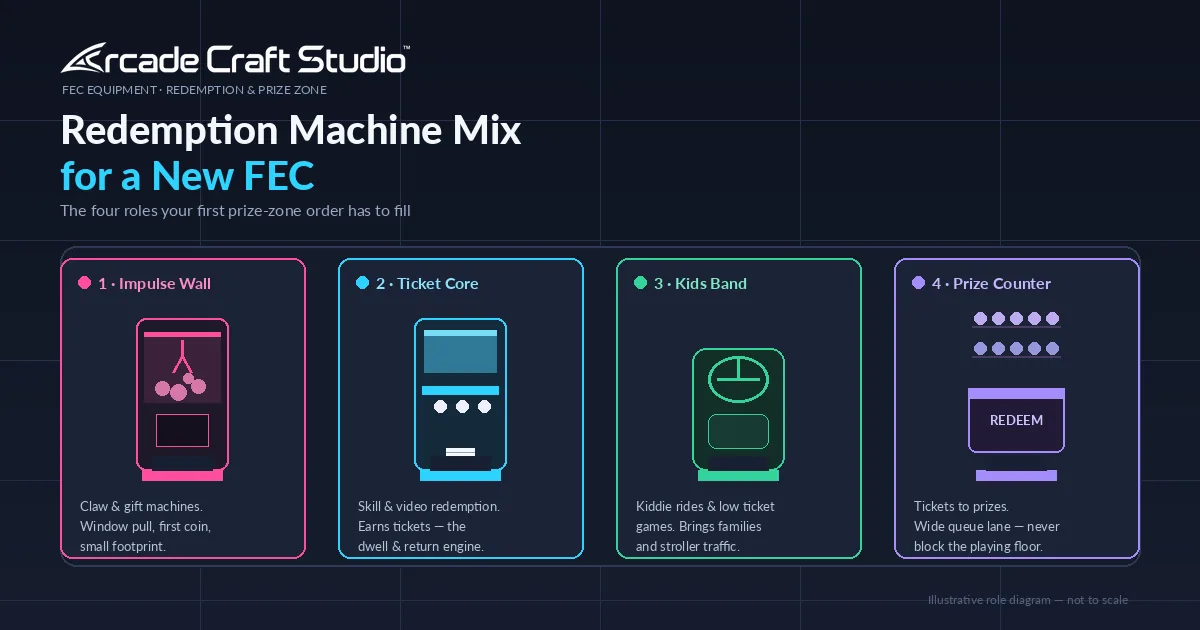
Every workable mix fills four roles: an impulse wall of claw and gift machines that captures the first coin at the entrance, a ticket core of redemption games that builds dwell time and return visits, a kids band that brings families through the door, and a prize counter that turns tickets into a reason to come back.
1 · Impulse wall — claw and gift machines
These are your window display. Small footprint, instant comprehension, no instructions needed. Face them toward the entrance or the mall walkway so the plush in the glass does the advertising. One practical detail from venues we’ve equipped: keep the prize window no more than two plush deep, and rotate what’s visible every few weeks — a full window reads as “winnable,” a sparse one reads as “rigged.” Browse the formats in our gift and claw machine range.
2 · Ticket core — skill and video redemption games
Basketball machines, hockey tables, block stackers, coin pushers, two-to-four-player ticket games. This is the earning engine and the reason guests return: an unspent ticket balance is the cheapest loyalty program in the industry. Multiplayer cabinets matter here: a four-player game turns one paying guest into a group of them. See the formats in our redemption machine range.
3 · Kids band — children’s machines and kiddie rides
Low ticket payouts, gentle gameplay, bright cabinets. This band decides whether a parent with a stroller walks in or walks past. Cluster it away from the loudest cabinets and give parents a sightline to seating. A parent who can sit down buys another round of play credit; one standing guard does not.
4 · Prize counter — the role that isn’t a machine
Budget it like a machine anyway: counter, shelving, prize wall, and a queue lane that doesn’t cut across the playing floor. Position it deep in the zone so ticket-holders walk past the machines again on their way to redeem — our FEC floor plan and guest-flow guide covers where the counter sits in the larger layout.
How to split a first order: a worked example
Plan the split by role share of machine count, not by picking models one at a time. The table below is the starting allocation we propose most often for a mall-based family venue. Venue type, ceiling height, and local audience all shift it — treat it as a first draft to mark up, not a rule.
| Role | Share of cabinets (our usual starting point) | Typical machines | It has failed if… |
|---|---|---|---|
| Impulse wall | About a quarter | Claw machines, gift cabinets, key machines | Guests play once at the window and never enter the ticket zone |
| Ticket core | About half | Basketball, hockey tables, block stackers, coin pushers, multiplayer ticket games | Ticket output is so stingy guests stop caring about the counter |
| Kids band | The remaining quarter | Kiddie rides, children’s ticket games | Parents can’t watch their kids from anywhere they’d want to sit |
| Prize counter | Floor budget, not cabinet count | Counter, prize wall, ticket eater or kiosk | The redeem queue blocks machines at Saturday peak |
On a first order of 40 cabinets, that starting point works out to roughly 10 claw and gift machines, 20 ticket-earning games, and 10 children’s machines, with the prize counter budgeted from the fit-out rather than the cabinet count. A street-front arcade aimed at teenagers pushes more weight into the ticket core and trims the kids band; a toddler-focused mall zone does the reverse. Our venue-by-venue arcade machine buying guide walks through how the mix changes across venue types. Whatever split you land on, price the order as one package — freight, spare parts, and installation support are all negotiated better on a full container than on ten separate quotes.
Prize counter planning: where new venues lose money
New venues lose money at the prize counter in three ways: prize payout that was never set as a target, a counter placed where its queue blocks machines, and dead stock nobody wants. Each one is a planning decision you can make before the first container ships, not an operating surprise you discover after.
Placement you have already seen: put the counter deep in the zone and keep its queue lane off the playing floor. Payout next. Decide before opening what share of your redemption revenue you’re willing to hand back as prize cost, then set ticket values and prize prices to hit it, and review the number weekly. The operators who struggle are rarely the ones who chose a generous or stingy target — they’re the ones who never chose one. Stock the wall in three tiers: sweets and small toys a child can reach in one visit, mid-tier items worth two or three visits, and a few aspirational prizes that exist mostly to be photographed. And if staffing is tight, a ticket eater plus self-service kiosk shortens the queue that a single staffed counter builds on a Saturday afternoon.
Checklist, red flags, and common mistakes before you order
Before you confirm redemption games for a new FEC, put every supplier through the same evidence test. The goal isn’t to catch anyone out; it’s to make sure the mix you planned on paper is the mix that actually arrives, works, and can be maintained in your market.
Evidence to collect from any supplier:
- Per-machine spec sheets: power draw, footprint, weight, and voltage for your market.
- Confirmation that ticket payout settings are operator-adjustable, and how.
- A wear-parts list with prices. Claw assemblies, buttons, and ticket feeders are what actually fail.
- Compatibility with the card or coin system you plan to run from day one.
- Warranty terms in writing: what’s covered, for how long, and who pays replacement-part freight. Our five after-sales questions to ask before you buy cover what “covered” should actually mean.
- Factory photos or video of your machines before packing, not catalog renders.
Red flags: a supplier who quotes machine by machine without asking about your floor plan or audience (our supplier vetting checklist lists the rest of the questions to put to them); catalogs with no spec sheets behind them; prices quoted without an Incoterm — our guide to importing arcade machines from China explains why that number is meaningless on its own; after-sales promises that exist only in chat messages.
Common mistakes: spending the budget on two hero machines and starving the ticket core; ordering before the floor plan is fixed; leaving the prize inventory out of the opening budget; treating the card system as a later upgrade, which means re-fitting every cabinet.
Frequently asked questions
How many machines does a new FEC need for redemption?
There is no fixed number — it depends on floor area, venue type, and budget. Plan by role share first: roughly half your cabinets in ticket-earning games, a quarter in claw and gift machines, and the rest in children’s machines, then adjust the count to your floor plan.
What is the difference between redemption machines and gift machines?
Redemption machines pay out tickets or points that guests exchange at a prize counter. Gift machines, including claw machines, dispense the prize directly from the cabinet. Most venues need both: gift machines capture impulse play, while ticket redemption builds return visits.
Can a small FEC open without a prize counter?
Yes — some small venues run only direct-prize machines such as claws and key machines. But without a counter you lose the ticket-balance return mechanic, so plan extra impulse and children’s machines to compensate, and revisit the counter once traffic justifies staffing it.
Does Arcade Craft Studio help plan the machine mix?
Yes. Send us your floor plan or space dimensions, venue type, and target audience, and we prepare a 2D layout with a role-based machine mix proposal. Compliance items such as CE marking or local safety rules should be confirmed with the relevant authority or your own advisor for the destination market.
Get a machine mix proposal for your floor
If you’re planning your first equipment order, send us three things: your floor dimensions or plan, your venue type and target audience, and your destination port. We’ll come back with a 2D layout and a role-based machine mix you can mark up before anything is quoted. Send your floor plan and request a machine mix proposal.