
Updated August 2026 — current as of first publication.
You already run one video shooter that pulls a steady crowd, and now you want a second shooting title to build a small “shooting corner.” Then the quotes arrive and the word “shooting” covers four very different machines: a compact two-player light-gun cabinet, a 42-inch motion shooter, a linked competitive row, and a low-recoil kids’ unit. They need different floor space, different power, and they earn from different guests. Picking the wrong one wastes a good spot.
This guide sorts a light gun arcade machine purchase by format, footprint, and the guests each one serves, so the second machine strengthens your floor instead of competing with the first for the same players.
Key takeaways
- “Shooting” splits into four buyable formats: light-gun cabinets, big-screen motion shooters, linked competitive rows, and kids’ shooters — each with its own footprint and audience.
- A standard two-player light-gun cabinet needs roughly 1.5–2 m of frontage; a 42-inch motion shooter and a linked row need more depth and a clear sightline for watching guests.
- Match the format to the guest: light-gun cabinets suit teens and repeat arcade players; big-screen shooters pull walk-up attention; kids’ shooters belong in the children’s zone, not the main arcade.
- Recoil, gun durability, and screen size drive both the guest experience and your long-term maintenance load, so ask about the guarantee on guns and consumables before you buy.
- Do not put a second machine that plays like the first one next to it; overlap splits the same players instead of adding new play.
What is a light gun arcade machine, and which shooting formats exist?
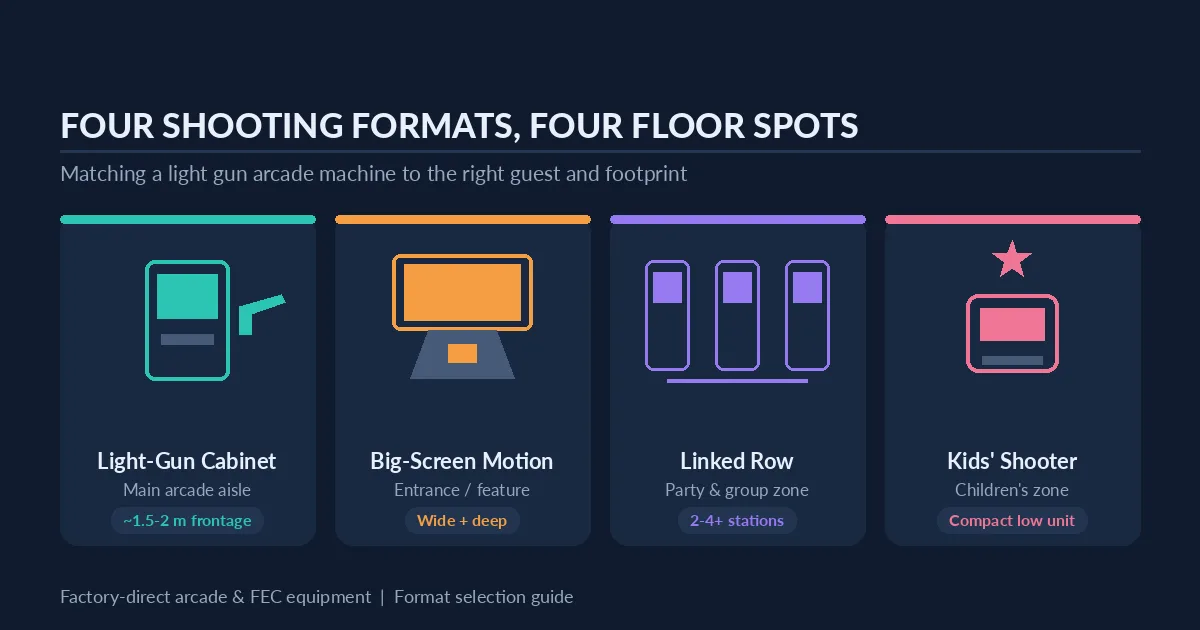
A light gun arcade machine is a coin- or card-operated cabinet where players aim a mounted or tethered gun at an on-screen target and the machine scores each hit. The category splits into four buyable formats: standard light-gun cabinets, big-screen motion shooters, linked competitive rows, and low-recoil kids’ shooters.
The word “shooter” hides those differences on a spec sheet, which is why two quotes labelled the same way can point at machines that need different floor space and serve different guests. Sorting your shortlist by format first, before price, keeps the comparison honest. You can browse the range in our coin-operated arcade shooting game machines to see how each format is built.
Compare the four shooting formats by venue and footprint
Match the format to the guest and the spot, not to the lowest quote. Light-gun cabinets suit teens and repeat arcade players in the main aisle; big-screen motion shooters earn from walk-up attention near an entrance; linked rows serve groups and parties; kids’ shooters belong in the children’s zone. The table below sorts the trade-offs.
| Format | Typical footprint | Best venue / spot | Who plays it | Watch-out |
|---|---|---|---|---|
| Standard light-gun cabinet (1–2 player) | ~1.5–2 m frontage, upright | Main arcade aisle, arcade/FEC | Teens, repeat players, pairs | Gun cables and triggers are the wear point |
| Big-screen motion shooter (42″+) | Wider and deeper; needs a sightline | Near entrance or a feature wall | Walk-up guests, groups watching | Bigger power draw; protect the spot from glare |
| Linked competitive row (2–4+ stations) | A run of the wall or a bank | FEC group/party zone | Groups, birthday parties, teams | Sell it as a group activity, not one unit |
| Kids’ shooter (low recoil) | Compact, low cabinet | Children’s zone, mall kids’ area | Young children with a parent | Keep it out of the main arcade sightline |
For the big-screen and simulator end of that table, our large-screen shooting simulators show what the wider footprint buys you, and the low-recoil units live in the kids’ shooting arcade cabinets range for the children’s zone. If you want the broad picture across all shooter types before narrowing to a format, start with our general arcade shooting games buying guide.
Light-gun cabinet vs big-screen motion shooter: which earns on your floor?
A light-gun cabinet earns from repeat players who already know the game and want a quick, competitive round in the main aisle. A big-screen motion shooter earns from attention: a 42-inch screen with strong recoil draws walk-up guests and onlookers, so it belongs near an entrance or feature spot, not a back row.
One concrete reference point from our own line: the Ultra Firepower shooter runs a 42-inch ultra-clear display with realistic recoil and a highly sensitive response, indicatively around $699–$899 EXW (first-party, not a quote; freight and duty are separate). A standard two-player light-gun cabinet costs less and takes less space, so the honest question is not “which is cheaper” but “which does this specific spot need.” A high-traffic entrance rewards the big screen; a mid-aisle slot next to your existing shooter rewards the cheaper cabinet — as long as it plays differently. For how these numbers sit against other categories, see our factory-direct price ranges by machine category.
What to check before you buy a shooting arcade game machine
Before you commit to any shooting arcade game machine, confirm the physical fit, the payment hardware, and the after-sales terms — the guns and cables are the parts that break first, so the guarantee on them matters more than the headline price. Run this checklist against every quote.
Evidence checklist
- Footprint and ceiling: measured frontage and depth for the format, plus clearance for a motion cabinet.
- Power: voltage and draw confirmed for your venue; a 42-inch motion shooter pulls more than a compact cabinet.
- Payment: coin acceptor, bill acceptor, or a card/Nayax reader — matched to how the rest of your floor takes payment.
- Guns and consumables: what the guarantee covers, and whether spare guns, cables, and triggers ship with the order.
- Content: how many game titles are included and whether they can be updated later.
Red flags
- A quote that says “shooting machine” without naming the format, screen size, or player count.
- No answer on gun and cable spares, the exact parts that wear out first in daily play.
- A kids’ shooter pitched for your main arcade aisle, where it will be outplayed by the adult cabinets around it.
Common mistakes
- Buying a second machine that plays like the first one and placing them side by side, so they split the same players.
- Putting a big-screen shooter in a dark back corner where its main asset, the screen, never draws a crowd.
- Skipping the spare-guns line to save a little up front, then losing uptime when a trigger fails on a Saturday.
FAQ
What is the difference between a light gun arcade machine and a shooting simulator?
A light gun arcade machine uses a tethered or mounted gun aimed at a standard-size screen and scores hits on video targets. A shooting simulator adds a much larger screen and often motion or a more realistic recoil feel, which needs more floor space and draws more walk-up attention.
How much floor space does a shooting arcade game machine need?
A standard two-player light-gun cabinet needs roughly 1.5–2 metres of frontage as an upright unit. A 42-inch motion shooter is wider and deeper and needs a clear sightline, and a linked competitive row needs a run of wall for several stations. Confirm exact dimensions per model before you plan the spot.
Is a gun shooting game machine for sale suitable for a children’s zone?
Use a low-recoil kids’ shooter for the children’s zone rather than a full-size adult cabinet. Kids’ units sit lower, use lighter guns, and are built for younger players with a parent nearby. A standard light-gun cabinet belongs in the main arcade aisle instead.
What after-sales support should I confirm before buying?
Confirm what the guarantee covers on the guns, cables, and triggers, since those wear first, and ask whether spare guns ship with the order. Arcade Craft Studio offers 7×24 after-sales support and can supply spare parts and English manuals; specific warranty terms are confirmed per model on your quote.
Get a format-matched shooting machine shortlist
Tell us your venue type, the spot you want to fill (main aisle, entrance, party zone, or kids’ area), the frontage in metres, and how your floor takes payment, and we will shortlist the shooting formats that fit. Send those details to request a format-matched shortlist and quote. Arcade Craft Studio is a factory-direct arcade machine manufacturer and FEC equipment supplier with OEM options and export coordination; compliance items such as CE, RoHS, and local safety approval can be coordinated and should be confirmed with your broker and local authority.