
Updated August 2026 — pricing current as of first publication; figures are indicative, not a quotation.
An FEC operator has floor space near the entrance and wants a strength attraction that pulls a crowd. The first question from the finance side is blunt: what does an arcade punching machine actually cost, and how long before it pays for itself? The answer is rarely one number. A compact boxing cabinet, a dual punch-and-kick unit, and a kids’ machine sit in different price bands, and the delivered cost depends on freight, duty, payment hardware, and options that never appear on a marketplace thumbnail.
This article compares punch machine price bands by format and shows a method for estimating earnback with your own venue numbers. Every figure below is an indicative EXW reference from Arcade Craft Studio, not a guaranteed landed cost or a promise of revenue.
Key takeaways
- Arcade punching machine price sits in bands by format: compact boxing, dual punch-and-kick, and kids’ cabinets are priced differently.
- Indicative factory pricing starts around $1,710–1,869 EXW for a standard boxing cabinet; larger or combo units are quoted per configuration.
- The sticker price is only part of the cost; freight, duty, payment hardware, and options change the delivered figure.
- Earnback is a calculation you run with your own daily takings, not a number a supplier can promise.
- Compare a written, model-specific quote against the same cost lines — never a marketplace thumbnail against a full project quote.
How much does an arcade punching machine cost?
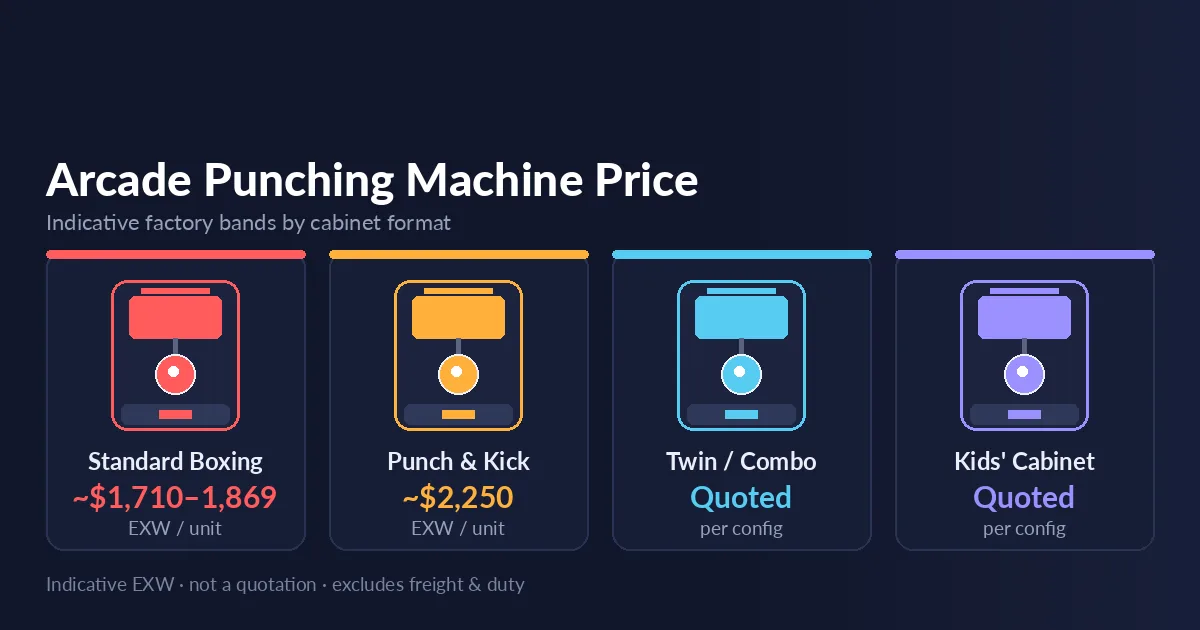
A standard commercial boxing cabinet starts around $1,710–1,869 EXW as an indicative factory reference. A dual punch-and-kick unit runs higher, near $2,250 EXW, and kids’ or custom cabinets are quoted per configuration. These are ex-works figures — freight, duty, and payment hardware are added on top and confirmed per destination.
The table below groups the common formats so a buyer can place a rough arcade punching machine price against the venue job before requesting an exact quote. Where no first-party figure exists for a format, the cell reads “quoted per configuration” rather than an extrapolated number.
| Machine format | Typical footprint | Indicative price (EXW, per unit) | Best-fit venue |
|---|---|---|---|
| Standard boxing / punch cabinet | Compact single-bay, wall-friendly | ~$1,710–1,869 | Arcades, bars, mall corners, FEC entrances |
| Dual punch-and-kick cabinet | Single-bay with kick target reach | ~$2,250 | High-traffic FECs wanting two play actions |
| Twin / combo multiplayer boxer | Wider two-station footprint | Quoted per configuration | Busy FECs and competitive group play |
| Kids’ / low-impact boxing cabinet | Smaller, lower target height | Quoted per configuration | Children’s zones and family corners |
| Custom / OEM branded cabinet | Varies with artwork and options | Quoted per configuration | Distributors and branded projects |
These bands are a planning reference, not a price list. The dual punch-and-kick figure reflects a machine with coin, bill, and card-reader payment options; a stripped or upgraded configuration moves the number. For a wider view across categories, the factory-direct price ranges by machine category put boxing cabinets next to claw, redemption, and racing units so a mixed order can be budgeted together.
What changes the price of a boxing arcade machine?
Boxing machine price moves with cabinet size, payment hardware, software and language, artwork or OEM branding, and order volume. Two machines that look identical in a photo can differ once payment systems, spare-parts kits, and export packing are specified. Confirm each line before comparing quotes.
The usual cost drivers, roughly in order of impact:
- Format and size: a dual-action or twin cabinet uses more hardware than a single boxing bay.
- Payment hardware: coin acceptor, bill acceptor, and a card system such as Nayax each add cost and must match the destination currency.
- Options and artwork: OEM branding, custom graphics, and language settings are quoted per model.
- Order volume: unit pricing usually improves when a boxing cabinet ships alongside other machines in a container.
- Delivered terms: EXW, FOB, and DDP are not the same cost; freight and duty are confirmed with your broker, not assumed.
Buyers deciding which cabinet before how much can work through the arcade punching machine buying guide for format selection, then compare vendors with the boxing arcade machine manufacturer comparison. To see the models behind these bands, browse the coin-operated boxing and punch machine range.
How do you estimate earnback on an arcade punching machine?
Earnback is the delivered cost divided by net daily takings, giving a payback period in days. No supplier can supply the takings figure — it comes from your own location, pricing, and traffic. Run the machine cost against a conservative daily estimate from your floor to see whether the payback window fits your budget.
Want to model this against a whole floor rather than one cabinet? Our free arcade and FEC ROI calculator runs the same payback arithmetic across a machine mix, using your own footfall and pricing assumptions — it is a planning tool, not a revenue promise.
A worked method, using your own numbers rather than any promised revenue:
- Delivered cost = factory price + freight + duty + payment hardware + install. Start from the indicative EXW band, then add your quoted freight and duty.
- Net daily revenue = your realistic plays per day × price per play, minus maintenance and floor cost. Use a cautious number from a comparable machine on your floor.
- Payback period (days) = delivered cost ÷ net daily revenue.
Because a punch machine has few consumables and a simple play loop, its running cost is usually low, but the revenue side is entirely location-dependent. For a fuller worked example of how coin-operated attractions pay back, the breakdown of what a coin-op machine actually earns back walks through the same math on a claw unit. Treat any payback figure as a project assumption that needs your own data.
Red flags and common mistakes when comparing punch machine prices
The most expensive mistake is comparing a marketplace thumbnail price against a full project quote. A low headline number often excludes payment hardware, export packing, freight, or after-sales coverage, the lines that decide the real delivered cost and uptime. Match quotes line by line before judging on price.
What trips up buyers most often:
- Reading an ex-works number as a landed cost, when freight and duty are separate and destination-specific.
- Ignoring payment hardware and currency fit, then paying for a retrofit later.
- Assuming a promised revenue or payback figure instead of running the numbers on the actual floor.
- Skipping the spare-parts and after-sales line, which turns a cheap machine into downtime.
- Comparing a single unit price against a container price without adjusting for volume.
On compliance items such as safety approvals, electrical standards, insurance, customs classification, and duty, Arcade Craft Studio can coordinate documentation, but the final position must be confirmed with your own broker, insurer, and local authority for the destination market.
FAQ: arcade punching machine price
Punch machine pricing depends on cabinet format, payment hardware, options, order volume, and delivered terms. The questions below separate an indicative factory reference from the delivered project cost so a buyer can budget the delivered figure, not just the sticker, before requesting a model-specific quote with freight and duty confirmed for the destination.
How much is a boxing arcade machine?
A standard commercial boxing cabinet starts around $1,710–1,869 EXW as an indicative factory reference, and a dual punch-and-kick unit runs near $2,250 EXW. Twin, kids’, and custom cabinets are quoted per configuration. All figures exclude freight, duty, and payment hardware.
Why do punch machine prices vary so much between suppliers?
Prices vary because cabinet format, payment systems, software and language, artwork, order volume, and delivered terms differ between quotes. A low headline price often excludes payment hardware, export packing, or after-sales coverage, so compare each cost line rather than the sticker number alone.
What is the cheapest arcade punching machine that still works commercially?
The entry point is usually a standard single-bay boxing cabinet from the indicative EXW band. Going below a genuine commercial build often means weaker components or thin after-sales support, which costs more in downtime. Compare the delivered cost and service plan, not only the unit price.
Can a supplier tell me how much a punch machine will earn?
No responsible supplier can guarantee venue income. Earnings depend on location, traffic, pricing, hours, competition, and maintenance. A supplier can share a payback method, but the revenue inputs must come from your own floor, so treat any earnings figure as a project assumption.
Next step: send your destination country, venue type, available floor area, payment preference, and the punch-machine format you are considering, then request a model-specific quote with freight and duty confirmed for your market. That turns an indicative band into an exact, comparable number.