
Updated October 2026 — a buyer’s guide for FEC operators and equipment importers (current as of first publication).
You signed the proforma invoice, wired the 30% deposit, and the machines have been on the line for weeks. Now the factory says the order is ready and the 70% balance is due before it ships. This is the one moment you have real leverage, and most first-time buyers waste it. Once the balance clears and the container sails, a wrong voltage, a dead monitor, or a coin door set to the wrong currency becomes a problem you are solving by courier across an ocean, weeks after your floor was meant to open.
A pre-shipment inspection is the check that happens in that gap: finished goods, at the factory, before you release the balance and before anything is loaded. It is cheap insurance against an expensive surprise. Here is what it covers, who should run it, and the checklist to work from.
Key takeaways
- A pre-shipment inspection checks the finished order at the factory before you pay the balance — the point where faults are still cheap to fix.
- Inspect against your signed spec: model, voltage and plug, payment system, language and currency, branding, and payout settings.
- Confirm every machine has been powered on and run, not just assembled and boxed.
- You have three routes: the factory’s own QC with photo and video evidence, a third-party inspection agency, or your own visit.
- Get the result before the balance moves. After the container loads, your leverage is gone.
What is a pre-shipment inspection for arcade machines?
A pre-shipment inspection is a check of your finished order at the factory, after production and before the container is loaded, confirming the machines match your signed spec and actually work. It catches wrong configurations, cosmetic damage, functional faults, and packing problems while they are still the factory’s to fix at no cost to you.
It is a different step from the readiness work you do before ordering. The logistics side, covered in our guide to the import and landed-cost process, is about Incoterms, HS codes and freight. This is the quality side: did the factory build the right machines, and do they run? The two checklists do not overlap, and skipping this one is how a container of the wrong units ends up on your dock.
Why the pre-shipment gate matters more than any later check
The pre-shipment gate matters because of when it falls in the payment schedule: the 30% deposit and 70% balance structure puts the inspection at the exact moment the factory most wants your money and you still hold it. Problems found now are fixed on the factory’s clock; problems found after delivery are fixed across an ocean.
Problems caught on the line are fixed there, on the factory’s clock. The same fault found after delivery is fixed by shipping parts, or whole cabinets, back and forth.
The cost gap is not small. A machine earning, say, $2,000 a month is roughly $67 a day of lost takings while it sits dead waiting on a part. A unit that arrives with the wrong voltage cannot even be switched on until you source a converter or a replacement board. Multiply either across a mixed container and a single skipped check can cost more than the inspection, the fix, and the delay combined. The buyers who get burned are almost always the ones who treated “ready to ship” as the same thing as “built correctly.”
Your arcade machine pre-shipment inspection checklist
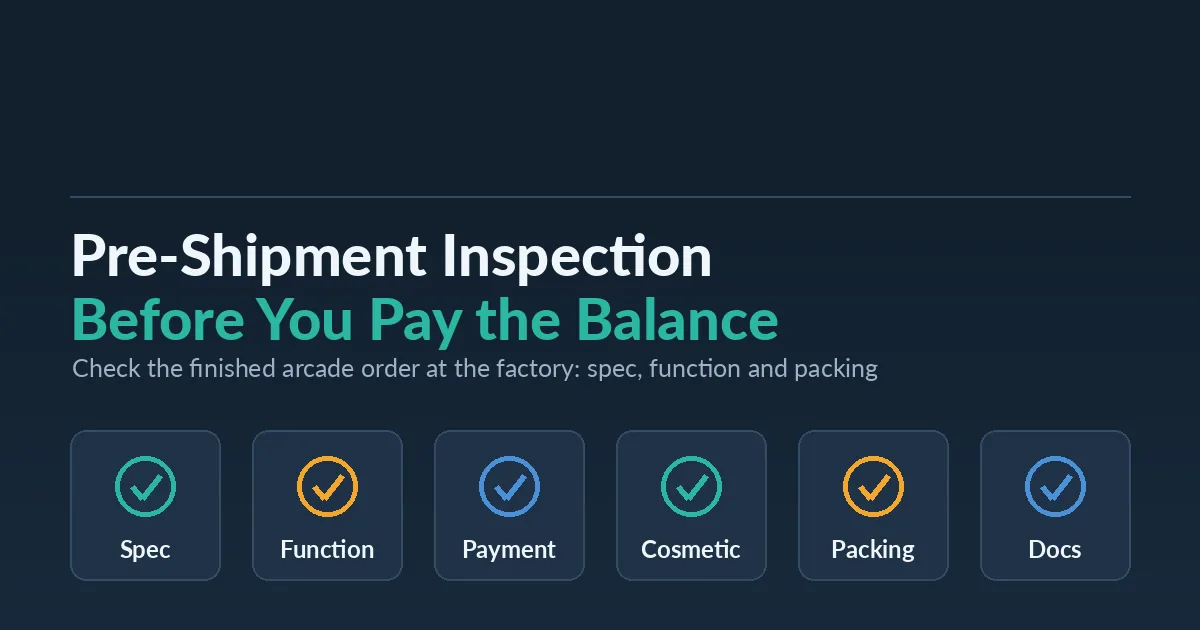
Work through these six groups, or have whoever inspects for you work through them, on the finished order before the balance is released. Ask for photos and video of your actual units, not catalog images or a sample from a previous batch.
1. Spec and configuration
- ☐ Correct model and quantity per model, matched line by line to the proforma invoice.
- ☐ Voltage and plug type set for your destination market, not China’s 220V default.
- ☐ Payment system fitted as ordered: coin, bill, or card, reading the right currency.
- ☐ On-screen language and price display set for your market.
- ☐ Branding, artwork and cabinet colour match the approved proof (for a custom or OEM run).
- ☐ Difficulty and payout settings as agreed, with payout rules checked against your local law.
2. Function and burn-in
- ☐ Every machine powered on and a full game played start to finish — no reboots, freezes, or error codes.
- ☐ Monitor checked for even brightness, dead pixels, lines, or colour shift.
- ☐ Motion, hydraulics or seat movement run on rides and simulators, with the emergency stop confirmed working.
- ☐ The order has been through an aging or burn-in run, not just switched on once at the end of the line.
3. Payment and redemption hardware
- ☐ Coin, bill and card acceptors register every credit, with nothing sticking or double-counting.
- ☐ Ticket dispensers, hoppers and sensors count and pay out accurately — these wear fastest and fail first.
4. Cosmetic and cabinet
- ☐ No scratches, dents, cracked acrylic, or panel gaps on the finished cabinet.
- ☐ Wiring tidy and secured, with no exposed splices.
- ☐ Serial or ID label present and readable on each unit for later parts and warranty claims.
5. Packing and loading
- ☐ Export-grade crating or wooden cases, not thin cartons, for an ocean voyage.
- ☐ Corners, screens and protruding parts padded; fragile machines marked.
- ☐ Carton or crate count and dimensions match the packing list and the booked container.
6. Documents and accessories
- ☐ English manuals, install guides and any 3D install video included.
- ☐ Agreed spare-parts kit packed and counted.
- ☐ Keys, power cords, and market-specific adapters in the box.
Factory QC, third-party inspection, or your own visit?
You have three ways to run the gate, and they trade cost against independence. The factory’s own QC with photo and video evidence is free and fine for a trusted repeat supplier. A third-party agency gives you an independent report for a fee. Your own visit gives you the most certainty and costs the most in time and travel.
Match the choice to the order’s size and the supplier’s track record.
| Who inspects | What you get | Best for | Watch-out |
|---|---|---|---|
| Factory QC + evidence | Photos and video of your units powered on, plus the factory’s test records | Repeat orders with a supplier you already trust | Ask for footage of your serial-numbered units, dated, not stock clips |
| Third-party agency | An independent inspector on site and a written report against your checklist | A first order, a large container, or a high-value custom run | Brief the agency with your spec sheet — a generic “AQL” check misses wrong voltage or currency |
| Your own visit | You see and play the machines yourself before releasing the balance | Flagship or anchor machines, or a new long-term supplier | Time the trip to when the full order is built, not mid-production |
For a first deal with a new factory, an independent third-party inspection is the cheapest peace of mind for the money. Once a supplier has shipped you several clean orders, dated photo and video evidence of your own units usually does the job. Either way, a factory that resists being inspected at all is telling you something: the quickest way to pressure-test that is to run it through how to vet an arcade machine supplier before you ever pay a deposit.
What a factory’s own QC should already cover
Your inspection is a check on top of the factory’s process, not a replacement for it. A capable manufacturer tests every unit well before you or an agency look, so ask what that process is and to see the records behind it. At Arcade Craft Studio the order passes three raw-material inspections (at the supplier, at the supplier’s factory, and again in our own workshop), then a 48-hour maximum-load test and a 72-hour aging run before anything is packed. Each machine carries a unique ID label for traceability, and packing follows a fixed SOP down to the board and screw.
That is the standard your own check is confirming, not creating. A supplier who can describe a process like this, and show you records from it, is a very different proposition from one whose answer is “we test everything, don’t worry.” If you are also still choosing between a new build and a second-hand unit, the inspection logic flips for used gear — our guide on how to inspect a used arcade machine before you buy covers the point-of-sale checks that matter there instead.
Red flags and common mistakes
The fastest way to lose the protection this gate gives you is to release the balance before you have seen the result.
A supplier who pushes for full payment against a “ready” email with no inspection evidence, who sends stock photos instead of your dated units, or who cannot produce a packing list that matches the container has given you a reason to slow down, not speed up.
The mistakes we see most often:
- Paying the balance on the word “ready.” Ready to ship is not the same as built to spec. Tie the balance to a passed inspection, written onto the proforma invoice.
- Inspecting assembly, not operation. A boxed machine tells you nothing. Insist every unit was powered on and run.
- Forgetting the config details. Voltage, currency and language are the quiet faults that pass a visual check and strand a machine on arrival.
- Skipping the packing check. A machine that passes every functional test still arrives cracked if it travelled an ocean in a thin carton.
- No plan for a fail. Agree in advance what happens if the inspection fails — rework timeline, re-inspection, and that the balance waits until it passes.
FAQ
When should an arcade machine pre-shipment inspection happen?
After the full order is built and before you pay the 70% balance or load the container. That timing is the whole point: it is the moment you still hold payment, so any fault the inspection finds is corrected on the factory’s clock rather than yours, an ocean away.
Do I need a third-party inspection or is the factory’s QC enough?
For a first order with a new supplier, or a large or high-value custom container, an independent third-party inspection is worth the fee. For repeat orders with a factory that has shipped you clean before, dated photo and video evidence of your own powered-on units usually suffices. Match the rigour to the risk.
What should I check before paying the balance on arcade machines?
Confirm the model and quantity against the proforma invoice, the voltage, plug, currency and language for your market, that every unit powers on and plays a full game, that payment and ticket hardware works, that the cabinets are undamaged, and that packing is export-grade and matches the packing list.
Can Arcade Craft Studio provide inspection evidence before shipment?
Yes. We can send photos and video of your actual units powered on at the quality-control and aging stage, and we welcome a third-party inspector or your own visit. We will also tell you plainly what we can and cannot certify for compliance; final CE, RoHS, insurance and customs positions should be confirmed with your own broker, insurer, or local authority.
Lock the inspection into your order
The buyers who never receive a bad container are the ones who make a passed inspection a condition of the balance payment, written on the proforma invoice from the start. Tell Arcade Craft Studio your models, destination market, and whether you want factory evidence, a third-party inspector, or your own visit, and send those details to set up your order and inspection plan. As a factory-direct manufacturer, we build, test and ship under one roof, and we are glad to be checked before the balance moves. If you are still weighing OEM or branding, a custom order adds an artwork and sample sign-off you will want on the same gate.