
Updated July 2026 — current as of first publication.
You have signed a lease on a 60 m² corner unit in a shopping mall, and the plan is a prize zone: a short wall of claw cranes, a couple of gift machines, and a prize counter. The trouble starts the moment you search “commercial claw machine for sale” and get thousands of listings that look identical in the photo. A $600 unit and a $2,400 unit can share the same render. What separates them sits under the window — and it decides whether your crane pays for itself or jams on a Saturday afternoon.
Key takeaways
- A true commercial claw machine has an adjustable payout cycle, an industrial claw motor, and a steel cabinet; a consumer “toy” crane carries none of these.
- Match the machine type to the floor: compact single cranes for kiosks and gift stores, jumbo or multi-player cranes for FEC prize zones, gachapon and prize-vending for impulse corners.
- Placement moves plays per day more than the cabinet does. Cluster cranes where people already queue, wait, or pass on the way out.
- Payout-rate settings are a compliance question in some markets — confirm the rules with your own local regulator before you fix a win frequency.
- Factory-direct pricing starts near $950 (EXW) for a compact 60-jaw crane; freight and duty land on top, so budget the landed cost, not the sticker.
What to look for in a commercial claw machine for sale
A commercial claw machine for sale should carry three things a home unit never does: an adjustable payout cycle you can set without opening the cabinet, an industrial-grade claw motor with thermal protection, and a heavy-gauge steel frame. Miss any one and the machine is a toy that will not survive a busy floor.
Work through these before you place an order, because they are the specs that separate a two-year earner from a warranty headache:
- Adjustable payout control. Every serious crane lets the operator set how often the claw grips at full strength. If a listing cannot tell you how payout is configured, it is not built for commercial use.
- Claw motor and grip mechanism. An industrial motor with thermal protection holds up under 100+ plays a day; a consumer motor overheats and drops grip. Ask what the motor is rated for.
- Cabinet build. Heavy-gauge steel around the door hinges and base corners, with toughened glass — not sheet metal and acrylic that flex when a frustrated player leans on them.
- Payment stack. Coin acceptor is the floor. A bill acceptor calibrated to your currency and a card reader (many operators run a Nayax terminal) each add a line to the invoice, and card-capable machines reach players who carry no coins.
- Voltage and parts. A 110V/220V switchable unit travels across markets. Before you pay, ask the prize machine supplier one blunt question: can you ship a replacement control board within two weeks? Hesitation there is a downtime cost you will pay later.
Specs decide durability; earnings are a separate calculation. For the revenue side of the same machine (plays per day, prize cost, and payback), see our breakdown of what a claw machine actually earns back.
Claw, prize and gift machine types: which one fits your floor
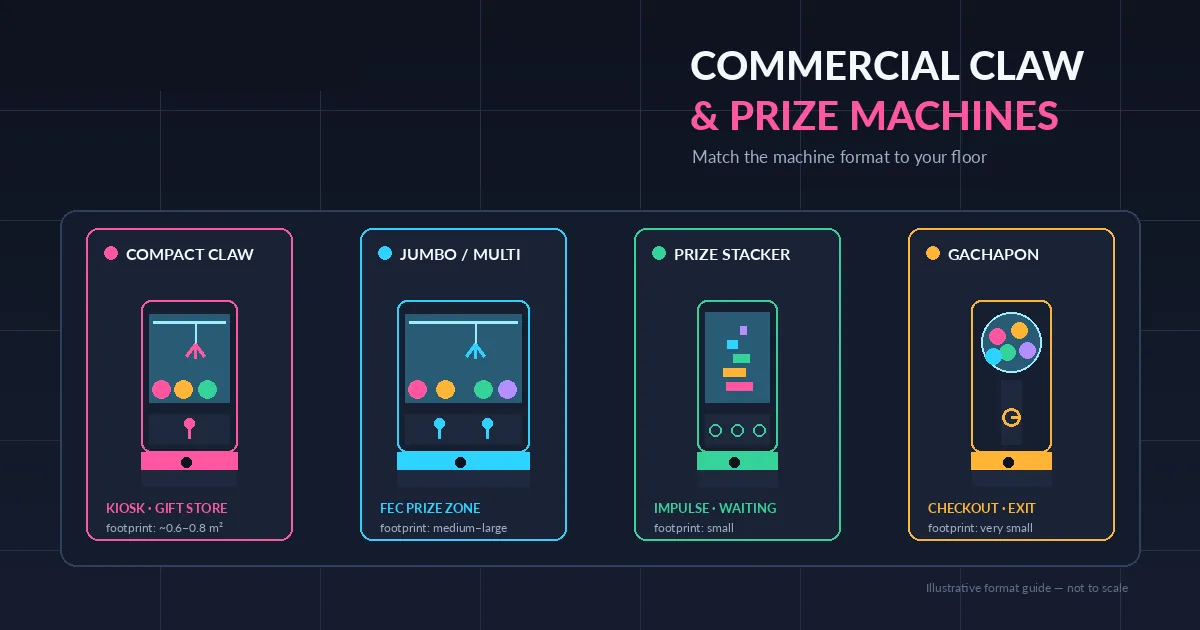
Claw and prize machines split into a handful of formats, and each earns best in a different spot. Compact single-player cranes suit kiosks and gift stores; jumbo and multi-player cranes anchor FEC prize zones; gachapon capsule machines and prize-vending stackers fill impulse corners near exits, queues and checkouts. Pick the format for the location, not the other way around.
| Machine type | Best-fit venue | Typical footprint | What to check before you buy |
|---|---|---|---|
| Compact single-player claw crane (60-jaw) | Gift store, mall kiosk, café corner | Small — roughly 0.6–0.8 m² | Payout control, coin + card payment, one-key setup |
| Jumbo / large-window claw crane | FEC prize zone, mall anchor spot | Medium to large | Prize-window size vs. plush you plan to stock; lighting and sightline |
| Multi-player / linked claw crane | High-traffic FEC, cinema lobby | Medium per station | Linked-play mode, independent payout per station |
| Prize-vending / stacker (e.g. block stacker) | Impulse spots, waiting areas | Small | Number of prize positions; how skill vs. chance reads in your market |
| Gachapon / capsule machine | Checkout, exit, kids’ area | Very small | Capsule size, refill access, coin mech |
A concrete anchor: a single-player 60-jaw claw crane is the workhorse of this category, with one-key operation, a small footprint, and the lowest entry price. From there you scale up to jumbo cranes for a prize-zone centrepiece or add prize-vending stackers to catch impulse plays. You can browse the formats side by side in our range of commercial claw crane machines and the wider claw, prize and gift machine range.
Sizing and placement: match the machine to the venue
Placement moves plays per day more than any spec on the cabinet. A crane near an entrance, a food court, or a queue consistently outperforms the same machine at the back of the room. Size machines to the floor first, then cluster them where people already wait, so a visible win pulls the next player in.
Three common scenarios, and how the sizing usually falls out:
- Mall kiosk or gift store (under 40 m²): two to four compact single-player cranes plus a gachapon or two. Keep the footprint tight and the glass visible from the aisle.
- FEC prize zone: a cluster of six to ten cranes mixing compact and jumbo, anchored by a large-window centrepiece, with the prize counter in sight so tickets and plush stay top of mind.
- Cinema lobby or waiting area: a short row of multi-player or linked cranes where groups gather before a session — dwell time is already there, so give it something to do.
The visual density of a cluster is what drives impulse plays; a lone crane against a back wall rarely earns its floor space. If you are still mapping zones, our guide to where prize machines belong on an FEC floor plan works through guest flow and sightlines in more detail. For the buying decision itself, see which prize machine for sale earns most in each venue.
Payout rate and prize rules: set it right, stay compliant
Every commercial claw machine lets the operator set how often the claw grips at full strength: the payout cycle. Many operators run it between one win in six plays and one in ten, tuned to prize value. Whether an adjustable-payout crane counts as a skill game or a regulated amusement depends on where it stands.
That distinction is a legal one, not something a supplier decides for you. Some jurisdictions treat adjustable-payout cranes as amusement-with-prize machines with their own rules on win rates, prize value caps, and permits; others treat them as pure skill games. We can supply machines with the payout controls your market expects and coordinate the export paperwork, but the win-rate and prize-value rules that apply to your venue are something to confirm with your local gaming or trading-standards authority before you open — not to read off any manufacturer’s guide, including this one.
On the money side, price a claw machine next to what it earns, never in isolation. Many operators aim to keep prize cost near 15–20% of play value, and the factory sticker is only the start. For how claw and gift machines sit against other categories, see current claw and gift machine price ranges by category, then budget freight and duty on top and confirm duty and HS classification with your own customs broker.
Red flags and common mistakes when buying claw machines
The cheapest listing has usually had something removed — the payout board, the card reader, a gauge of steel, or the spare parts. A crane that looks identical in a photo can be a different machine once its motor is cycling 150 times a day on a busy floor. Watch for the gaps that only surface after payment clears.
Red flags worth a second look:
- A price with no Incoterm attached — “$700” means nothing until you know whether it is EXW, FOB, or delivered.
- A quote that omits the payment device, then adds the bill acceptor or card reader once you have committed.
- Refurbished boards or worn claw mechanisms presented as new. Ask directly which components are new.
- No answer on adjustable payout — a fixed-payout crane removes your single most important operating lever.
- No spare-parts line and no support hours. Uptime is a cost you either budget or absorb.
Common mistakes first-time buyers make:
- Ordering one big jumbo crane instead of a cluster of smaller ones, when density earns more than size.
- Buying coin-only in a card-first market, then discovering the machine cannot take the payment most players carry.
- Stocking prizes that do not match the age range in front of the machine, which quietly kills play frequency.
- Skipping the compliance check on payout rules and prize value for the destination market.
FAQ
How much does a commercial claw machine cost?
A compact single-player 60-jaw claw crane starts around $950 factory-direct on EXW terms. Jumbo, large-window and multi-player cranes cost more and are quoted per configuration, because cabinet size, lighting, and the payment devices you spec all move the number. Freight and duty are additional, so budget the landed cost.
What is the difference between a commercial and a home claw machine?
A commercial claw machine has adjustable payout control, an industrial claw motor with thermal protection, a steel cabinet, and commercial payment options. A home or “toy” crane has none of these — it is built for a few plays a week, not a hundred a day, and will not hold up on a paying floor.
Can you adjust how often a claw machine wins?
Yes. Commercial cranes let operators set a payout cycle, meaning how often the claw grips at full strength, usually accessible without opening the cabinet. Operators tune it to prize value. Whether you may set a given win rate depends on local rules, so confirm the position with your regulator before you fix it.
What size claw machine is best for a small shop or kiosk?
A compact single-player 60-jaw crane. It takes roughly 0.6–0.8 m², runs on one-key setup, and gives you payout control and coin-plus-card payment in the smallest footprint. Two to four of them, kept visible from the aisle, suit a gift store or mall kiosk better than one large cabinet.
How many claw machines should a new prize zone start with?
A cluster of three to six is the most reliable starting layout, scaling to eight or ten for a larger FEC prize zone. Visual density drives impulse plays, since a player who sees someone win is more likely to try, which a single crane against a wall cannot reproduce.
Request a claw machine quote for your venue
The right machine mix depends on your floor, not a catalogue. Send Arcade Craft Studio three things: your venue type, floor size, and the prize mix you have in mind, and request a claw machine quote for your venue. As a factory-direct arcade machine manufacturer and FEC equipment supplier, we can return an itemized figure with the payment devices, payout configuration, and loading plan shown as separate lines, and coordinate the export documentation while you confirm the payout rules with your local authority.
Free planning tool
Will your prize zone pay off?
Enter your venue size, budget and visitor assumptions — get a machine mix and payback model in about a minute.