
Updated August 2026 — current as of first publication.
You have signed the lease on a mall unit, and one corner is already spoken for: the spot near the entrance where parents with strollers will slow down. That is the kids zone, and it needs to earn its rent from toddlers who cannot read a screen and from a six-year-old who wants to “drive.” Picking the right machines for that corner is a different job from stocking the teen arcade, and it is the part most first-time operators underspend or overspend on. This guide walks a buyer through choosing kiddie rides for sale by age band, footprint, and venue, so the corner pays instead of just filling space.
Key takeaways
- Buy by age band first. A machine that thrills a five-year-old often frightens a toddler, and one that a toddler loves bores an older child. Map your machines to the ages your venue actually draws.
- Footprint and floor flow matter more than headline price. Ride-on cars and train rides need clear run-out space; mini prize machines earn from a wall or aisle end.
- A parent standing nearby is a paying customer too. Sightlines, seating, and low noise keep the adult happy while the child plays and replays.
- Confirm voltage, safety marking, and spares before you wire payment, not after the container lands.
- Mix “ride” income with “prize” income. Coin-op rides sell a single experience; mini claw and gift machines add repeat spend from the same family.
What counts as a kiddie machine, and who buys them
Kiddie machines are the small, low-intensity, coin- or card-operated units built for children roughly aged one to ten: ride-on animals and cars, coin-operated kiddie cars and trains, spinning or robot rides, mini claw and gift machines, and simple interactive games. Buyers are FEC operators, indoor playground owners, and mall play-zone tenants who need a family draw near the entrance.
The category is broad on purpose. In our own catalog a “kids” corner might combine a ride-on unit like the Space Rabbit or Deer coin-operated ride, a themed car such as the Liantya Elephant Bus, a two-seat train like the Kiddie Castle Train, and a low, easy-win prize machine so the visit ends with a small toy. Each does a different job, and that is the point: you are building a short loop a young family can complete in a few minutes and repeat.
How to choose kiddie rides for sale by age band and venue
Choose kiddie rides for sale by matching three things: the child’s age, the space you have, and the type of venue. Toddlers (about one to three) want gentle motion and a seat a parent can reach into. Preschoolers (three to six) want to “operate” something. Older children (six to ten) want a game with a score or a prize.
Fit the machine to the age you actually see, not the age you hope for.
Venue changes the answer as much as age does. A mall kiosk with a tight floor leans toward single ride-on units and a wall of compact gift machines, because every square meter is visible and rented by the month. A dedicated indoor playground can carry larger amusement park electric cars and a small track, because it already sells time-based entry and wants dwell. A bowling or family entertainment center usually wants a self-contained kids corner that keeps young children safely away from fast racing and shooting cabinets while parents stay in sightline.
Two practical rules keep the corner working. First, keep the loudest, fastest-motion rides away from the toddler seating so a nervous two-year-old is not scared off before the parent inserts a coin. Second, place at least one low, high-win-feel prize machine at child height, so the visit ends on a reward and the parent hears “again.”
Kiddie machine types compared: age fit, footprint, and where they earn
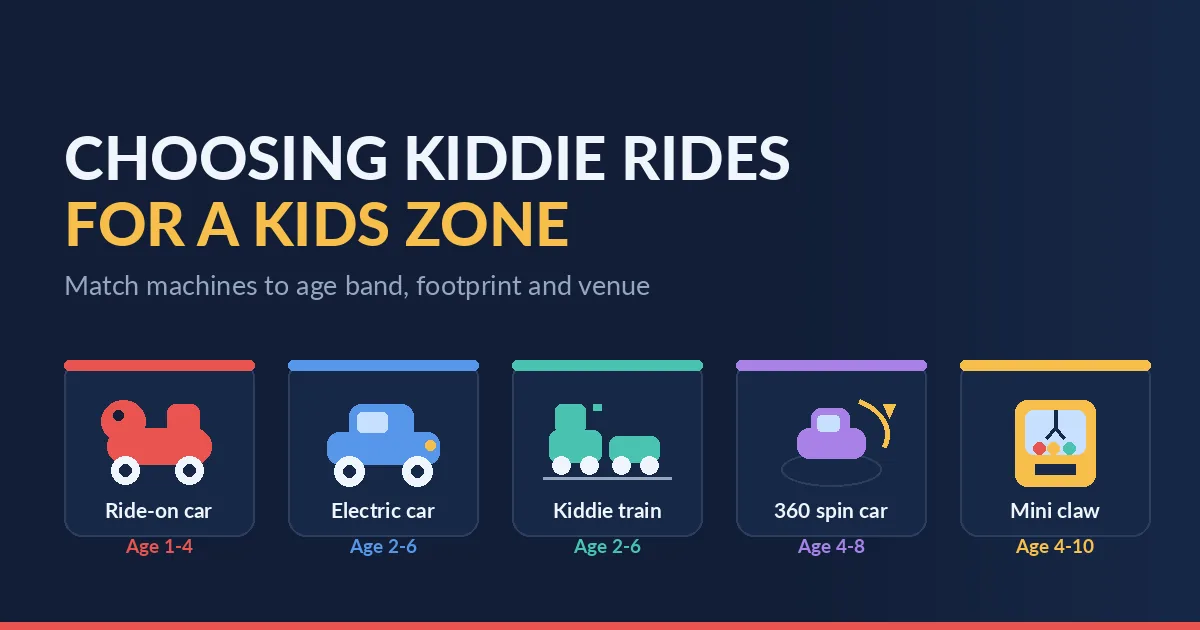
The main kiddie machine types are coin-op ride-ons, amusement park electric cars, kiddie trains, spinning cars, mini claw or gift machines, and simple toddler games, each suited to a different age band and footprint. Use this table as a starting shortlist, then confirm exact dimensions and power on the spec sheet for each model, because footprints vary widely between a single ride-on and a multi-seat train.
| Machine type | Best age band | Rough footprint | Where it earns | Buying notes |
|---|---|---|---|---|
| Coin-op ride-on (animal, car, bus) | 1–4 | Small, single unit | Mall kiosk, playground entrance, waiting areas | Low staff load; check seat belt/bar and music volume |
| Amusement park electric car | 2–6 | Medium; needs run-out space | Indoor playground, larger FEC kids zone | Confirm battery/charging vs mains, floor grip, and a defined driving area |
| Kiddie train / track ride | 2–6 | Large; linear layout | Playground, mall event space | Plan the loop and barriers; higher setup, strong photo draw |
| 360 rolling / spinning car | 4–8 | Small–medium | FEC kids zone, arcade edge | Popular search item; verify safe rotation limits and restraints |
| Mini claw / gift machine (child height) | 4–10 | Small, wall or aisle end | Every venue; ends the visit on a prize | Set an honest, easy win feel; stock prizes families recognize |
| Simple interactive / toddler game | 2–6 | Small | Playground, kids party area | Choose wipe-clean surfaces and no small loose parts |
The 360 rolling car sits in the sweet spot for a 4–8 crowd on a small footprint, and it is one of the most searched kids units buyers ask us to quote — see the 360 rolling car and coin-operated kiddie car models we build for footprints, rotation limits and restraint options.
What to check before you buy: safety, power, and operation
Before you pay, confirm four things on every kiddie machine: electrical fit for your country, physical safety features, payment hardware, and spare parts. Kids machines are handled hard by their smallest users, so durability and simple restraints matter more here than in an adult cabinet. Get these in writing on the proforma, not verbally.
Use this pre-order checklist:
- Voltage and plug: confirm the unit is built for your mains (110V or 220V) and destination plug, or specify it before production.
- Restraints and edges: seat belt or safety bar where relevant, rounded edges, no accessible pinch points or small loose parts.
- Safety marking and standards: ask which markings a unit carries (for example CE) and confirm what your own market and insurer require. We can coordinate documentation, but the applicable safety standard for a children’s ride is something to confirm with your local authority and insurer, not something a supplier should decide for you.
- Payment: coin, bill, or card/QR reader matched to your currency and your card system.
- Spare parts and manuals: a first spares kit (coin mechanism, buttons, a spare motor or belt where relevant) and an English manual, ordered with the machine.
- Cleaning: wipe-clean surfaces, since kids seats get sticky and get inspected by parents.
Common mistakes operators make with kids zones
The most common mistake is buying for the wrong child. Operators fall for a big, exciting ride that photographs well but suits a six-year-old, then wonder why the stroller crowd walks past. A close second is ignoring the parent: no seat, poor sightlines, or a machine so loud they want to leave. Kids play again when the grown-up is comfortable staying.
Other recurring errors: crowding ride-on units so children collide on the way in and out; setting mini claw machines so hard that families give up after one try, which kills repeat spend; and buying a mismatched jumble of themes so the corner looks like a warehouse instead of a small world. A tight, well-themed set of four to eight machines usually outperforms a random dozen. If the corner sits inside a larger floor, plan it into the overall arcade floor layout and guest-flow plan from the start rather than wedging it in afterward.
Frequently asked questions
What is the best age range to plan a kids zone around?
Plan around the ages you actually draw. Most indoor kids zones center on roughly two to eight years old, then add a couple of toddler ride-ons at the young end and one or two prize machines at the older end so siblings of different ages all have something.
How many kiddie machines should a small mall kiosk start with?
A compact kiosk often starts with four to eight units: two or three coin-op ride-ons, one themed car or spinning ride, and one or two child-height gift machines. Keep the mix tight and visible rather than overcrowding a small footprint. Confirm exact dimensions per model before you commit the space.
Are children’s arcade machines and coin-op kiddie cars safe for toddlers?
Units built for toddlers use gentle motion, restraints, and rounded edges, but “safe enough” depends on your market’s rules and your insurer. Ask which safety markings each unit carries and confirm the requirements for children’s rides with your local authority and insurer before you open.
Do kiddie rides run on batteries or mains power?
It varies by type. Fixed ride-ons and gift machines usually run on mains; some amusement park electric cars use rechargeable batteries. Confirm the power setup, and the voltage and plug for your country, before production so you are not adapting hardware on site.
Can I order kids machines with my own branding?
Often yes. Factory-direct suppliers can typically customize colors, theming, and branding on many kids units through OEM production. Ask for the minimum order and lead-time implications for custom work when you request a quote.
Plan your kids corner with a supplier who builds the floor
If you are choosing kiddie rides for sale for a new kids zone, tell us the venue type, your floor size, the age range you draw, and your destination port and currency. Arcade Craft Studio is a factory-direct arcade machine manufacturer and FEC equipment supplier, and we can map a kids-corner machine mix to your space, arrange OEM branding, and coordinate export. Browse the children’s game machine range, the coin-operated kiddie ride line, and the amusement park electric cars, look at examples like the carnival duck game and the tide house small claw machine, check indicative pricing in our arcade machine cost guide, and then send us your kids-zone floor size and age range for a machine-mix quote.