
Updated August 2026 — current as of first publication.
You are two weeks from opening a 500-square-meter family entertainment center, and one line item keeps getting pushed to “later”: how guests actually pay. Coins are simple to picture, but you have watched a rival’s staff burn the last hour of every Saturday emptying hoppers and counting change while a queue builds at the prize counter. A card or tap system across the floor sounds cleaner, but it adds hardware to every cabinet and a management server behind them. Decide it before the container ships: retrofitting a payment layer onto machines already bolted down is the expensive way to learn the lesson.
This guide walks through what an arcade card system is, how coins, cards and app payment compare for a real venue, what the management software behind a cashless floor actually controls, and what to confirm before you order.
Key takeaways
- An arcade card system replaces coins with a tap card or wristband that guests top up once and spend across every machine, backed by management software that tracks each play.
- The real payoff is not novelty: it is fewer coin-handling hours for staff and a faster path from “walk in” to “first play” at peak.
- Coins, cards and app payment are not all-or-nothing. Many floors run a card system as the spine and keep a few coin or contactless machines at the edges.
- Card readers, a top-up kiosk and the management server are separate line items — spec them with the machines, not as an afterthought.
- Payment security and local rules sit with your payment processor and regulator, not your machine supplier. Confirm them for your market before you commit.
What is an arcade card system?
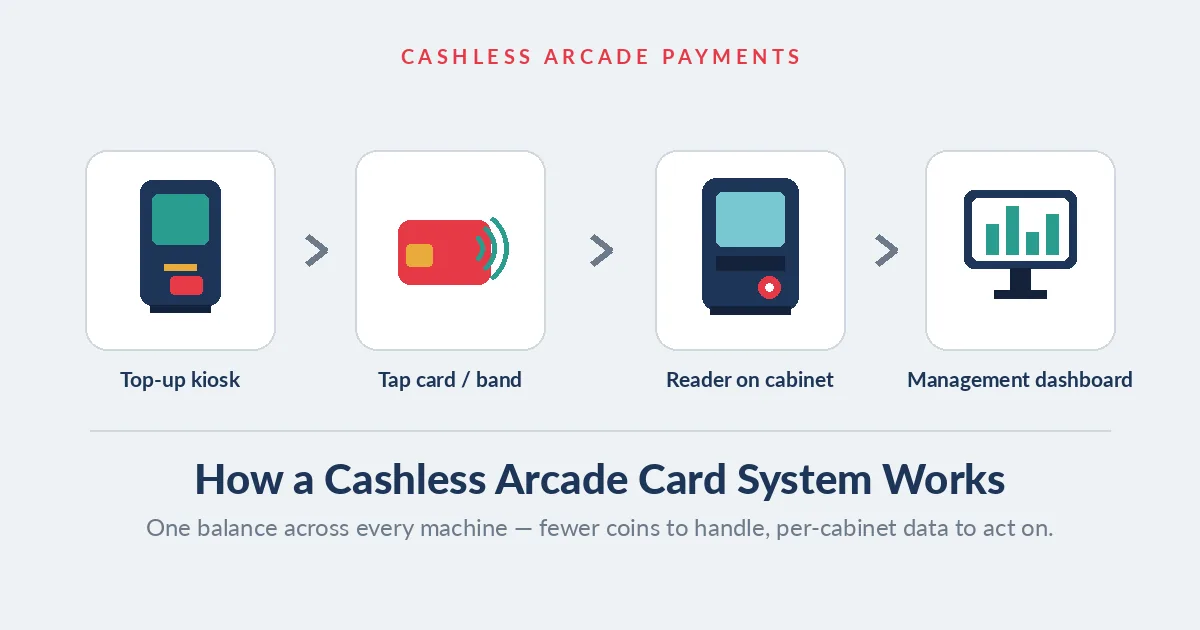
An arcade card system is a cashless payment method where guests load credit onto a tap card or wristband at a kiosk, then spend it by tapping a reader on each machine. Behind the cards sits management software that records every top-up and play, so pricing and reports run from one place, not a coin box.
In practice it has three parts. Guests hold a rewritable RFID card or band. Every cabinet carries a reader in place of, or alongside, its coin and bill acceptors. And a management server ties them together, so a play on the racing machine and a top-up at the kiosk land in the same account. On our machines the reader lives where the coin acceptor, bill acceptor or a Nayax terminal would normally go, which is why the payment stack is a decision you make per cabinet at order time rather than a switch you flip afterward.
Coins vs. cards vs. app: which payment model fits your venue?
There is no single right answer: coins suit small or low-staff sites, a card system suits mid-to-large family venues that want throughput and reporting, and app or contactless suits operators whose guests expect to pay by phone. Most large floors run a card system as the backbone, with a few coin or contactless units at the edges.
Match the model to how your floor actually runs, not to what looks most modern in a brochure. The table below lays out the trade-offs operators weigh most often.
| Payment model | Best fit | Upside | Trade-off |
|---|---|---|---|
| Coins / tokens | Small arcades, street-front sites, single-operator venues | Lowest upfront hardware; guests understand it instantly; no server to maintain | Heavy cash handling; theft and jam risk; no per-machine data |
| Card / wristband system | Mid-to-large FECs and family zones | One balance across the floor; remote pricing; play-level reporting; less cash on site | Reader on every cabinet plus a kiosk and server; staff training; upfront cost |
| App / contactless | Venues whose guests expect phone payment; brand-led operators | No card to print or lose; loyalty and top-ups from a phone; modern feel | Depends on connectivity and a processor; onboarding friction for some guests |
| Hybrid | Most floors, in reality | Card spine for the main floor, coins or contactless where they fit | Two systems to reconcile; plan the split before ordering |
The hybrid row is where most real venues land. A card system runs the ticket core and the impulse wall, while a coin-op novelty or a standalone contactless kiosk sits at the edge. If you are still deciding the machines themselves, the payment device is one of the variables that moves each machine’s factory price, so weigh the two together.
What an arcade management system controls
An arcade management system is the software layer behind a card floor. It sets and changes prices per machine or per zone, tracks earnings and play counts by cabinet, manages guest balances and refunds, runs promotions and loyalty, and produces the reports that tell you which machines earn and which sit idle.
The reason operators move to it is rarely the cards themselves. It is what the software removes. Without it, changing a price means visiting each cabinet; with it, you adjust a happy-hour rate for the whole floor from a back-office screen. Without it, “which machine underperforms” is a guess; with it, it is a report. That reporting is also why a management system pairs naturally with planning your redemption machine mix — once you can see per-cabinet earnings, you can rebalance the mix on evidence instead of instinct. Explore the readers, kiosks and controllers in our arcade card systems and management accessories range.
How a cashless system changes throughput and staff load
A cashless card system mainly changes two things at peak: it shortens the path from arrival to first play, and it cuts the hours staff spend handling coins. Guests top up once and roam, instead of feeding change into each machine, and staff stop emptying hoppers and counting cash — time that moves to hosting, the prize counter and the floor.
Both effects show up hardest on your busiest Saturday, which is exactly when they matter. A guest who taps a pre-loaded card starts playing in seconds; a guest hunting for coins or a change machine does not, and that gap is where entrance queues form. On the back end, coin handling is quiet, constant labor — collection, counting, reconciliation, jam clearing — that a card floor largely removes. Where the card system does not solve the queue by itself is the prize counter, which stays a bottleneck unless the layout gives it room; that is a floor-plan problem, and where the counter and kiosks sit in your floor plan decides whether the throughput you gained at the entrance survives to redemption.
What to confirm before you order an arcade card system
Before you commit to a card floor, confirm the reader is fitted to every cabinet, that pricing and reports are operator-controlled, that the kiosk and server are quoted as their own lines, and that payment security and local rules are settled with your processor and regulator. It only works if every machine speaks to it and the numbers reconcile.
Evidence to collect from any supplier:
- Which cabinets ship with a reader pre-installed, and what it costs to add one to a model that does not.
- Whether the reader coexists with a coin or bill acceptor, for a hybrid floor.
- Who owns the management software, whether it runs on-site or in the cloud, and what happens to your data if you change supplier.
- How the system behaves in an internet outage — does the floor keep running offline?
- Card and reader supply: cost per card, reader spares, and lead time on replacements.
- A written spec for the kiosk and server as separate line items, not bundled into a vague “system” price.
Red flags: a “cashless system” quoted as one number with no breakdown of readers, kiosk and server; software with no offline mode on a floor with unreliable internet; a proprietary platform that locks your earnings data in if you ever switch supplier; readers quoted for the hero machines but silently omitted from the cheaper cabinets.
Common mistakes: treating the card system as a phase-two upgrade, which means re-fitting every cabinet later; forgetting the top-up kiosk and change-of-plan hardware in the opening budget; and assuming the machine supplier settles payment compliance for you. On that last point, card-payment security follows standards such as the PCI Security Standards Council framework, and whether and how they apply to your setup is a question for your payment processor and local regulator — not something any equipment supplier should decide on your behalf. We can coordinate the hardware and integration; the merchant account, data handling and local licensing are yours to confirm for your market. Vetting the supplier behind the system follows the same discipline as the machines, covered in our supplier vetting checklist for FEC buyers.
Frequently asked questions
What is an arcade card system, in simple terms?
It is a cashless setup where guests load money onto a tap card or wristband and spend it across the machines, instead of using coins. A reader on each cabinet takes the tap, and management software behind the floor tracks top-ups, plays and earnings in one place.
Is a card system better than coins for an arcade?
For mid-to-large family venues, usually yes, because it cuts cash handling and gives you per-machine data. For a small or low-staff arcade, coins can still be the sensible choice. Many floors run a hybrid: a card system as the backbone, with coins or contactless where they fit.
Can I add a card system to machines I already own?
Often yes, if the cabinet has room for a reader and the controller supports it, but retrofitting across a whole floor is slower and costlier than specifying readers at order time. If a cashless floor is the plan, order the machines with readers fitted rather than upgrading later.
Do card systems need an internet connection?
Most run on a local server so the floor keeps operating during an outage, syncing to the cloud when the connection returns. Confirm the offline behavior with your supplier before ordering, especially if your venue’s internet is unreliable, and ask what functions pause without a connection.
Does Arcade Craft Studio supply the card system and management software?
Yes. We supply cabinets with readers fitted, top-up kiosks, and the management system, and can integrate them across a mixed machine order. Payment processing, merchant accounts and local compliance are arranged on your side; we coordinate the hardware and flag the items to confirm with your processor and regulator.
Spec your payment system with the order
The cheapest time to decide how guests pay is while you are still choosing machines. Send us your venue type, floor size, the machine list you are weighing, and whether you want a full card floor or a hybrid, and we will quote the readers, kiosk and management system as itemized lines alongside the cabinets — so you can see exactly what the payment layer costs before anything is built.