
Updated September 2026 — a buyer’s guide for FEC operators, distributors, and equipment importers (current as of first publication).
A distributor emails three factories the same request: forty machines for a new arcade floor, but with the marquee art, cabinet colour, and card payment matched to their own brand rather than the generic units in the catalog. Two reply with standard product sheets. The third asks for the logo files, the destination market’s voltage, and which currency the coin door should read. That third reply is what sourcing custom arcade machines should feel like.
Off-the-shelf machines are quick and cheap, and for most floors they are the right call. But when you are building a branded chain, matching a mall fit-out, or selling on to your own customers, the standard cabinet stops fitting. This guide covers what you can realistically change, how OEM differs from just adding your logo, how a custom project actually runs, and what to pin down before you commit.
Key takeaways
- “Customization” is a spectrum: from branding a standard cabinet, through OEM builds to your design, to full ODM.
- The changes buyers ask for most: marquee and artwork, cabinet colour, payment system, on-screen language and currency, and difficulty or payout.
- Customization usually raises the MOQ and lead time: confirm both, in writing, before you pay a deposit.
- Insist on an artwork proof and a sample or approval photos before mass production starts.
- A factory-direct maker with in-house R&D keeps branding and spec changes under one roof, not passed down a trading chain.
What can you actually customize on an arcade machine?
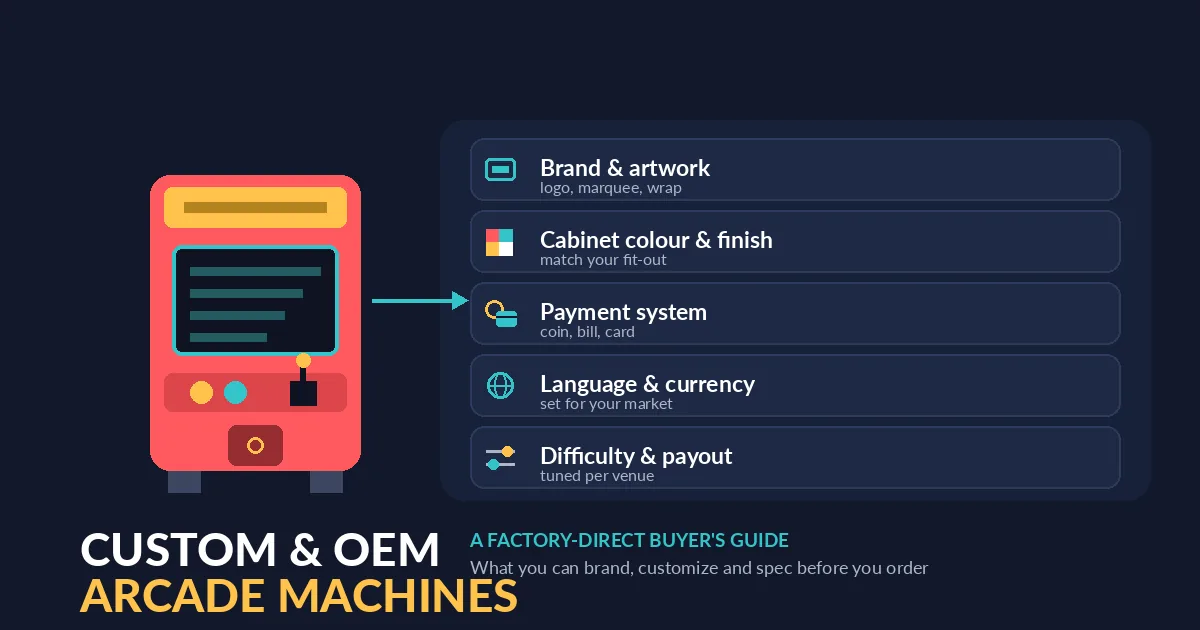
Most requests fall into a handful of areas: the branding and artwork, the cabinet colour and finish, the payment system, the on-screen language and currency, and the game’s difficulty or payout. Deeper OEM work can change cabinet size, hardware and even the game content itself, but that is a bigger project than a branded standard machine.
Here is what each layer covers, who usually asks for it, and the one thing to watch:
| Customization | What it covers | Usually asked for by | Watch-out |
|---|---|---|---|
| Branding & artwork | Marquee, side wraps, logo, on-screen loading graphics | Distributors and branded chains | Supply print-ready vector files, not a screenshot |
| Cabinet colour & finish | Body colour, LED trim, panel finish | Venues matching a fit-out | Agree a colour reference (e.g. Pantone) up front |
| Payment system | Coin, bill, RFID card or contactless | Operators standardizing payment | Fix the currency and card platform early — it changes the hardware |
| Language & currency | On-screen language and price display | Non-English markets | Confirm the character set your language needs |
| Difficulty & payout | Game difficulty, ticket or prize payout | Operators tuning margin | Payout rules follow local law, not the factory default |
| Size & content (deep OEM) | Cabinet dimensions, hardware, game content | Large or private-label projects | Longer lead time and a higher MOQ |
One caution on content. Putting a licensed character or a well-known film theme on a cabinet is not “customization” unless you hold the rights to it — using one you do not own is a copyright problem you would carry into your own market. A reputable factory will apply your brand and your artwork, and will tell you where a theme you have asked for crosses into someone else’s intellectual property.
OEM, ODM, or a branded standard machine: which custom arcade machines route fits you?
A branded standard machine is the fastest: a catalog cabinet fitted with your artwork and payment system. OEM means the factory builds to your design or brief and puts your brand on it. ODM means you adopt the factory’s design and sell it under your own name. Most buyers of custom arcade machines want the first or second.
Choose by how far you need to move from the standard product. If you only need your logo, colours and a card reader, a branded standard machine gets you there with the shortest lead time. If your concept needs a different cabinet, a specific hardware layout, or your own game content, that is genuine OEM — more design work, a higher minimum, and a sample step you should not skip.
How a custom or OEM arcade machine project runs
A custom order runs through a fixed sequence. The order: brief and spec, then 2D layout and artwork proof, then 3D design or a sample for true OEM, then material stock and production, then QC, then export documents, and finally shipment and install. Each approval you skip surfaces later as a rework.
A typical project at Arcade Craft Studio moves through these stages:
- Brief and spec: models, quantity, branding, payment method, voltage and plug standard, target market and on-screen language, all agreed in writing.
- 2D layout and artwork proof: for a full venue, a 2D floor layout; for the machines, artwork mockups you sign off before anything is printed.
- 3D design or sample: for true OEM, a 3D design and, where the change is significant, a physical sample or approval photos and video.
- Material stock and production: components sourced against the approved spec, then assembly on the line.
- Quality control: a routine inspection and a 48-hour aging test before anything is packed.
- Export documentation: commercial invoice, packing list and bill of lading prepared; CE and RoHS documentation coordinated where you need it.
- Shipment and install: machines shipped, then commissioned with English manuals, 3D install videos and 7-to-1 technical support on call.
Timelines vary with how deep the customization goes — a branded standard run clears faster than a new OEM design with sampling — so get the lead time written onto the proforma invoice rather than relying on a verbal estimate. When the machines are ready to ship, the same care applies to importing your finished order from China: freight, duty and delivery decide the number that lands on your floor.
MOQ, lead time and cost: what customization changes
Customization moves three numbers. The minimum order rises because artwork, tooling or a new design has to be worth a production run. The lead time grows because design and approval come before production. And the unit cost shifts with the depth of the work. None of these has a universal figure; they are set by your exact configuration.
What does stay standard is the payment structure: a 30% deposit to start production with the 70% balance before shipment, with the milestones written onto the proforma invoice. For a sense of where a branded standard machine sits before customization, our factory-direct arcade machine price ranges are the baseline; the custom quote is built on top of it and confirmed per configuration. If you are also deciding the wider floor, our guide to planning your full FEC games mix sets the machine mix a custom order then slots into.
Your pre-OEM brief checklist
Before you ask for a custom quote, you should be able to hand over every item below. Each blank is a place where the artwork, the lead time or the cost slips later.
- ☐ Models and quantity per model.
- ☐ Print-ready vector artwork (marquee, wraps, logo) plus a brand colour reference.
- ☐ Payment method (coin, bill or card platform) and the currency it reads.
- ☐ Destination voltage, plug type, and on-screen language.
- ☐ Difficulty and payout expectations, and who confirms local payout law.
- ☐ A sample or artwork proof approval step agreed before mass production.
- ☐ MOQ and lead time for your exact configuration, written on the PI.
- ☐ After-sales terms: spare parts, warranty, and response time.
- ☐ CE / RoHS or local compliance documentation requested, with the final position confirmed by your broker or authority.
Red flags when sourcing custom machines
Be wary of a supplier who says yes to everything but never raises the MOQ or asks for your artwork files — that usually means the customization is thinner than it sounds. Other warnings: no sample or proof step before mass production, branding quoted with no colour reference or file spec, licensed characters offered with no mention of rights, and a support contact who is the salesperson who closed the deal rather than a technical line. The quickest way to test a factory is to run it through how to vet an arcade machine supplier before you brief a custom run.
Common mistakes buyers make
The most common is sending a low-resolution logo and expecting a crisp marquee — print needs vector files. Close behind: locking artwork before the payment system and currency are confirmed, then reworking it; assuming a custom order takes the same time as a stock one; setting a payout that breaks local rules because nobody checked; and committing to a full OEM run before signing off a single sample. Each is avoidable with the checklist above.
FAQ
What is the minimum order for custom arcade machines?
It depends on how deep the customization goes. A branded standard machine — a catalog cabinet with your artwork and payment system — can start low, while a full OEM build with new tooling needs a larger run to be worth it. There is no universal number, so confirm the MOQ for your exact configuration in writing before you commit.
Can you put our brand and artwork on the machines?
Yes. Marquee art, side wraps, logo and on-screen loading graphics can carry your brand, provided you supply print-ready vector files and a colour reference. Licensed characters or themes are different — you need to hold the rights, and a reputable factory will not apply intellectual property you do not own.
How long does a custom arcade machine order take?
Longer than a stock order, because design, artwork approval and any sampling happen before production starts. The depth of the change drives the timeline, so get the lead time written onto your proforma invoice rather than relying on a verbal estimate.
Can the machines be set for our currency and language?
Yes. Payment systems can be configured for coin, bill or card in your currency, and the on-screen language can be set for your market. Confirm the currency and card platform early, because they decide the payment hardware fitted to each cabinet.
Does Arcade Craft Studio handle compliance like CE for custom machines?
We can coordinate CE and RoHS documentation and prepare export paperwork, but we will not decide your market’s compliance position for you. Final requirements should be confirmed with your broker or the relevant authority in your destination country, and we will tell you what we can and cannot certify before you order.
Brief your custom build
A real custom quote starts from real details. Tell Arcade Craft Studio the models and quantity, your branding files, the destination market’s voltage and currency, and the payment system you want, and send those details to request a custom quote. As a factory-direct manufacturer with in-house hardware, software and content teams, we keep the branding, spec and build under one roof — and if you are reselling, our solutions for distributors and resellers and arcade management and payment-system accessories round out a private-label floor. Prize formats like a claw and prize machine range are among the most common to brand.