
Updated September 2026 — current as of first publication; reflects our current string-type lane packages and the indicative ten-lane EXW price anchor below.
You have a corner of the floor plan that a claw row would waste and a ticket wall can’t fill. A prospective FEC owner in a mid-size mall unit keeps coming back to the same question: does bowling belong in an arcade at all, or does it need a dedicated alley? The answer is that “bowling” is not one machine. It runs from a single coin-op cabinet that drops into an arcade row to a row of full-length lanes that anchors the whole venue, and the format you pick decides your footprint, your staffing, and how the attraction earns.
This guide walks through the four bowling formats a commercial buyer actually chooses between, which venue each one fits, and the questions worth settling before you request a quote.
Key takeaways
- A bowling arcade machine is not a single product. It spans a compact coin-op cabinet, kids novelty bowling, short mini-bowling lanes, and full-length string lanes.
- Footprint is the first filter: a cabinet fits an existing row, while lanes need dedicated length and a machinery zone behind the pins.
- String-type pinsetters (what we build) reset faster and let one technician cover several lanes, which lowers running cost versus traditional free-fall pinspotters.
- Only the largest lane packages carry a first-party price anchor; smaller and custom builds are quoted per configuration, freight and duty on top.
- Plan the machinery clearance and power early — retrofitting length into a signed lease is the mistake that kills bowling projects.
How to choose a bowling arcade machine by venue and footprint
Start with the space, not the game. A bowling arcade machine has to fit both the playing length and the machinery zone behind the pins, so measure the deepest usable run of floor you have before you shortlist a format. A cabinet suits a tight row; mini-bowling a mid-size FEC; full lanes a venue built around them.
After length, weigh three things: who plays (kids, families, or league-style adults), how much supervision the format needs, and whether the attraction is a filler or an anchor. A kids’ novelty unit runs itself inside a supervised zone. A ten-lane row becomes the reason people book the venue, and it needs scoring, seating, and a service plan to match. Match the format to the role you actually need it to play on the floor, and the footprint math usually settles the rest.
Four bowling arcade machine formats, and where each fits
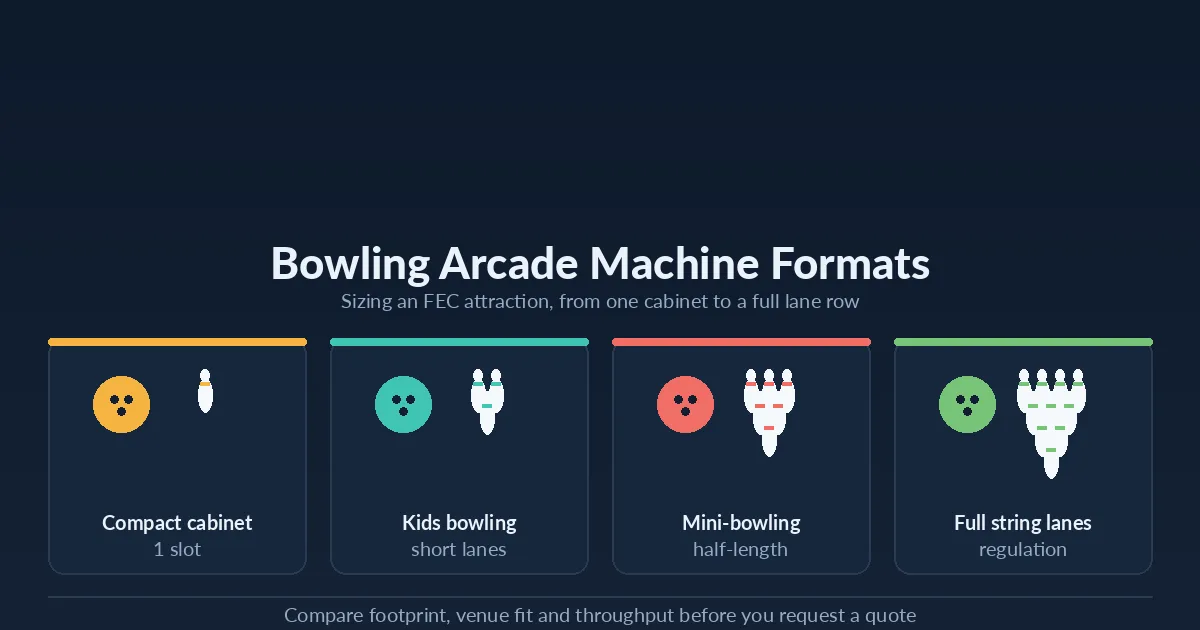
There are four formats worth comparing, and they suit different floors rather than compete. A compact cabinet earns as an arcade game; kids bowling inside a children’s zone; mini-bowling as a mid-size group attraction; full lanes as a venue anchor. The table below lines them up by the factors that decide the buy.
| Format | Best venue | Footprint | Players / throughput | Watch-out |
|---|---|---|---|---|
| Compact bowling cabinet (roller / video bowling) | Arcade rows, bars, small FECs | Fits a standard cabinet slot | 1–2 players, quick rounds, high turnover | It plays like an arcade game, not a lane — set expectations in your marketing |
| Kids novelty bowling | Children’s zones, mall play areas | Short lanes, low side rails | Young kids, short supervised sessions | Lightweight balls and bumpers matter more than realism here |
| Mini-bowling (short string lanes) | Mid-size FECs, party venues | Roughly half a regulation lane, plus machinery behind | Groups and parties, several lanes side by side | Lane count drives party capacity — size it to your booking model |
| Full string lane bowling | Bowling-led FECs, entertainment centers | Regulation-length run plus a machinery and seating zone | League and open play, highest per-group spend | This is a venue anchor, not a floor filler — it drives your whole layout |
Across all four, the pinsetter type matters as much as the lane. We build string-type bowling machines and lanes rather than free-fall pinspotters: the pins hang on strings, so they reset faster, run quieter, and let a single technician keep several lanes going. For an operator, that shows up as fewer stoppages and lower maintenance labor, the two things that quietly decide whether a lane row stays profitable. Bowling sits within our wider arcade game machine range, so it can ship alongside the rest of your floor.
What a bowling setup costs, and what adds to the factory price
Price scales with format, and only the largest packages have a published anchor. As an indicative, first-party figure, a ten-lane string bowling package runs about US$167,700 EXW, covering lanes, gutters, capping, and the string-type capital equipment. That is a large-format number, not a per-machine one; smaller cabinets, kids units, mini-bowling and custom builds are quoted per configuration.
Whatever the format, the EXW figure is the factory price and not the landed cost. Ocean freight, import duty, and inland delivery sit on top, and they vary by destination port and lane count. For how those layers stack up, see our breakdown of factory-direct price ranges by machine category and what freight and duty add. Any electrical, safety, or customs classification question stays with your own broker and local authority to confirm; we can coordinate documentation, but the compliance call is theirs, not ours.
Evidence to ask for, red flags, and common mistakes
Before you commit to a lane package, ask for evidence it will run in your space, not just a render. Request the true playing length plus machinery clearance for your lane count, the power draw, a spare-parts and pin-string plan, and video of the string pinsetter resetting live. A supplier who shows those has installed the format before.
The red flags are familiar. A quote that hides freight inside a headline price, a “regulation” claim with no length drawing, and no answer on after-sales response time all signal trouble. The most common and most expensive mistake is dimensional: buyers size the lanes to the playing area and forget the machinery and approach zones behind and in front, then discover the row does not fit a lease they have already signed. Confirm the full run — approach, lane, and pin machinery — against your FEC floor plan and guest-flow layout before anyone pours a deposit.
Frequently asked questions
Is a bowling arcade machine the same as a real bowling alley?
Not always. The term covers everything from a single coin-op cabinet that plays like an arcade game to full regulation-length lanes. Compact cabinets and kids units simulate bowling in a small footprint; mini-bowling and full string lanes are real lanes with balls, pins, and automatic pinsetters. Pick by the footprint and role you need.
How much floor space does mini-bowling need?
Mini-bowling lanes run roughly half the length of a regulation lane, but you still have to add the approach in front and the pinsetter machinery behind. Exact dimensions depend on lane count and model, so treat any single number with caution and confirm the full run per configuration against your floor plan before committing.
What is string-type bowling, and why does it matter?
String-type bowling attaches thin strings to each pin so a compact mechanism can lift and reset them, instead of the free-fall pinspotters used in traditional alleys. For a commercial operator it means faster resets, quieter operation, lower energy use, and one technician able to service several lanes, so less downtime and lower running cost.
How much does a bowling setup cost?
It depends entirely on format and lane count. As an indicative first-party anchor, a ten-lane string bowling package is about US$167,700 EXW; smaller cabinets, kids units, mini-bowling and custom builds are quoted per configuration. Freight, duty, and delivery are added on top of the factory price for your destination.
Can you customize lanes and branding?
Yes. As a factory-direct manufacturer we handle OEM customization on lane finishes, side panels, and branding, and can adapt lane counts to your space. Send your available floor dimensions and we will map a configuration to them rather than forcing your room to fit a fixed package.
Sizing a bowling row for your floor
Bowling can be a quiet filler cabinet or the anchor that defines your venue, and the format decides which. If you know your usable length, your audience, and whether bowling is a side attraction or the main draw, the shortlist narrows to one or two formats fast. For the wider machine mix around it, our guide to planning your full FEC games mix and our sports simulator buyer’s guide show how bowling sits alongside redemption, prize, and simulator formats.
When you are ready for numbers, send us your venue size, ceiling height, and target lane count, and we will map a bowling configuration and a landed-cost quote to your floor.