
Updated September 2026 — current as of first publication.
You have already picked the racing row and the basketball corner. Now you have a 40 to 60 square metre pocket of floor left, a mixed weekday crowd that thins out by 2pm, and a question the standard machine list does not answer: does a golf simulator arcade bay, an archery lane, or an interactive projection zone earn its keep in that space? These three specialty sports simulators behave nothing like a hoop machine, and buyers who treat them the same way usually over-spend or under-book. This guide sorts them by venue, footprint and how the money actually comes in.
Key takeaways
- A golf bay sells booked time by the hour, not coins per play, so it fills the slow weekday afternoons most amusement machines leave empty.
- Archery simulators give you a target sport with none of the range, netting or supervision a real bow demands, and they read instantly to walk-past guests.
- Interactive projection games need no cabinet and no controllers — they turn a bare floor or wall into a play zone for toddlers through party groups.
- Footprint and ceiling height, not price, decide which of the three fits: golf wants depth and height, archery wants a clear throw lane, projection wants an unobstructed surface.
- We quote each format per configuration; ask for the price ranges by category and send your floor plan before you commit a zone.
How to choose a golf simulator arcade or specialty sports sim by venue
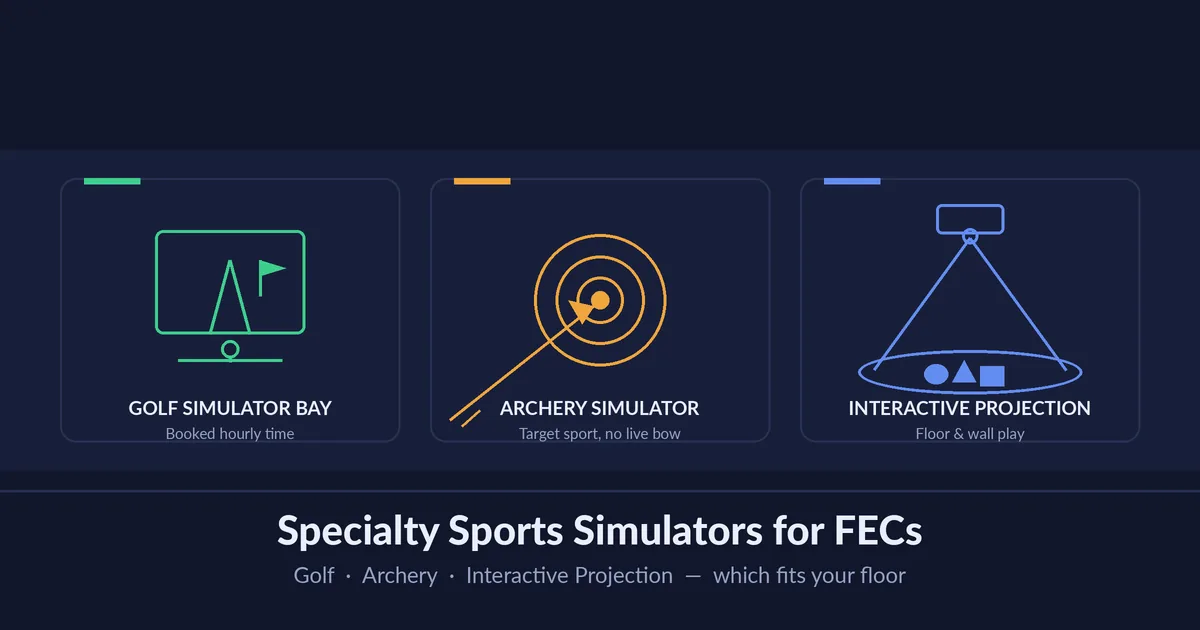
Match the format to how your space earns and who walks in. A golf simulator arcade suits a bar, lounge or premium FEC that can sell booked hours. Archery fits a mid-size family floor that wants a novelty target sport. Interactive projection belongs in a kids or party zone with an open surface. Space and audience decide, not headline price.
Start with three numbers before you look at any machine: the floor area you can spare, the ceiling height at that spot, and the guest profile at your slowest hour. Golf and archery both want depth and height that a hoop cabinet never asks for. Projection wants a clear floor or wall with no traffic crossing it. If the space fails on any of those, a different format will out-earn the one you had in mind. Our sports simulator buyer’s guide covers the racing, basketball and shooting formats that fill the rest of a sports zone.
Golf simulator arcade: a format that sells time, not plays
A golf simulator arcade bay is booked by the hour, and that changes the whole business model. Guests reserve a slot, buy food and drinks while they play, and stay far longer than any coin-op session. A single bay can fill the quiet weekday afternoons most amusement equipment cannot, so bars, lounges and premium venues buy them first.
The trade-off is space. A hitting bay needs real depth for a full swing, a ceiling clear of ducts and sprinklers, and an impact screen or enclosure the ball can safely strike. Most operators budget a rectangular room rather than a slice of open floor. Because build specs vary so widely by ceiling, screen and sensor choice, we quote golf bays per configuration rather than off a list — see our factory-direct price ranges by machine category for how freight, duty and delivery stack on top of the equipment. If you are weighing a bay against the rest of your floor, our commercial golf simulator bays show the enclosure and screen options in one place.
Archery simulators and interactive projection games
These two formats solve different problems. An archery simulator gives a venue a target sport with none of the safety overhead of a real bow — no range or netting — and the action reads across the room. Interactive projection games use a projector and sensors to turn a floor or wall into play space, no controllers to hold.
Archery suits a mid-size family floor or an activity venue that wants a physical, photogenic challenge without the liability of live archery. It needs a clear throw lane in front of the target screen and enough ceiling to mount the projector or camera cleanly. Interactive projection is the most flexible of the three: a ceiling-mounted unit lights up a bare floor for toddlers, a climbing wall for older kids, or a group game for a birthday party, and you reconfigure the content rather than the hardware. Browse the archery simulator machines and interactive projection floor and wall games to see the throw distances and mounting heights each one needs, or step up to the full sports simulator range for the wider catalogue.
Specialty sports simulator formats compared
Use this table to shortlist formats before you request specs. It lines up the three specialty formats by the factors that actually decide placement: footprint, ceiling, who plays, how the revenue arrives, and the mistake operators make most with each.
| Format | Best venue | Footprint & ceiling | Players / session | How it earns | Watch-out |
|---|---|---|---|---|---|
| Golf simulator arcade | Bar, lounge, premium FEC | Room depth for a full swing; high, clear ceiling | 1–4 per booked bay | Booked hourly time + food and drink spend | Sizing a bay to open floor instead of a walled room |
| Archery simulator | Mid-size family floor, activity venue | Clear throw lane; moderate ceiling | 1–2 per lane | Per-play or per-round coin/card | Placing it where foot traffic crosses the shooting line |
| Interactive projection game | Kids zone, party room, mall corridor | Open floor or wall; ceiling mount for the unit | Group play, several at once | Per-session or timed party bookings | Mounting over a surface with glare, gaps or through-traffic |
Evidence to ask for, red flags and common mistakes
Before you commit a zone to any specialty simulator, get proof it will run in your building, because your technician will be a shipping ocean away. Ask for the exact footprint and ceiling clearance drawing, a video of the unit running a full session, the calibration steps, and a written after-sales scope.
A supplier who cannot produce those has not thought your install through. The red flags are consistent across all three formats: be wary of a quote with no ceiling-height requirement stated, a demo that only shows the screen and never the room around it, and a spec sheet that lists dimensions but not the calibration or content-update process. On our side, ACS is a factory-direct manufacturer running since 2012 with in-house hardware, software and content teams, 2D and 3D layout support, English manuals with 3D install videos, and a 7-days-a-week after-sales team on a multi-shift roster — the practical support that keeps an imported bay earning after the container lands.
The most common mistakes are placement, not purchase. Operators size a golf bay to open floor and then find the swing hits a walkway; they drop archery where a queue crosses the shooting line; they mount projection over a glossy floor that washes out the image. Fix the space first, then choose the format. When you are balancing these against the rest of the floor, our guide to planning your full FEC games mix shows how a specialty zone fits the wider machine budget.
Frequently asked questions
How much floor space does a golf simulator arcade bay need?
A golf bay needs a walled or partitioned room with enough depth for a full swing and a ceiling clear of ducts, sprinklers and lights, not a slice of open floor. Exact dimensions depend on the enclosure, screen and sensor you choose, so send us your ceiling height and available depth and we will size a bay to it.
Are archery simulators safe for a family entertainment center?
Archery simulators give you the target sport without the hazard of a real bow — there is no live arrow, no range and no netting to manage. You still position the throw lane away from walking routes and follow your local electrical and insurance requirements, which your own insurer and authority should confirm for your venue.
What does an interactive projection game need to run?
An interactive projection game needs a ceiling or high wall mount for the projector-and-sensor unit and a clear surface below it — a matte floor or an unobstructed wall with no glare or through-traffic. There is no cabinet to place and nothing for guests to hold, so you change the game content rather than the hardware to refresh it.
How much do specialty sports simulators cost?
Because footprint, screen, sensor and content options vary so widely, we quote golf, archery and interactive projection formats per configuration rather than from a fixed price list. Freight, duty and delivery are added on top of the factory price. Ask us for the price ranges by machine category and we will map a quote to your space and shortlist.
Can you customize a specialty simulator for our venue and brand?
Yes. As a factory-direct manufacturer with in-house hardware, software and content teams, we can adjust content, branding and configuration to your market, and provide 2D and 3D layout drawings so the zone is planned before anything ships. Send your floor plan and target audience and we will build the specification around them.
Plan your specialty sim zone
The fastest way to know which format fits is to let us look at the actual space. Send us your venue size, ceiling height and floor plan through our quote and project form, tell us the guest profile at your slowest hour, and we will map a golf, archery or interactive projection zone to it — with a per-configuration quote and a layout drawing, not a guess.