
Updated September 2026 — current as of first publication.
You have a quiet corner near the exit of your family entertainment center, and every operator who visits says a photo booth would pay for that space. The problem is that “photo booth” covers everything from an open selfie unit that prints on the spot to a curtained cabin sized for a birthday group. Choose the wrong format and it either blocks a walkway or sits idle in a spot that should earn. Here is how to pick the right one.
Key takeaways
- A commercial photo booth earns twice: the guest pays for a print, then shares the shot online, which advertises your venue at no extra cost to you.
- Format follows venue and staffing — open selfie booths suit high-traffic corners, enclosed cabins suit party rooms, and coin-op units suit unattended mall zones.
- The parts that decide profit are the printer, the frame and branding options, and the payment system, not the cabinet itself.
- An ACS open selfie-and-print booth runs at an indicative US$4,099–$4,599 EXW; larger or custom builds are quoted per configuration.
- Privacy, payment handling, and import compliance depend on your market — confirm each with your own regulator, payment provider, and customs broker.
How to choose a commercial photo booth by venue and operating model
Match the booth to two things: where it sits and who runs it. High-traffic entrances and food courts reward a compact open selfie booth. Party and group rooms reward an enclosed cabin. Unattended mall or lobby corners reward a coin-operated, cashless unit. Footprint, supervision, and payment method all follow from that first choice.
Start with traffic. A booth beside your main walkway lives on impulse plays, so it needs a small footprint and a fast print, not a private cabin. A booth inside a party room lives on booked sessions, so a slower, roomier cabin that fits a group is the better earner there. Then decide supervision: an attended booth can upsell prints and reset jams, while an unattended one has to run itself, which puts weight on reliable payment and remote monitoring. You can browse the commercial photo booth machines and the wider full vending and self-service range to see where a booth sits alongside your other unattended earners.
Four commercial photo booth formats, and where each fits
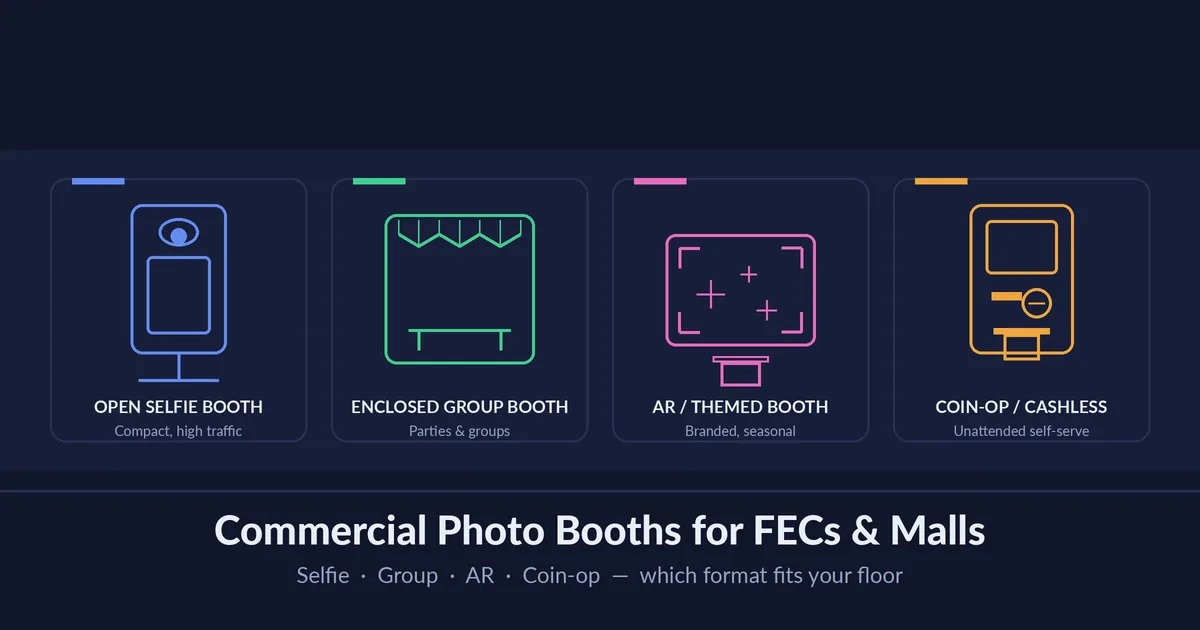
There are four formats most FEC and mall buyers weigh: the open selfie-and-print booth, the enclosed group cabin, the AR or themed booth, and the coin-operated cashless unit. They differ by footprint, how many guests fit a session, whether staff are needed, and the revenue role each plays on your floor. The table below lines them up.
| Format | Best venue | Footprint | Operating model | Revenue role |
|---|---|---|---|---|
| Open selfie booth | Entrance, food court, high-traffic corner | Small | Attended or self-serve | Volume prints, fast turnover |
| Enclosed group booth | Party rooms, group zones | Medium (enclosed cabin) | Attended or booked | Party & group revenue, longer sessions |
| AR / themed booth | Seasonal events, branded promos | Small–medium | Attended for events | Branded content, social reach |
| Coin-op / cashless booth | Mall corners, lobbies, unattended zones | Small | Unattended self-serve | Passive, low-staff income |
Most buyers do not need four different machines. A modern open booth with a touchscreen, a good camera, and a print slot can serve as a self-serve selfie booth at the entrance during the week and a branded, themed booth for a weekend event, simply by swapping the on-screen frames. The enclosed cabin is the real fork in the road: choose it only if group and party sessions are a genuine part of your plan, because it costs you floor space that an open booth would turn over faster. Sizing all of this against your walkways is easier with an FEC floor plan and guest-flow layout in hand.
What makes a commercial photo booth actually earn
The cabinet is the least important part. Three things decide whether a photo booth pays: the printer, which sets speed and cost per print; the frame and branding options, which drive social shares and repeat plays; and the payment system, which decides how many guests can actually pay. Get those right and the booth earns well beyond a single ticket.
On the printer, a dye-sublimation printer (the type used in ACS booths) produces a dry, water-resistant print in seconds, and a single paper roll yields around 700 prints before a swap. That roll yield matters because your real running cost is paper plus ribbon per print, not the machine. On branding, the ACS booth carries a 21.5-inch touchscreen that can show your logo, a DSLR camera for sharp shots, and more than ten custom frames and filters, so a guest’s print — and the version they post — carries your venue’s name. On payment, the booth accepts coins, notes, and Nayax cashless cards, and a back-end dashboard reports sales remotely, which is what makes an unattended coin operated photo booth practical in a mall.
To size the payback, take the daily print count, multiply by your price per print, then subtract the consumable cost (paper plus ribbon) per print and any card fees. Divide the delivered cost of the booth by that net daily figure to estimate payback in days. The booth-specific lever is consumable cost per print, so a high-yield roll and durable prints keep it low. Use your own venue’s traffic and pricing here; we do not promise a number. For where a booth’s price sits next to the rest of your floor, see the factory-direct price ranges by machine category, and for how a booth fits the whole floor, the guide to planning your full FEC games mix.
Evidence to check, red flags, and common mistakes
Before you buy any photo booth machine for an FEC, check three kinds of evidence: a working print sample from the exact printer in the machine, the real consumable cost and roll yield, and the payment options your market needs. The red flags are vague print specs, no spare-parts plan, and booths sold without local payment support.
Evidence to ask for:
- A physical print sample from the same printer model, so you can judge color and durability.
- The printer’s paper-per-roll yield and the price of a replacement roll and ribbon.
- Confirmation the payment module supports your currency and your cashless provider.
- A written after-sales and spare-parts plan, including printer heads and the camera.
Red flags:
- “HD camera” with no make or model — a phone-grade sensor prints poorly at 6×4.
- No stated roll yield, which hides the true cost per print.
- A cashless module that only supports one region’s cards.
- No plan for consumables once the first roll runs out.
Common mistakes:
- Placing a booth where there is no light or no backdrop, so prints look flat.
- Buying an enclosed cabin for a venue that never runs group sessions.
- Pricing a print so low that consumables eat the margin.
- Forgetting that guest photos and payment data carry privacy and compliance duties in your market.
Commercial photo booth FAQ
How much does a commercial photo booth cost?
It depends on format and configuration. As an indicative first-party anchor, an ACS open selfie-and-print booth is about US$4,099–$4,599 EXW, including the outer frame and photo station; enclosed cabins and custom or AR builds are quoted per configuration. Freight, duty, and delivery are added on top of the factory price for your destination.
Is a photo booth a good fit for a small FEC or mall kiosk?
Yes, because an open selfie booth has a small footprint and runs on impulse plays, so it suits a compact corner or kiosk. The test is foot traffic and light, not floor size: a bright, busy spot near an entrance earns far more than a large but quiet back corner.
Can a coin operated photo booth run unattended?
Yes. A coin-op or cashless booth is built to run unattended, taking coins, notes, or cards and reporting sales through a back-end dashboard. In practice you still need a routine to restock paper and ribbon and clear the occasional jam, so plan for a short weekly service visit even on a self-serve unit.
What ongoing costs does a photo booth have?
The main running cost is consumables — the paper and ribbon per print — plus any cashless transaction fees. A dye-sublimation roll yields around 700 prints, so your cost per print is predictable once you know the roll price. Power draw is modest, and the camera and printer head are the parts to plan spares for.
Can the booth be branded for our venue?
Yes. The on-screen interface can carry your logo, and the booth ships with more than ten custom frames you can theme to your venue or a seasonal event. As a factory-direct manufacturer we also handle OEM customization on the cabinet and frames, so send your branding and we will map it to the machine.
Talk to us about your floor
Every venue prints differently, so a quote starts with your setup, not a fixed package. Send us your venue type, floor space, and payment setup and we will recommend a photo booth format, confirm the indicative price, and map it to your floor. Freight, duty, and delivery are quoted for your destination on top of the factory price, and compliance items such as guest-data privacy and payment handling should be confirmed with your own regulator and payment provider.