
Updated October 2026 — current as of first publication, a planning guide for FEC operators and equipment importers.
The container clears customs, the cabinets roll into the venue, and an electrician you hired by the hour asks the one question nobody answered during the order: are these 110-volt or 220-volt machines, and how many amps does each one pull? If the answer is wrong, a 220V racing cabinet plugged into a 120V outlet either sits dead or, worse, powers up on an adapter and runs hot. If the floor is right but the wiring is thin, opening night ends with a tripped breaker in the middle of a birthday party.
Voltage and circuits are the part of an arcade build that gets settled last and should be settled first. A machine ordered without its destination power spelled out is a machine you may not be able to switch on when it arrives. Here is how to plan arcade machine power requirements before you wire the deposit, so the floor runs on day one instead of waiting on a rewire.
Key takeaways
- Spec voltage, frequency and plug type for your country before production, not after the container lands.
- A 220V machine will not run safely on a 120V outlet, and the reverse is just as true, without the correct build or a proper transformer.
- Power draw varies widely: compact prize machines sip; large motion simulators, big-screen racers and VR platforms are the heavy users.
- Get the nameplate wattage or amperage for every model so your electrician can size circuits. Never guess.
- Wiring, circuit sizing and electrical code are your licensed electrician’s call and the local authority’s, not the supplier’s.
Arcade machine power requirements: the four specs that matter
Arcade machine power requirements come down to four specs: the voltage (commonly 110–120V or 220–240V), the frequency (50Hz or 60Hz), the plug and socket type, and how much current each machine draws. Match the first three to your country’s mains and size your circuits to the fourth, and the floor runs without drama.
The first three are set when you order. A factory-direct supplier can build the machine for your market’s voltage, fit the plug your sockets use, and set the payment system to your currency, but only if those details are on the proforma invoice. The fourth, current draw, is what your electrician needs to lay out circuits. Every cabinet carries a rating label (the nameplate) listing its voltage and either its wattage or its amperage; collect those figures model by model and the electrical plan almost writes itself.
When you order custom or branded machines, voltage and plug standard are part of the spec you lock in. Our OEM buyer’s guide to customizing arcade machines covers what else you can specify in the same order, from artwork to payment hardware.
Arcade machine voltage: 110V vs 220V and why frequency matters
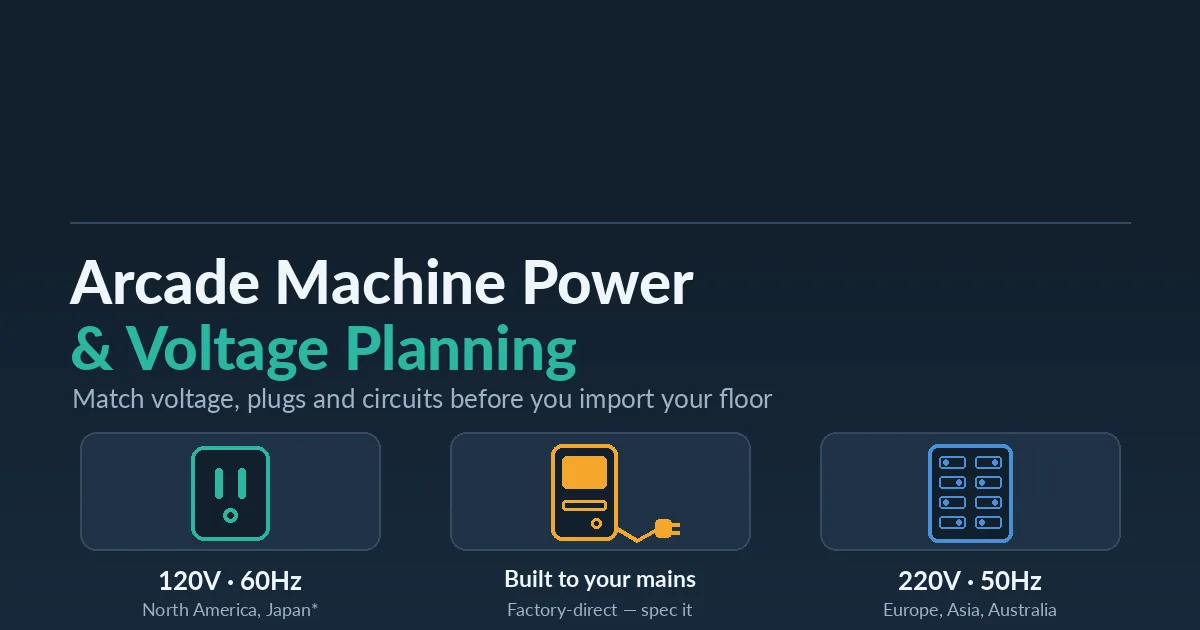
The world runs on two broad mains standards. North America and Japan use roughly 100–120V, while Europe, Australia and most of Asia (including China, where the machines are built) use 220–240V. Frequency splits too: 60Hz across the Americas and 50Hz across most of the rest. Your machine has to be built for the right pair.
Voltage is the one that stops a machine cold if it is wrong. Feed a 120V cabinet 230V and you can destroy the power supply; feed a 220V cabinet 120V and it may not power up at all. Either way the fix on arrival is a transformer or a rebuild, both of which cost more than specifying the right voltage at the factory. The safe move is to tell your supplier the destination country and let the machine ship configured for it. You can confirm your country’s figures against the IEC’s World Plugs reference for voltage, frequency and socket type.
Frequency matters less often but is not cosmetic. Some motor-driven and timing-sensitive components behave differently on 50Hz versus 60Hz, so a machine built for one and run on the other can turn or time slightly off even when the voltage is right. When you confirm voltage, confirm frequency in the same line. Machines from Arcade Craft Studio use branded switching power supplies and can be configured for your market’s voltage and frequency; the point to settle is which pair your venue actually has.
| Region | Typical mains | Frequency | What to spec |
|---|---|---|---|
| North America (US, Canada) | 120V | 60Hz | 120V build, NEMA plug |
| Japan | 100V | 50/60Hz | Confirm region’s frequency |
| Europe, UK | 230V | 50Hz | 230V build, local plug |
| Australia, NZ | 230V | 50Hz | 230V build, Type I plug |
| Middle East, most of Asia | 220–240V | 50Hz | Confirm exact voltage |
Figures above are general planning references; confirm your site’s actual supply with your electrician, since large venues often have three-phase service for heavy equipment.
How much electricity do arcade machines use?
It depends entirely on the machine. A compact claw or capsule machine draws very little, closer to a household appliance than an industrial load. The heavy users are large motion simulators, four-screen racing cabinets, 5D cinema seats and VR platforms with motion bases, big screens and PCs. There is no single “arcade machine” figure, which is why the nameplate matters.
Because the range is so wide, do not trust a blanket wattage number from anyone, including this page. Ask for the rated power of each specific model you are ordering and total it up. That total tells you your rough daily electricity cost and whether your service and circuits can carry the floor at peak. To estimate cost, multiply a machine’s rated kilowatts by its hours running per day by your local electricity price; repeat per model and sum. Treat it as a planning estimate, not a guarantee, since real draw varies with how hard a machine is played.
Energy does belong in the buying decision, not just the install. Over a machine’s life the power bill is a real line item, and some designs, such as string-type bowling lanes and LED-lit cabinets, are built to run leaner than older equivalents. If running cost is a factor in your mix, weigh it alongside the purchase price; our factory-direct price ranges by machine category give you the other half of that comparison.
A power profile by machine type
Use this to flag which machines need dedicated attention from your electrician. It is a relative guide to planning effort, not a wattage table.
| Machine type | Relative power draw | Planning note |
|---|---|---|
| Claw, gift & capsule machines | Low | Several can share a general-purpose circuit |
| Ticket redemption & skill games | Low–medium | Group by rated draw per circuit |
| Boxing, basketball & sports games | Medium | Check the nameplate; lighting adds load |
| Big-screen shooting & large video | Medium–high | Large displays raise the total |
| Motion racing, 5D cinema, VR platforms | High | Often want their own dedicated circuit |
Planning circuits and outlets for your arcade floor
Beyond matching voltage, the floor needs enough circuits so machines are not fighting for the same breaker. The honest answer to “how many machines per circuit” is that it depends on each machine’s draw and your local electrical code, so this is a job for a licensed electrician, not a rule of thumb from a supplier.
What you can do before the electrician arrives is give them good inputs: a model list with rated power per machine, a floor plan showing where each cabinet sits, and a note of which machines are the heavy users that may want their own circuit. Position outlets with the layout in mind so cords do not cross walkways or stretch to reach, the same guest-flow thinking that shapes the rest of the room. Our FEC floor plan and guest-flow layout guide walks through placing zones and services, and power drops belong on that same plan.
Compliance is where the supplier stops and your local experts start. Electrical code, circuit sizing, grounding, surge protection and inspection sign-off are decided by your licensed electrician and the authority having jurisdiction in your market, not by us. Arcade Craft Studio can build to your voltage, frequency and plug standard, but the wiring in your building and its code compliance are confirmed on your side. If you are also working out shipping and duty, our guide on how to import arcade machines from China covers the landed-cost side of the same order.
Your pre-order power checklist
Run through this before you confirm the order. Each unchecked line is a machine that might not switch on, or a circuit that might trip, after the money has moved. Settle each item in writing on the proforma invoice, so nothing is left for the electrician to discover on arrival.
- ☐ Destination voltage and frequency confirmed and written onto the proforma invoice (e.g. 120V/60Hz or 230V/50Hz).
- ☐ Plug and socket type for your country specified per machine.
- ☐ Nameplate rating (watts or amps) requested for every model on the order.
- ☐ Payment-system currency and language set for your market.
- ☐ Heavy-draw machines (motion, VR, large displays) flagged for your electrician.
- ☐ A licensed electrician engaged to size circuits and confirm your incoming service.
- ☐ Outlet positions marked on the floor plan so cords stay clear of walkways.
- ☐ Local electrical code and inspection requirements confirmed with your authority.
Red flags when a supplier talks about power
Be wary of a supplier who answers “what voltage will these ship at?” with “no problem” instead of a spec, who cannot give you a nameplate rating per model, or who tells you a universal power supply means voltage “doesn’t matter.” It usually does. A supplier who treats voltage and plug type as an afterthought is one who will ship whatever is on the line that week and leave the mismatch for you to discover on arrival.
Common mistakes buyers make
The frequent one is assuming the factory knows your country’s voltage without being told; it does not unless it is on the order. Close behind: forgetting to specify the plug type and ending up with a container of machines wired for sockets you do not have; buying before an electrician has seen the model list, then discovering the venue’s service is undersized; and using cheap step-down adapters to force a mismatched machine to run, which risks the power supply and voids the warranty. Each is avoided by settling power at order time. The right supplier will also stand behind the machine afterward. The five after-sales questions worth asking before you buy are the quickest way to test that.
FAQ
Do arcade machines use a lot of electricity?
It varies more than most buyers expect. A compact claw or capsule machine draws about as much as a household appliance, while a motion simulator or VR platform with large screens and a PC can draw many times more. There is no single figure, so ask for the rated power of each model you are ordering and total it to estimate your real cost.
Can I run a 220V arcade machine on a 110V supply?
Not safely without the right setup. A machine built for 220–240V will usually not power up on a 120V outlet, and forcing it with an incorrect adapter can damage components. The clean solution is to have the machine built for your voltage at the factory; a properly rated step-up or step-down transformer is a fallback, not a first choice.
What voltage are arcade machines from China built for?
China’s domestic mains is 220V at 50Hz, but a factory-direct supplier builds for the destination, not for China. If your market is 120V/60Hz, say so on the order and the machine should ship configured for it: voltage, frequency and plug type together. Confirm all three in writing before production starts.
How many arcade machines can I run on one circuit?
It depends on each machine’s current draw and your local electrical code, so a licensed electrician should decide it from your model list and nameplate ratings. Low-draw prize machines can often share a circuit; high-draw motion and VR machines frequently want their own. Do not estimate this yourself.
Do I need a special electrical setup for an arcade?
Most arcade floors run on standard commercial wiring, but the number of circuits and whether you need three-phase service depends on your machine mix and how heavy the load is. Have an electrician review the floor before install. We can confirm each machine’s voltage and rating; your electrician confirms the building can carry them.
Spec your power before you order
The floors that switch on smoothly are the ones where voltage, plugs and circuits were decided with the order, not discovered with the container. Tell Arcade Craft Studio three things — your destination country, the models you are weighing, and the voltage at your venue — and request a quote with each machine’s power spec confirmed. Ask for the voltage, frequency, plug type and nameplate rating per model, so your electrician can plan the floor before the deposit is wired.