
Updated July 2026 — current as of first publication.
A new FEC can look full on opening day and still feel thin after the first month if every cabinet does the same job. The stronger question is not “Which redemption machine is popular?” It is “What role does each game play in the ticket loop, and can guests understand the next step?” That distinction affects the game mix, prize counter, staff routine and the amount of space reserved for queues.
This guide is for FEC operators and buyers comparing redemption arcade games, ticket redemption machines and prize-zone equipment. It focuses on procurement decisions that can be checked before ordering. It does not promise revenue, payback or a universal winning mix.
Key takeaways
- Choose a role-balanced mix instead of filling a room with similar ticket games.
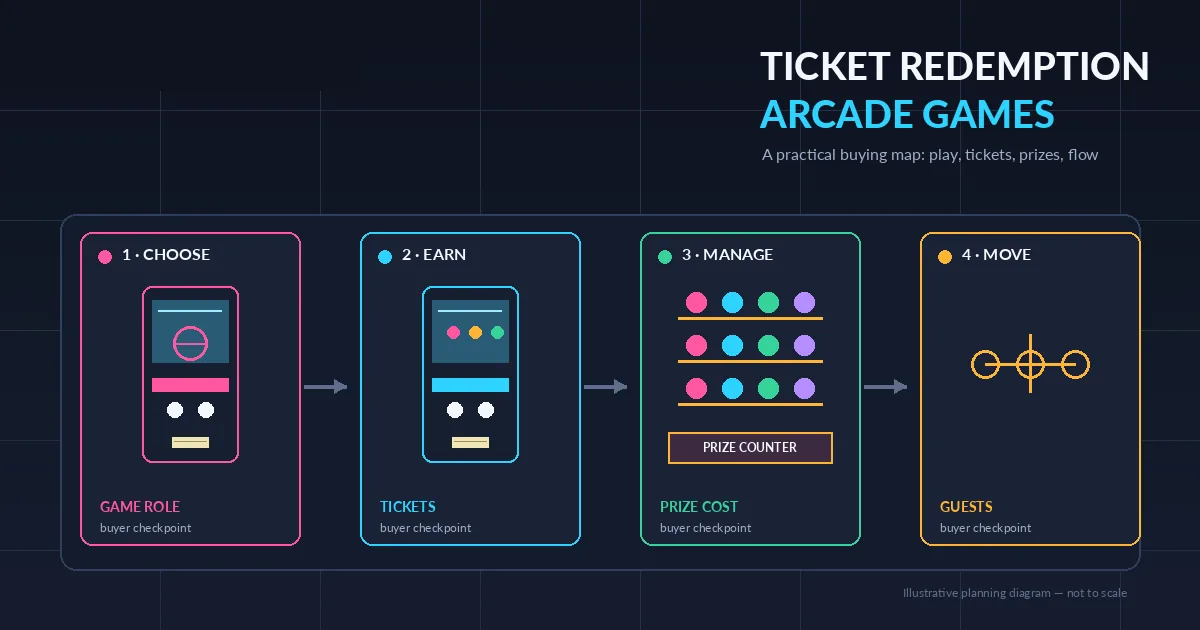
- Review the complete loop: play, ticket output, counting, prize choice and repeat visit.
- Match game complexity and footprint to the venue’s age mix, dwell time and supervision.
- Reserve space for prize display, queueing, replenishment and service access before finalizing the cabinet count.
- Ask for a measured layout, power information, spare-parts plan and clear assumptions in the quotation.
What are redemption arcade games supposed to do in an FEC?
Redemption arcade games connect play to a prize decision. A guest chooses a game, plays for a result, receives tickets or a digital credit, and then decides whether to redeem immediately or save for a larger prize. A useful mix makes that sequence easy to understand while giving different ages and skill levels more than one way to participate.
That means the buyer should judge more than the cabinet’s appearance. Ask what the machine contributes to the room:
- Fast-entry games: simple controls and short turns for guests who are joining a group already in motion.
- Skill games: a clearer learning curve for repeat players who want to improve.
- Family games: formats that let an adult and child understand the play together.
- Prize-facing games: cabinets that make the ticket and reward connection visible from the aisle.
Use the redemption machine mix planning guide to think in roles rather than model names. It is also useful to compare the broader ticket redemption game machines category before narrowing the request to a particular cabinet or configuration.
How should an operator choose ticket redemption machines?
Choose ticket redemption machines by matching the game’s play pattern to the venue’s guest flow, not by copying a competitor’s cabinet count. Start with audience, available footprint, queue behavior, supervision and service access. Then compare controls, ticket handling, visibility, noise, power and replenishment requirements for each shortlisted model.
| Buyer question | What to check | Why it matters |
|---|---|---|
| Who will play? | Children, families, teens, adults or mixed groups | Controls and difficulty should be understandable for the intended audience. |
| How long is a turn? | Short impulse play or longer skill session | Turn length affects queue size and how many people can see the game in use. |
| How is the result delivered? | Paper tickets, card credit or another approved system | The guest must know how the reward enters the prize workflow. |
| Who services it? | Local staff, distributor or factory support | Downtime and troubleshooting ownership should be clear before purchase. |
| What surrounds it? | Prize shelves, tables, lanes, exits and staff paths | A playable machine can still be a poor fit if the surrounding circulation is blocked. |
For a buyer comparing supplier options, the request should include the destination country, target venue type, available dimensions and preferred ticket system. Arcade Craft Studio describes its offering as factory-direct equipment, OEM customization, export coordination and 2D/3D layout support. Those are planning inputs, not a substitute for the venue’s local safety, accessibility, insurance or electrical review.
What should the prize and ticket zone include?
A prize and ticket zone should be planned as part of the game purchase, not added after the cabinets arrive. Guests need a readable path from game result to reward choice. Staff need enough room to count, replenish and maintain the area. The final plan should keep the prize counter visible without turning the queue into a corridor obstruction.
Before approving the order, draw four areas on the floor plan:
- Play footprint: the cabinet, player stance, controls and any moving parts.
- Waiting footprint: the space required for a small queue without blocking another attraction.
- Ticket or credit path: the route from the machine to counting, scanning or redemption.
- Prize-service path: staff access for replenishment, cleaning, repairs and stock rotation.
Do not put a large prize display where it hides the game’s instructions. Do not put a ticket counter where it forces guests to cross a ball-return path, café line or emergency route. A layout review should also identify cable runs, ventilation, ceiling clearance and the locations where staff can safely work on a machine.
Operators comparing gift-oriented equipment can also review gift and prize-machine formats. The right choice depends on the prize model and operating routine, not just on whether a cabinet is visually attractive.
What should an FEC buyer ask a redemption-game supplier?
An FEC buyer should ask the supplier to state what is confirmed, what depends on the final model and what must be checked locally. A useful quotation includes the proposed game role, footprint, power information, ticket or card assumptions, packaging, documentation, spare-parts support and the delivery scope. It should not hide important conditions behind a headline unit price.
- Which models are intended for short-turn family play, and which are designed for repeat skill play?
- What ticket, card or accounting system does each configuration support?
- What are the cabinet dimensions, service clearances and power requirements?
- Which wear parts, boards, controls and manuals are included or available?
- What information does the supplier need to prepare a 2D or 3D placement plan?
- Which delivery, customs, installation and local compliance items remain the buyer’s responsibility?
Arcade Craft Studio reports a 48-hour load test, a 72-hour aging test and a packing SOP as part of its factory quality process. Buyers should ask which checks apply to the selected model and request the relevant documentation rather than treating a general process description as a guarantee for every project. For a supplier comparison, see ten redemption game machine manufacturers compared.
How can an operator turn the shortlist into a quote request?
Turn the shortlist into a quote request by sending one concise project brief: venue type, country, floor-plan dimensions, target guest mix, preferred ticket or card system, estimated machine roles, destination port and any known installation limits. Ask the supplier to return a marked layout, equipment table and list of assumptions. This makes competing proposals easier to compare.
Do not ask for “the best redemption package” without stating the venue constraints. Instead, request two or three role-based options, such as a compact waiting-zone mix, a family-heavy prize zone and a larger skill-game area. Ask what changes between the options and why. For market context before finalizing the brief, compare the third-party arcade and FEC market statistics while keeping local site data as the decision source.
When the project brief is ready, use the factory-direct equipment quote request and include the floor plan, categories, destination and required timeline. The response can then be judged against the same checklist used for other suppliers.
FAQ: ticket redemption machines for FECs
Are redemption arcade games only for children?
No. The right mix can include simple family games, skill-based formats and longer-play attractions for different age groups. The operator should match controls, difficulty, turn length and prize logic to the actual venue audience.
How many ticket redemption machines should a new FEC buy?
There is no universal number. Start with a measured layout, guest-flow assumptions, the intended game roles and the space needed for ticket handling, prize display, queues and service access. Then compare a small, balanced mix before expanding.
Should a supplier guarantee revenue or payback for a redemption game?
No responsible quote can guarantee revenue or payback without verified site data. A buyer should ask for the assumptions behind any model and build its own operating case from local pricing, traffic, staffing, prize cost and venue rules.
What is the first document to send to a redemption-game supplier?
Send a measured floor plan with the destination country, guest mix, target game roles, available power information, preferred ticket or card system and any local installation or insurance requirements that need confirmation.