
Updated August 2026 — current as of first publication.
You have a 400-square-foot corner near the party rooms, a shopping-mall developer asking for a “family midway,” or a seasonal event where the games have to pay for the whole booth in six weekends. Carnival games are the obvious fill: they are colourful, guests understand them in two seconds, and a child can win a plush without reading a single instruction. The hard part is not finding carnival games for sale; it is picking formats that match your floor, your staffing plan, and how you actually want them to earn.
This guide walks an FEC operator, mall play-zone buyer, or event organiser through the main carnival game types, where each one fits, and the questions worth asking before you wire a deposit to any supplier. Arcade Craft Studio has built and exported amusement equipment factory-direct from Guangzhou since 2012, so the framing below is the one we use when a buyer sends us a floor plan and asks what to put in a midway zone.
Key takeaways
- Carnival games split into two operating models: attended booth games (staff-run, ticket or cash) and coin-operated ticket versions that run themselves and drop redemption tickets.
- Choose by footprint and labour first, theme second; an attended ring-toss wall needs a person every open hour; a coin-op ball-throw does not.
- A mixed midway usually blends 3–5 formats so no two booths compete for the same guest at the same moment.
- Prize cost and, where relevant, any skill-versus-chance or gaming rules are decided by your local regulator and prize budget, so confirm both before you set payouts.
- Ask every supplier about voltage, spare parts, and after-sales response before price; a dead booth in your busiest zone costs more than the discount you negotiated.
Types of carnival games for sale
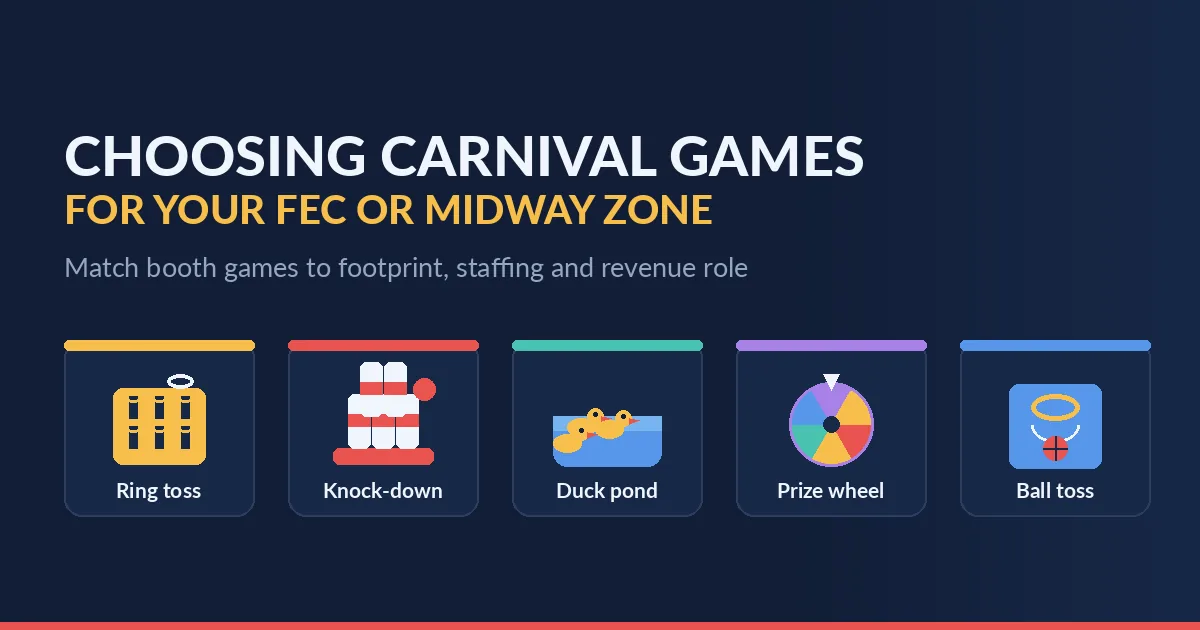
Most carnival games for sale fall into five recognisable formats: ring toss, knock-down (ball-toss at stacked cans or targets), duck pond, prize wheel, and ball-into-hoop tosses. Some are staff-attended midway booths; others come as self-contained coin-op cabinets that dispense redemption tickets. The right label matters because it decides your staffing, your prize flow, and where the game sits on the floor.
Attended booths are the classic midway: a member of staff takes payment, hands over rings or balls, and gives out a plush or novelty on a win. They carry theme and energy well, which is why mall developers ask for them, but each open booth needs a person. Coin-op versions, like a ball-throw cabinet that counts hits and drops tickets, run unattended inside an arcade and feed your existing redemption counter. ACS lists real examples in its commercial carnival and midway game range, including a carnival duck pond game and a World Cup ball-throw cabinet. If your zone leans toward ticket play rather than instant prizes, the format overlaps with what we cover in our redemption arcade games buyer’s guide.
How to choose carnival games for your FEC or midway zone
Choose carnival games by three filters in order: floor space, staffing model, and audience. Space rules out formats that will not fit a walkway; staffing decides attended versus coin-op; audience sets the theme and prize tier. Only after those three do price and looks matter. The table below maps the five common formats against those filters.
| Format | Typical footprint | Operating model | Best venue | Revenue role | Watch-out |
|---|---|---|---|---|---|
| Ring toss wall | Wall bay, 1.5–3 m wide | Attended | Mall midway, event booth | Photo-friendly anchor, steady cash | Needs staff every open hour |
| Knock-down / ball toss | 2–3 m booth depth | Attended or coin-op | FEC midway, seasonal fair | High-energy draw for groups | Reset time between plays |
| Duck pond | Compact counter, ~1–2 m | Attended | Kids zone, toddler areas | Guaranteed-win for young children | Water upkeep and hygiene |
| Prize wheel | Very small, wall or counter | Attended | Party rooms, promo stands | Fast, low-skill filler | Prize odds must be set deliberately |
| Ball-into-hoop toss | 1–2 m cabinet | Coin-op (ticket) | Arcade floor, mall zone | Self-running ticket earner | Ceiling height for arced throws |
A new FEC midway usually mixes three to five of these so the zone reads as varied and no two booths pull the same guest at the same time. If you are still deciding how the midway sits against redemption, racing and kids machines across the whole venue, plan it inside your arcade floor layout and guest-flow plan rather than dropping booths into leftover corners.
Attended booth games vs coin-operated: how they earn and staff
Attended booths and coin-op carnival cabinets earn in opposite ways. An attended booth turns staff time into higher price-per-play and a stronger show, but it stops earning the moment nobody is standing there. A coin-op ticket cabinet earns lower per play, yet it runs every hour you are open with no extra labour and rolls straight into your redemption system.
The decision is really about your labour plan. If you already staff a prize counter and party hosts, one or two attended booths add theatre without much extra headcount during peaks. If you run a lean floor or overnight hours, coin-op formats keep the zone earning when you cannot spare a person. Many venues do both: an attended hero booth at the entrance for the photo and the noise, coin-op ticket games filling the aisle behind it.
On prizes, treat cost as a running expense, not an afterthought. Attended booths win real plush and novelties, so your prize spend scales with plays; coin-op ticket games push value onto the redemption counter instead. Whether a given game counts as skill, chance, or a regulated amusement, and what that means for payouts or permits, depends on your jurisdiction. Set those rules with your local authority and licensing body before you fix any prize ratio; we can share how a machine is configured, but the compliance call is yours to confirm.
Before you buy: an evidence checklist, red flags, and common mistakes
Before you buy carnival games, verify the operational basics that decide uptime, not just the sticker price. A booth that looks great in a video but ships on the wrong voltage, or sits dead for a week waiting on a part, quietly costs more than any discount. Run every candidate supplier through the checklist below.
Evidence checklist to run with each supplier:
- Confirmed voltage and plug standard for your country, stated in writing.
- Exact cabinet dimensions and weight so you can plan the walkway and the container load.
- Spare-parts availability and lead time, including which parts are consumable and what ships with the order.
- After-sales response: who answers, in what language, and how fast. ACS runs 7-day support with fast response across time zones, which matters when a booth fails on a Saturday.
- Payment and ticketing hardware options if you want coin, note, or cashless play.
- Whether OEM or theme customisation is available if you need the booth to match a local brand.
Red flags: a supplier who quotes a headline price but goes vague on voltage, dimensions, or parts; stock photos with no real production or QC images; and “guaranteed” revenue or payback figures, which no honest supplier can promise because they depend on your traffic and pricing.
Common mistakes: buying five booths that all target the same age group; putting a water-based duck pond somewhere with no drainage or cleaning routine; ignoring ceiling height for ball-throw arcs; and treating prize cost as a one-off instead of a weekly line item. For where these formats sit against full-floor budgets, see the factory-direct price ranges by machine category. Carnival booths generally sit at the lower end, though exact figures depend on size, theme and payment hardware.
Frequently asked questions
How much do carnival games cost?
Carnival booth games generally sit at the lower end of amusement equipment pricing, but the exact figure depends on size, theme, build quality, and whether you add coin, note, or cashless hardware. We publish indicative factory-direct ranges by machine category, and a precise number always comes from a quote against your chosen models and destination.
What are the best carnival games for a small FEC or mall zone?
For a tight footprint, compact formats work best: a prize wheel or duck pond on a counter, a single ring-toss bay against a wall, or one coin-op ball-throw cabinet. These fill a corner without blocking the walkway. Reserve wide attended booths for venues with the space and the staff to run them.
Do carnival games need staff to run?
It depends on the format. Attended booths — ring toss, duck pond, most knock-down walls — need a staff member during open hours to take payment and hand out prizes. Coin-operated versions, such as ticket ball-throw cabinets, run unattended and feed your redemption counter, which suits lean floors and long hours.
Can carnival games be customised or branded?
Yes. As a factory-direct arcade machine manufacturer, Arcade Craft Studio offers OEM and theme customisation, so a booth can carry your venue’s colours, name, or a local theme. Share your artwork and the models you want, and we can confirm what is possible and how it affects lead time.
Plan your carnival zone with a factory-direct supplier
Tell us what you are filling and we will shortlist formats that fit. Send your venue type, floor size or a rough layout, the zones you want the carnival games to cover, and your destination country, and our team will map real models to your space and prepare a quote. To start, send your venue type, floor size and the zones you want to fill. We can also coordinate mixed-container loads and 2D/3D layout support; compliance items such as electrical certification and any local gaming rules can be coordinated but must be confirmed with your broker and local authority.