
Updated August 2026 — current as of first publication.
You already run a busy arcade floor, and now a landlord or a franchise partner keeps asking when the VR zone is going in. The pull is real: virtual reality has become a genuine draw in family entertainment, and guests now expect to find it. But the catalog is a mess of names (360 chairs, egg pods, free-roam arenas, kids’ pods), and you have a fixed corner, a ceiling of unknown height, and no appetite for a machine that plays four games and dates within a year. This guide sorts commercial VR arcade machines by the decision that actually matters: which format fits your space, your crowd, and how much staff you can spare.
Key takeaways
- A commercial VR arcade machine is a coin- or card-operated unit that runs pre-loaded VR content on managed hardware built for constant public use — not a home headset on a stand.
- Pick the format by footprint, audience age, and supervision level first; content and looks come second.
- Seated motion chairs and kids’ pods run almost unattended; free-roam multiplayer arenas need trained staff and bookings.
- The single biggest VR mistake is buying a machine with a thin, un-updatable content library, because novelty tends to fade faster in VR than in most arcade categories.
- Hygiene, headset fit, and content refresh are ongoing operating costs, not one-time setup — budget for them before you buy.
What is a commercial VR arcade machine?
A commercial VR arcade machine is a coin- or card-operated attraction that runs virtual-reality content on hardware built for heavy public use, with managed headsets, a fixed content library, and an operator dashboard. Unlike a consumer headset, it is designed to survive hundreds of sessions a day, reset itself between players, and be supervised by non-technical staff.
That distinction drives every purchase decision. You are not buying a game; you are buying a piece of floor equipment that has to earn its square meters, stay clean, and keep working through a Saturday rush. Arcade Craft Studio is a factory-direct arcade machine manufacturer, and VR is one of the lines where the gap between a consumer rig and a venue-grade cabinet shows up fastest: in the mounts, the cleaning access, and the remote management.
Commercial VR arcade machine formats compared
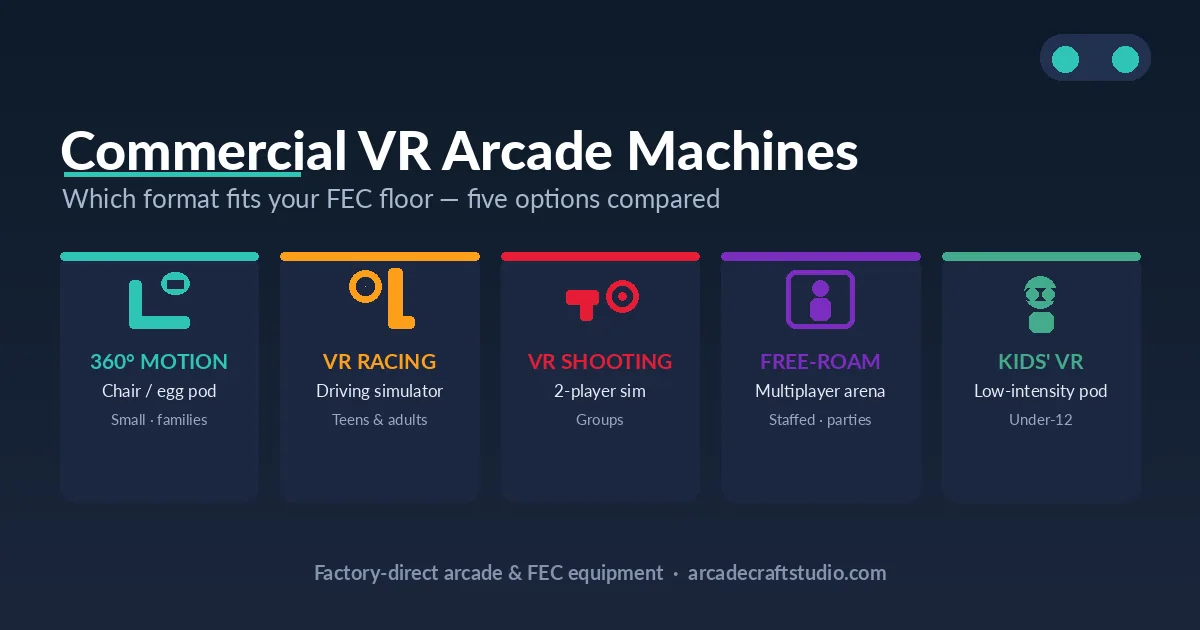
Commercial VR arcade machines come in five main FEC formats: 360° motion chairs, VR racing simulators, VR shooting simulators, free-roam multiplayer arenas, and kids’ VR pods. They differ mainly by footprint, best audience, and how much staff they need, so match the format to your zone before you compare brands or content.
Our commercial VR and simulator machine range shows these formats side by side.
| VR format | Rough footprint | Best audience | Supervision | Throughput | Watch out for |
|---|---|---|---|---|---|
| 360° motion chair / egg pod (1–2 seats) | Small (about 4–6 m²) | Families, first-timers, mall walk-ups | Low, near self-service | Moderate; short 3–5 min rides | Thin ride library; some riders feel motion sickness |
| VR racing / driving simulator (seated) | Moderate | Teens and adults | Low | Moderate | Overlaps a non-VR racing cabinet; check content variety |
| VR shooting / interactive simulator (2-player) | Moderate | Teens, adults, small groups | Moderate | Good; multiplayer keeps queues moving | Controller wear; needs clear floor markings |
| Free-roam / multiplayer VR arena | Large (open room) | Groups, parties, teens–adults | High, trained and staffed | Lower per m², higher ticket | Staffing, calibration, and booking flow |
| Kids’ VR machine (low-intensity, seated) | Small | Under-12 and parents | Moderate | Good; quick cycles | Headset fit and hygiene; age-appropriate content |
How to choose a commercial VR arcade machine for your FEC
Choose a commercial VR arcade machine by answering four questions in order: who is your crowd, how much floor and ceiling do you have, how much staff can you assign, and how will the content stay fresh. Get those right and the model shortlist narrows itself; skip them and you buy on looks and regret it by month three.
Start with audience and space
If your weekday traffic is parents with young kids, a seated kids’ pod or a family motion chair earns more than an adult free-roam arena that sits idle until the weekend. If you draw teens and young adults for parties, a staffed multiplayer experience becomes a bookable, higher-ticket draw. Measure both floor area and ceiling height before you shortlist — room-scale and standing formats need clearance that a mall kiosk corner rarely has.
Match supervision to your staffing reality
Seated, harness-free formats can run close to self-service with signage and occasional resets. Free-roam and standing multiplayer formats need a trained attendant for calibration, safety, and headset handling. Be honest about whether you can spare that person on a Saturday — an unstaffed arena becomes a broken arena fast.
Plan for content refresh from day one
VR novelty tends to decay faster than in most arcade categories. Ask, before you buy, how new content reaches the machine, how often it updates, and whether updates are included or billed. A cabinet with a large, refreshable library keeps earning; one locked to a handful of demos becomes a coat rack. For a wider view of how VR sits alongside your other machines, our guide to choosing the right FEC games mix maps where each category belongs on a floor.
Evidence checklist, red flags and common mistakes
Vet a commercial VR machine by checking five things before you buy: the content list and update cost, headset hygiene, a split hardware and software warranty, written power and space specs, and remote diagnostics. Verify each one now, and treat any promised payback period as a red flag, not a selling point.
Evidence checklist, ask the supplier for:
- The full content list, its age ratings, and the update schedule and cost.
- Headset and controller models, plus how they are cleaned and replaced.
- Warranty terms and after-sales response for hardware and software separately.
- Power, floor and ceiling requirements in writing.
- A remote-management or diagnostics option so staff aren’t debugging PCs.
Red flags: a demo library with no update path; vague answers on headset hygiene; a single supplier who cannot separate hardware warranty from content licensing; and any promise of a specific payback period, which no honest supplier can guarantee for your venue.
Common mistakes: buying the flashiest arena when your traffic is families; ignoring ceiling height until delivery; forgetting sanitation supplies and staff time in the budget; and treating VR as set-and-forget when it is the category that most needs a refresh plan. Many operators also overlook how a shooting-VR unit competes for the same players as their existing cabinets — our arcade shooting games buyer’s guide covers that overlap.
Running a VR zone after it lands
A VR zone earns on operations, not just on the purchase. Plan a daily headset-wiping routine and disposable liners, a named person for content updates, and clear floor markings and signage so guests use the standing formats safely and comfortably from day one.
VR is one of the fastest-growing arcade categories, which also means content and player expectations move quickly — see our sourced arcade and FEC market statistics for where the category sits. Position the zone where staff can see it and where it draws walk-up curiosity; a corner with sightlines beats a hidden back room. For the surrounding layout, our arcade floor layout and guest-flow guide and the commercial sports simulator buyer’s guide help you place VR among motion and simulator attractions.
On safety, insurance, electrical certification and age limits: these depend on your market. Arcade Craft Studio can coordinate documentation and configuration, but the final call on compliance, insurance cover and permitted age limits should be confirmed with your own insurer, electrical authority and local regulator — not decided from a catalog.
Frequently asked questions
How much floor space does a commercial VR arcade machine need?
It depends on the format. Seated motion chairs and kids’ pods fit in about 4–6 square meters, while standing shooting simulators need extra clearance for arm movement, and free-roam multiplayer arenas need an open room. Always confirm both floor area and ceiling height with the supplier in writing before you order.
Are VR arcade machines suitable for young children?
Some are, but not all. Kids’ VR machines use lighter headsets, gentler content and shorter sessions, while adult free-roam and intense shooters are not designed for under-12s. Ask the supplier for age ratings on every title, and confirm permitted age limits for public VR with your local authority and insurer.
How often do VR arcade games need updating?
More often than most arcade categories, because VR novelty fades fast. Before buying, confirm how new content reaches the machine, how frequently it updates, and whether updates are included or billed. A cabinet with a large, refreshable library holds player interest far longer than one locked to a few demos.
What after-sales support should a VR machine include?
Look for warranty terms that separate hardware from software, a clear response time, spare-parts availability, and remote diagnostics so non-technical staff aren’t troubleshooting PCs. Arcade Craft Studio offers factory-direct after-sales support; confirm the exact terms and coverage for your market before you order.
Get a VR format matched to your floor
Send us your available floor area, ceiling height, target age groups, and whether the zone will be staffed or self-service, and we’ll put together a format-matched shortlist and an exact quote. Send your VR zone details to request a format-matched shortlist and quote. For how VR pricing fits against your other machines, see our factory-direct price ranges by machine category.